Physical Address
304 North Cardinal St.
Dorchester Center, MA 02124
Physical Address
304 North Cardinal St.
Dorchester Center, MA 02124

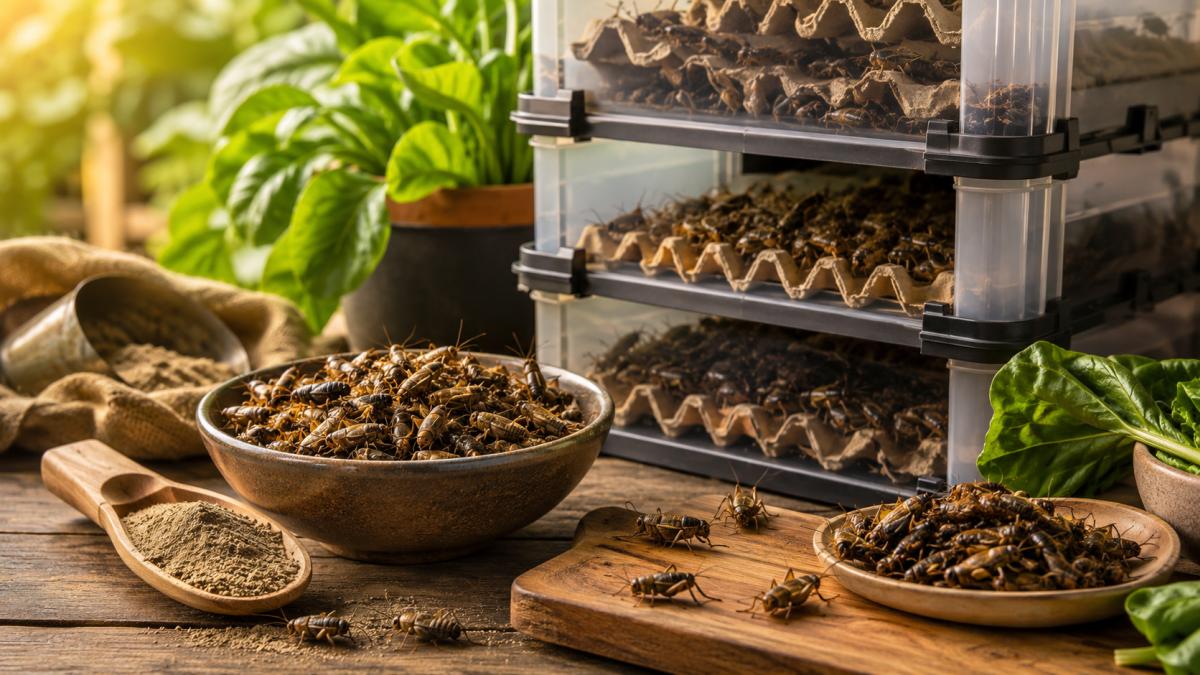
Beef has quietly become a luxury. Prime cuts regularly push past R200 a kilogram in South African supermarkets, and even the cheaper stewing cuts have crept to a point where a family braai is now a budgeting decision rather than a weekend default. For anyone already thinking hard about financial resilience, the obvious response is to look for a protein source you can produce yourself, in a small space, without a smallholding or a herd of anything. Crickets fit that brief better than almost any other option, and the idea is a lot less fringe than it sounds. Southern Africans have eaten insects for generations, from mopane worms sold by the bucket to termites gathered after the first rains. Farming crickets deliberately, in crates, for a steady year-round supply is simply the next logical step.
This is not a novelty piece about daring yourself to eat a bug. It is a practical look at whether a backyard or spare-room cricket colony can meaningfully offset your meat spend, what it actually takes to run one, and where the honest limits lie.
The case for crickets starts with how little you have to put in to get protein out. A cow needs roughly twelve kilograms of feed to produce one kilogram of edible body mass, and it needs land, water and months of time to do it. Insects flip that maths. Feed-to-body conversion for farmed insects can be several times better than beef, and the water footprint is a rounding error by comparison. Research summarised by sustainability-focused food writers notes that where a kilogram of beef can demand well over a thousand gallons of water, crickets need close to a single gallon for the equivalent, largely because they draw much of their moisture from their food and produce a fraction of the methane a ruminant does.
The protein itself is genuinely good. Dried cricket meal typically runs extremely high in crude protein, and a detailed feeding study on the two-spotted field cricket measured live-cricket protein content in the mid-forties as a percentage of body composition, with a favourable spread of essential amino acids including lysine and methionine. That same study clocked the field cricket reaching harvest weight in around six weeks under warm mass-rearing conditions with survival rates near ninety percent. Six weeks from egg to plate, in a crate the size of a large storage tub, is a production cycle no livestock animal on your property can match.
There is also the small-space advantage that makes this viable for people without land. You do not need a yard. A methodical operation stacks crates vertically, which means the yield per square metre of floor space climbs far beyond anything you could achieve with poultry, rabbits or the backyard snail farming that occupies a similar niche in the self-sufficiency world. Crickets are the scalable version of that same instinct.
Two species dominate cricket farming worldwide: the house cricket, prized for a milder, nuttier taste, and the two-spotted or field cricket, which grows bigger and faster and is the workhorse of commercial operations. For a home producer chasing yield, the field cricket is usually the better starting point, though the house cricket is often easier to keep quiet and calm at higher densities.
The legal picture in South Africa deserves a clear-eyed look before you buy your first eggs. Insects as human food occupy a genuinely grey zone here. Academic work on the regulatory environment for edible insects in the South African context points out that food regulation is split across several government departments operating at national, provincial and local level, and that no single tidy framework governs rearing insects for the table. In practice this means farming crickets for your own household consumption sits in the same broadly permissive space as growing your own vegetables, while selling cricket products to the public would pull you into food-safety, labelling and health regulations you would need to check carefully with your local authority. A broader review of edible-insect legislation across Africa also flags an important point for anyone tempted to be clever: bringing in foreign species can run into nature-protection and trading rules, so source your starter stock from an established local breeder rather than importing.
Worth knowing too is that South Africa already has serious insect-farming pedigree, mostly on the feed and novelty side. Companies like Cape Town’s Gourmet Grubb, which pioneered an insect-based dairy alternative, have spent years chipping away at the “would you really eat that” barrier, and the country hosts some of the largest black-soldier-fly operations in the world. The infrastructure and the cultural groundwork are further along here than most people assume.
The physical setup is refreshingly cheap. A cricket farm at its simplest is a set of smooth-walled plastic crates or tubs, deep enough that the crickets cannot jump out and slick enough that they cannot climb. Inside each crate you stack cardboard egg-carton trays in a zigzag to multiply the surface area the crickets can live on, because crickets are three-dimensional creatures that want to climb and hide. That single trick is what lets a modest footprint hold thousands of animals.
Temperature is the one variable you cannot ignore. Crickets are warm-weather animals that thrive between roughly 28 and 35 degrees Celsius, and they slow down badly or die when it gets cold. Across much of South Africa the summer months take care of this for free, but a highveld winter will stall a colony completely unless you provide gentle heat, which is where a spare room, a garage or a simple heat mat earns its keep. This is the same off-grid, manage-your-own-inputs thinking that underpins projects like home biogas digesters, where a bit of insulation and thermal management is the difference between a system that works and one that sulks through winter.
Feed and water round out the essentials. Crickets do well on a base of commercial poultry or cricket feed supplemented generously with kitchen and garden scraps, which is precisely what makes them attractive as a financial-resilience play: they turn material you would otherwise compost into protein. Water is best delivered through a wicking system or shallow dish packed with pebbles, because open water drowns them. Feeding on agricultural by-products and food waste has been studied extensively and shown to produce nutritionally solid crickets, so you are not locked into buying expensive feed to get a good result.
Harvesting is the part squeamish beginners dread and then find anticlimactic. The standard, most humane method is chilling: crickets are cold-blooded, so a few hours in the fridge sends them dormant, and the freezer then dispatches them painlessly. From there you rinse them, and the two classic preparations are oven-roasting until crisp or drying and milling into a fine flour.
That flour is the secret to actually getting insect protein into a South African family’s diet without a fight at the dinner table. Whole roasted crickets are an acquired taste, but cricket flour disappears into the things people already eat. Stirred into pap, baked into rusks or bread, blended into a smoothie or worked into biltong-style snacks, it adds a serious protein punch with a mild, slightly nutty background note. This is the same route that overseas producers took to mainstream the ingredient, with brands building entire ranges of cricket-flour baked goods and protein powders precisely because milling sidesteps the psychological hurdle of recognisable insects. For a household, a jar of cricket flour in the pantry is a far easier sell than a bowl of whole crickets on the counter.
It would be dishonest to present this as free protein. It is not. A cricket colony is livestock, and livestock demands consistency. Miss the heating for a cold week, let the crates get damp and mouldy, or crowd them too densely and you can lose a whole batch fast. The mass-rearing research is candid that survival rates swing considerably with temperature, humidity and stocking density, and that faster-growing field crickets tend to have higher feed-conversion ratios and lower survival than the smaller house cricket. In other words, there is a real learning curve, and your first crate or two should be treated as tuition rather than dinner.
There is also the allergy caveat that genuinely matters: cricket protein contains chitin and shares allergenic proteins with shellfish, so anyone in your household with a shellfish allergy should steer well clear. And on pure economics, a small home colony will not replace your entire meat budget. What it will realistically do is supplement it, turning kitchen scraps and a corner of a room into a steady trickle of high-quality protein that takes real money off your monthly grocery bill over time.
Weighed against a R200-plus kilogram of beef, though, that trade looks increasingly sensible. Crickets ask for very little space, very little water, very little feed you are not already throwing away, and about six weeks of patience. For a country that already knows how to eat insects and is watching red meat drift out of reach, a few crates of crickets in the spare room might be one of the most quietly practical protein hedges available.