Physical Address
304 North Cardinal St.
Dorchester Center, MA 02124
Physical Address
304 North Cardinal St.
Dorchester Center, MA 02124

Nine out of ten South African households have thrown away food that spoiled in the fridge during load shedding, according to a survey commissioned by Debt Rescue, and more than a third have had a fridge damaged outright by the power cuts. That is not a small problem. It is meat, milk and vegetables going into the bin week after week, at a time when grocery budgets are already stretched thin.
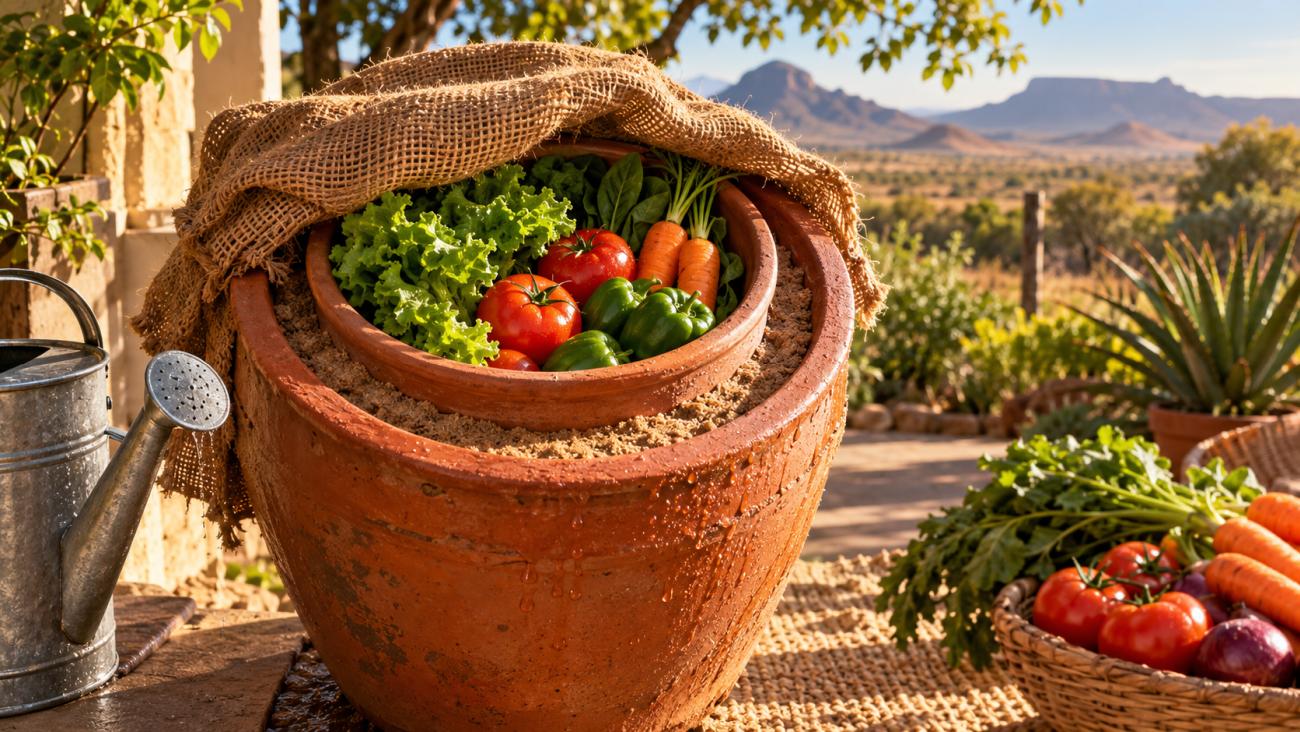
The zeer pot sidesteps the whole problem, because it never needed electricity in the first place. It is two clay pots, one inside the other, with wet sand packed into the gap. As the water in the sand evaporates through the porous outer pot, it pulls heat out of the inner one. No compressor, no battery, no inverter, and nothing to break during stage 4 or stage 6.
This is not a new trick dressed up for a blog post. The pot-in-pot cooling system has roots going back to ancient Egypt, where wall paintings show servants fanning water jars to speed up evaporation and cool their contents. The modern version was refined in the 1990s by a Nigerian schoolteacher named Mohammed Bah Abba, whose family made pottery for a living. His design let rural households in northern Nigeria, far from any grid connection, keep tomatoes and peppers fresh for close to three weeks instead of three days, and it won him the Rolex Award for Enterprise in 2001.
Keep the shopping list short on purpose. You want:
Unglazed pots from a nursery or hardware store, sold loose rather than as a boxed planter set, are the cheapest route and usually land the whole build well under R300, sand included. Avoid glazed or painted pots for the outer layer. Glaze seals the surface, and a sealed surface cannot let water evaporate through it, which defeats the entire mechanism.
The physics is straightforward evaporative cooling, the same principle behind a swamp cooler or the sweat on your own skin. Water needs energy to change from liquid to vapour, and it pulls that energy from its surroundings as heat. As moisture evaporates outward through the porous walls of the outer pot, it draws warmth from the sand, which draws warmth from the inner pot, which draws warmth from your vegetables.
The ceiling on how cold this can get is called the wet bulb temperature, which is the coldest an object can become through evaporation alone at a given humidity. As one engineering explainer on evaporative cooling puts it, the bigger the gap between the air temperature and the wet bulb temperature, the harder an evaporative device can work. That gap, not the number on your kitchen thermometer, is what decides whether your zeer pot delivers a dramatic drop or barely a shiver.
That wet bulb ceiling is why this project is such a strong fit for large parts of the country and a poor fit for others, and being upfront about that is more useful to you than a blanket “this works everywhere” claim.
The Karoo, the Free State interior and much of the Northern Cape run hot and dry for most of the year, which is exactly the combination that pushes the wet bulb temperature well below the air temperature. In these regions you can expect a genuinely noticeable drop, often in the range of the 10 to 20 degree improvements reported in similar builds and trials elsewhere in Africa.
Durban tells the opposite story. Summer relative humidity along the KwaZulu-Natal coast regularly sits in the high seventies to high eighties percent, and air that is already close to saturated has very little spare capacity to absorb more moisture. There simply is not much room for evaporation to do its work, so the wet bulb temperature sits close to the air temperature and the zeer pot’s cooling effect shrinks accordingly.
If you live on the humid coast, this project is still worth trying for the mild, steady coolness it adds over open air storage, but set your expectations at a few degrees rather than the double-digit drops a dry inland climate can produce. Pair it with shade and airflow rather than relying on the pot alone.
Leafy greens, tomatoes, peppers, carrots, and other vegetables with high water content respond best, since the cooling and the gentle rise in humidity around them slows wilting as well as heat spoilage. Root vegetables and hardier crops last well too. In the original Nigerian trials, eggplant kept for around 27 days against the usual three, a fair benchmark for what a well maintained pot in a dry climate can achieve.
Meat, dairy and cooked leftovers are a different matter entirely. A zeer pot cannot reach the 4°C that food safety guidance for load shedding treats as the safe threshold for perishables, so keep those in a cooler box with ice, or plan to cook and eat them the same day, rather than trusting them to clay and sand.
A few things reliably undo a zeer pot’s performance. Letting the sand dry out is the biggest one, since dry sand cannot evaporate anything. Sealing the outer pot with paint, varnish or a glaze blocks the pores that make the whole system work. Standing it in full sun heats the clay directly and fights the cooling rather than helping it. Packing the inner pot too tightly stops air from circulating around the produce, so leave gaps between items rather than stacking everything in.
For a spend of under R300 and an afternoon’s work, a zeer pot is one of the cheapest genuine hedges against load shedding food losses available to a South African household, particularly anywhere from Gauteng inland toward the Karoo and Northern Cape. It will not replace your fridge for meat and dairy, and it will do less for you on the humid KwaZulu-Natal coast than it will in Kimberley or Kroonstad. But for keeping a week’s vegetables fresh through an outage, with nothing to plug in and nothing to break, it earns its place next to the back door.