Physical Address
304 North Cardinal St.
Dorchester Center, MA 02124
Physical Address
304 North Cardinal St.
Dorchester Center, MA 02124


Most South Africans who research solar power hit the same wall. They request quotes from turnkey installers, see numbers between R90,000 and R190,000 for a modest residential system, and quietly close the browser tab. The dream of energy independence gets filed under “someday” alongside emigration plans and gym memberships.
But there is a smarter path that thousands of South Africans are already taking, and it can cut your solar costs by 25% to 40%. Instead of handing a single company a lump sum to supply and install everything, you source your own components from a dedicated solar equipment supplier, and then you pay a registered electrician purely for labour and cabling. You get the same equipment, the same warranty coverage, and a fully compliant installation, just without the massive markup that turnkey companies build into their all-in-one quotes.
Here is exactly how to do it, what it costs, and what you need to know to stay safe and legal.
When a solar company gives you a turnkey quote, you are not just paying for panels, an inverter, and a battery. You are paying for their showroom rent, their sales team commission, their project management overhead, their vehicle fleet, and a profit margin that typically ranges from 30% to 50% on the equipment alone. The actual installation labour is usually a relatively small portion of the total.
A typical turnkey 5kW hybrid system in Gauteng costs between R85,000 and R120,000 fully installed in 2026. Step up to an 8kW system and you are looking at R140,000 to R190,000. These numbers come from multiple installer pricing surveys across Johannesburg and Pretoria, and they include panels, a hybrid inverter, a lithium battery, mounting hardware, cabling, and a Certificate of Compliance (COC).
The thing is, every single one of those components is available to you directly from online solar equipment suppliers at wholesale or near-wholesale prices. The only thing you cannot do yourself is the electrical work. That is where your electrician comes in.
The strategy is straightforward. You research and purchase each component separately from an online solar supplier, have everything delivered to your home, and then hire a qualified electrician to install and commission the system. Your electrician handles the wiring, mounting, configuration, and issues the legally required COC.
Here is a realistic cost breakdown for a solid 8kW hybrid system using components you can buy online today from South African solar retailers:
Hybrid inverter (8kW Sunsynk or equivalent): R20,000 to R25,000. The Sunsynk 8kW Compact hybrid inverter is one of the most popular residential inverters in South Africa and can be found at online retailers for around R22,000 to R24,000 including VAT. Comparable options from Deye and Solis fall in a similar range. Buying from a turnkey installer, the same inverter often appears on quotes at R30,000 to R38,000.
LiFePO4 battery (10kWh): R35,000 to R45,000. Lithium iron phosphate batteries have come down significantly in price. A 10kWh wall-mount unit from brands like Sunsynk, Pylontech, or Dyness can be sourced directly for this range. Turnkey quotes typically price the same battery at R50,000 to R65,000.
Solar panels (8 x 550W monocrystalline): R14,000 to R22,000. Individual 550W panels from Canadian Solar, JA Solar, or Longi retail for approximately R1,800 to R2,800 each from online suppliers. Eight panels give you 4,400W of PV capacity, which is a practical starting point for an 8kW inverter. You can always add more panels later. Turnkey companies often mark panels up by 40% to 60%.
Mounting rails and brackets: R4,000 to R7,000. This depends on your roof type. IBR (corrugated iron) roofs are the cheapest and easiest to mount on. Tiled roofs cost more because of the specialised tile hooks needed. Online suppliers sell complete mounting kits.
DC and AC switchgear: R3,000 to R5,000. This includes DC isolators, AC breakers, surge protection devices, and a distribution board for your essential loads. These are standard electrical components and your electrician will know exactly what is needed for your specific setup.
Cabling (DC solar cable + AC cable): R2,000 to R4,000. The length of cable runs depends on the distance between your panels, inverter, and distribution board. Your electrician can specify the exact lengths and gauges before you order.
Electrician labour and COC: R8,000 to R15,000. This is the fee for a registered electrician to physically install everything, connect the system, commission the inverter, and issue the Certificate of Compliance. The price varies by region and complexity, but most straightforward residential installs fall in this range.
Total estimated cost: R86,000 to R123,000 for a complete 8kW hybrid system with 10kWh battery storage and 4.4kW of solar panels.
Compare that to the R140,000 to R190,000 you would pay a turnkey company for the same capacity, and you are looking at savings of R30,000 to R70,000. That is money that could buy you a second battery, more panels, or a JoJo tank for your water independence project.
The online solar retail market in South Africa has matured rapidly since 2023. Several reputable suppliers sell directly to homeowners with nationwide delivery. Solar Shop carries Sunsynk, Deye, Solis, and Victron inverters alongside batteries and panels, with expert support and sizing tools. Sustainable.co.za stocks Victron Energy products and a wide range of panels and batteries tailored for South African conditions. Sunstore in Midrand offers free shipping on orders above R1,000 and carries all the major inverter and battery brands. JC Solar Panels is another strong option with competitive pricing on Sunsynk inverters and mounting hardware.
When buying separately, always check that the supplier provides a proper VAT invoice that clearly itemises each component. This is essential for your COC paperwork and for any potential tax incentive claims. Also confirm warranty terms. Reputable online suppliers provide the same manufacturer warranties as turnkey installers because the warranty comes from the manufacturer, not the installer.
A Certificate of Compliance is a legal document that proves your electrical installation meets the safety standards outlined in SANS 10142-1. In South Africa, any modification to your home’s electrical installation, including adding a solar system, requires a COC or supplementary COC to be issued by a qualified electrician.
Only a registered Installation Electrician (IE) or Master Installation Electrician (MIE) can legally issue a COC for a solar PV system. An Electrical Tester for Single Phase (ETSP) may assist with installation under supervision but has limited authority to sign off on multi-phase systems. Before hiring your electrician, ask to see their registration card from the Department of Employment and Labour. This card confirms their registration type and that they are authorised to do the work and sign it off.
Do not skip the COC. Without it, your home insurance may be invalidated if there is a fire or electrical fault. If you ever sell your property, the buyer’s conveyancing attorney will require a valid COC that includes the solar installation. And if you are an Eskom direct customer registering your system, you will need a COC, an inverter test certificate (NRS097), and a basic SSEG installation test report.
If your home is directly supplied by Eskom, you need to register your solar system as a Small-Scale Embedded Generation (SSEG) installation. The good news is that Eskom has been waiving all registration fees, connection charges, and the cost of a smart meter for residential systems up to 50kVA. This exemption has been in place since March 2023 and covers the vast majority of home solar setups. Check the current status of these exemptions directly with Eskom, as they have historically been extended but are subject to periodic review.
If your electricity comes through your local municipality rather than directly from Eskom, contact your municipal electricity department for their specific SSEG registration process. Municipalities like Tshwane, Cape Town, and eThekwini each have their own registration requirements and timelines.
This is where your project succeeds or fails. A good electrician who is experienced with solar installations will actually welcome the component-sourcing approach because it removes procurement hassle from their plate. They show up, they install, they get paid for their skill and time, and they move on to the next job.
Ask for referrals from your solar equipment supplier, as most of them maintain lists of recommended installers in each region. Check platforms like Solar Training which provide directories of qualified PV installers. Ask any prospective electrician for photos of previous solar installations and references from recent clients. Confirm they carry the correct registration and will issue a full COC.
Agree on a fixed price for the installation before work begins. A good electrician will want to do a site visit first to assess your roof, your distribution board, cable run distances, and any potential complications before quoting. This site visit might cost R500 to R1,000 but it protects both of you from surprises on installation day.
The financial case for solar in South Africa strengthens every single year. Eskom’s direct customer tariffs increased by 12.74% in April 2025, with the average standard price of electricity rising to approximately 221 cents per kWh. For the 2026/2027 financial year, further increases have already been approved by NERSA, with restructured tariffs that include a new Generation Capacity Charge. Municipal tariffs are rising in parallel, with cities like Johannesburg, Cape Town, and Ekurhuleni implementing increases of 10% to 13.4%.
At current rates, a 10kWh battery cycled daily offsets roughly 3,600 kWh of grid consumption per year. At R2.20 per kWh, that translates to annual savings of approximately R7,900 from battery cycling alone, before accounting for the direct solar PV generation consumed during the day. Combined with reduced peak-time usage and potential feed-in credits in municipalities that offer them, a well-designed system can save R2,000 to R4,000 per month on electricity costs.
The payback period for a self-sourced system at R90,000 to R120,000 is roughly 3 to 5 years at current tariff rates. After that, your electricity is effectively free for the remaining 15 to 20 years of your equipment’s warranty life.
One of the biggest advantages of sourcing your own components is that you can phase your investment. Start with just the inverter and battery for backup power during load shedding. That combination costs R55,000 to R70,000 and immediately eliminates your vulnerability to outages. Add solar panels six months later when your budget allows. Then expand your panel array or add a second battery as your finances and energy needs evolve.
Turnkey installers rarely offer this flexibility because their business model depends on a single large transaction. When you control the components, you control the timeline.
Going solar in South Africa does not have to mean writing a R150,000 cheque to a turnkey company. By purchasing your components directly from a reputable online solar supplier and paying a qualified electrician for labour and cabling only, you can achieve the same energy independence for 25% to 40% less.
The work requires more research and coordination on your part. You need to understand your energy consumption, choose compatible components, find a reliable electrician, and manage the registration process. But the savings are real, the equipment is identical, and the legal compliance is the same.
South Africans are tired of being at the mercy of systems that fail them. Every rand you save on your solar installation is a rand you can invest in your next step toward water independence, food production, or financial resilience. That is what self-sufficiency looks like in practice: not a single grand gesture, but a series of smart, informed decisions that add up to freedom.



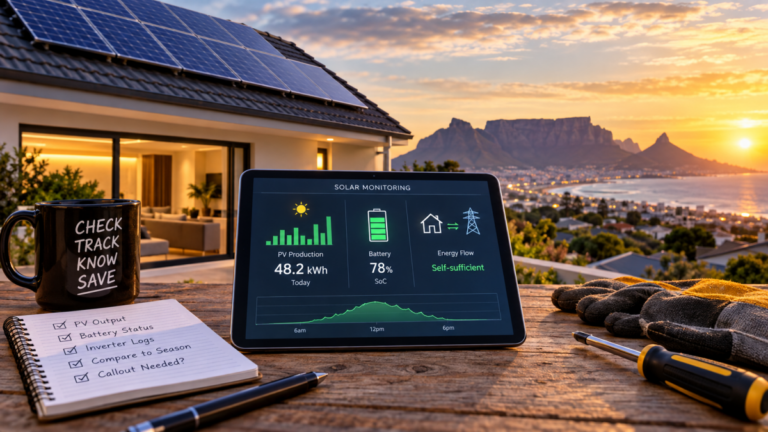




[…] you are still at the planning stage, our breakdown of the more affordable way to go solar in South Africa covers how to size the system in the first place. This piece is about what happens to it […]