Physical Address
304 North Cardinal St.
Dorchester Center, MA 02124
Physical Address
304 North Cardinal St.
Dorchester Center, MA 02124

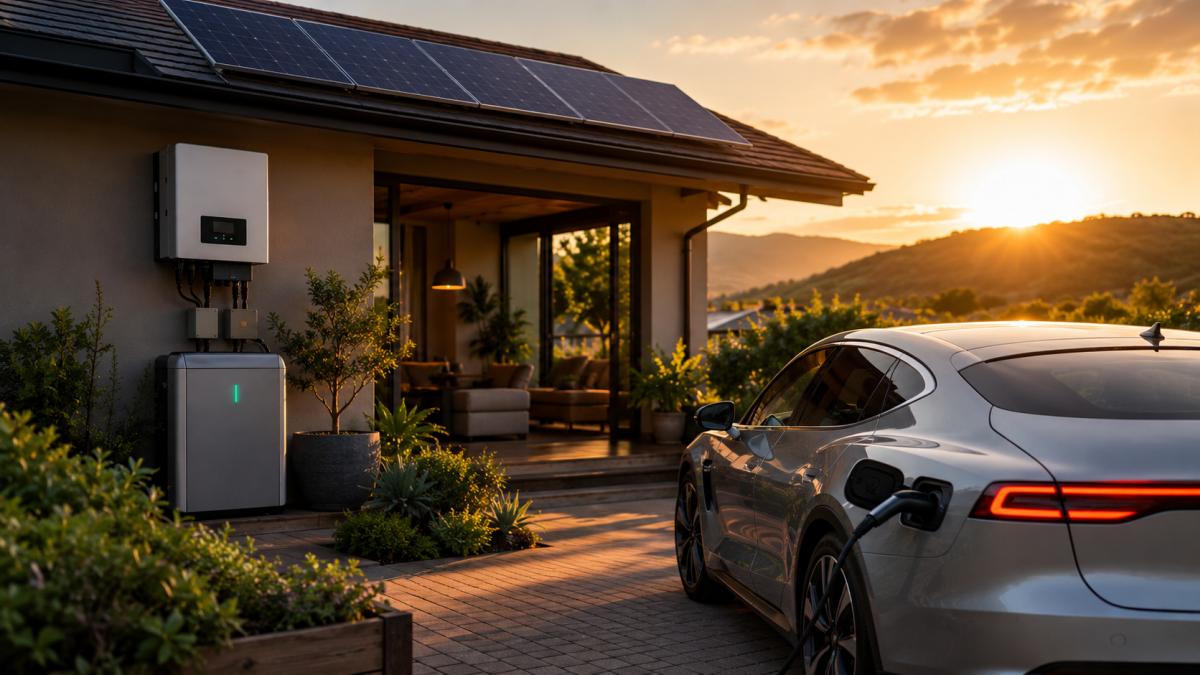
Every EV-and-solar article you’ll find online assumes you’re starting from a blank slate: 10kW arrays, dedicated 15kWh batteries, three-phase supply. Fine if you’re building from scratch. Less useful if you already run a modest hybrid system sized for the house, and you’re now wondering whether it can stretch to cover a daily commute too — without a second inverter, a second battery bank, and a second mortgage.
The honest answer is: it depends less on the size of your array than on how much headroom you’ve already clawed back from your own household load. That’s the part nobody selling you a solar-EV bundle wants to lead with.
Most solar-EV explainers gloss over the fact that an EV battery is a genuinely large thing to fill. A typical pack runs 30–60kWh, with luxury models over 100kWh, and your average household solar setup was never designed to be a car-charging powerhouse — it was sized around fridges, geysers, lighting and a home office.
That said, the numbers aren’t as grim as they first look, provided your household load is lean. One recent breakdown of Gauteng systems found that even after covering a typical four-bedroom household’s baseline 10–15kWh a day, a 5kW system still produces enough surplus to run an EV on solar alone for most of the year. Scale up slightly and a 10kWp system in Gauteng can push 25–35kWh a day into an EV for free — enough for roughly 130km of daily driving at no grid cost.
That 25–35kWh number is the whole story, really. It’s not “can my inverter technically charge a car” — every hybrid inverter can do that. It’s “how much of that capacity is left over once the house has eaten its share.” Which is exactly where cutting your baseline draw starts to matter more than upsizing the array.
If you’re currently working through your house replacing hungry appliances with low-wattage alternatives, you’re doing the single highest-leverage thing available before you even think about EV charging. Every kWh you’re not burning on an inefficient geyser element, an old bar fridge, or a legacy pool pump is a kWh that shifts straight into the “surplus available for the car” column — without adding a single panel.
This matters more in South Africa than in most solar-EV guides written for milder climates, because our production swings hard by season. Even Gauteng, generally the best-off province for sun hours, drops to just 5–6 peak sun hours a day in June and July, and a large array can fall to 1–3kW output on an extended overcast stretch. On those days, a leaner household base load is the difference between the car getting a meaningful top-up and getting nothing.
Practical guidance from installers backs this up: before sizing anything, start with a proper home energy audit and figure out your baseline load first — the appliance swap-out you’re already doing is effectively that audit in action, appliance by appliance.
There’s a hard physical limit worth knowing before you plan around a specific charging speed: a standard single-phase South African home supply comfortably handles a 7kW charger, which is the fastest AC rate most EVs sold locally can actually use. Three-phase only becomes relevant if you want 11kW or 22kW charging and your vehicle can accept it. For a smallish system, this is good news — you were never going to feed a 22kW charger off a modest hybrid inverter anyway, so the wiring limit and the solar-supply limit roughly line up.
The order in which your inverter draws power matters as much as total capacity. The advice from AutoTrader’s George Mienie is worth following on any hybrid system: configure the inverter to prioritise solar first, then battery storage, and only fall back to grid last, with a discharge floor around 50% kept in reserve for essentials. Charging the car during that reserve floor defeats the point of having a battery for outages at all.
On timing, the simplest rule for a smaller system without a dedicated EV charger is to plug in during the middle of the day rather than overnight — 7:30am to noon, to draw directly off solar production rather than eating into stored battery capacity. A hybrid inverter with even basic scheduling can automate this, but manually timing it costs nothing and works on any setup.
If you eventually want the car to charge itself without you thinking about it, solar-aware chargers exist that throttle their output dynamically to consume only surplus solar, so the vehicle only draws power the house genuinely isn’t using — worth knowing about even if it’s a future upgrade rather than a day-one purchase.
For anyone weighing whether this is worth doing at all versus just paying municipal rates: at an average tariff of R3.50/kWh, a properly specified solar EV charging setup pays for itself in roughly 4.4 years. That number assumes a system built around EV charging from the outset. If you’re retrofitting a smallish existing setup and leaning on appliance efficiency instead of a bigger array, your payback improves further, because the appliance swap-out is paying for itself twice — once on the household bill, once on the effective cost of every kWh that ends up in the car.
A small(ish) hybrid inverter absolutely can carry a daily commute on solar, but only if you treat household efficiency as part of the system rather than a separate project. Cut your baseline draw first. Charge in the late-morning solar window. Respect your battery’s reserve floor. And don’t chase a bigger array before you’ve confirmed how much surplus your current one actually has left once the fridge, geyser and everything else you’re upgrading has taken its share.
That’s the version of solar EV charging that fits an existing homestead setup — not the version built around buying more hardware.








[…] your pool pump, dishwasher, washing machine and any electric vehicle charging into the eleven to three window comes second, at the same rate, for the cost of setting a […]