Physical Address
304 North Cardinal St.
Dorchester Center, MA 02124
Physical Address
304 North Cardinal St.
Dorchester Center, MA 02124

There is a particular moment that every South African with a decent solar array eventually recognises, whether the roof is in Centurion, Somerset West, Hillcrest or halfway up a farm road outside Bethlehem. It is about eleven in the morning on a clear day. The battery hit 100 percent an hour ago. The geyser is hot. Nothing much is running in the house. And the inverter is quietly throttling the array back because there is simply nowhere for the power to go.
That wasted midday production is the reason so many people start looking at Bitcoin mining. The logic seems airtight. The electricity is free. Mining turns electricity into money. Therefore mining turns free electricity into free money.
It is a reasonable thought and it deserves a proper answer rather than a dismissal. So let us run it with South African tariffs and South African numbers, rather than the American figures that dominate every mining video on YouTube.
The right question is not “can I mine Bitcoin at home”. Of course you can. The useful question is this: what is one kilowatt hour of your surplus solar production actually worth, depending on what you point it at?
Framed that way, mining stops being a special case and becomes one option on a list. It competes with heating water, running a pool pump, charging a battery, charging a car, or doing nothing at all. Each of those converts a kilowatt hour into some number of rands. The winner is whichever number is biggest.
Everything below fills in that list.
You cannot value surplus solar without knowing what grid power costs, because a self generated unit is worth roughly what you would have paid for the unit you did not buy.
There is no single national number. South Africa has more than two hundred distribution authorities, municipal tariffs rose on 1 July 2026 in line with a NERSA guideline of around 9 percent, and Eskom Direct customers took a separate 8.76 percent increase back on 1 April. Here is where the major supply areas landed, all figures including VAT, because that is the money that actually leaves your prepaid balance.
Durban is the simplest. eThekwini runs a flat R4.17 a unit with no blocks and no fixed monthly charge at all, as set out in the eThekwini 2026 tariff breakdown.
Cape Town runs R4.14 for the first 600 units and R4.94 above that on the Domestic tariff, with a service and wires charge of R74.77 a month on credit meters. Households on Home User pay less per unit but carry a R424.30 monthly charge instead, which the Cape Town 2026 tariff analysis sets out in full.
Johannesburg’s City Power residential prepaid runs roughly R3.34 to R4.37 across its blocks, plus about R241.50 a month in fixed capacity and service charges. Watch the VAT trap here: City Power publishes its rates excluding VAT, so comparing its headline numbers against Cape Town’s understates Joburg by 15 percent.
Tshwane runs about R3.72 on the first 100 units, rising through R4.36 and R4.74 to R5.12 above 650, and added a basic charge of roughly R163.88 a month on single phase prepaid supplies.
Ekurhuleni landed near R4.23 a unit after restructuring its residential tariffs from inclining blocks to flat rate charging.
Eskom Direct customers, which covers most smallholdings and a great many rural and peri-urban properties, sit lower. Homelight 60A is a flat R3.44 with no fixed charge, Homelight 20A is R2.70, and Homepower 4 is around R3.56 plus roughly R536 a month in fixed charges. MyBroadband’s comparison of the four largest metros and EnergyBee’s national per unit roundup are both worth checking against your own bill.
The number to hold from all of that is a range. Depending on where you live and which tariff you are on, the next unit you would otherwise buy costs you somewhere between R2.70 and R5.12. Even the cheapest legitimate residential electricity in the country, Eskom’s Homelight 20A, sits at R2.70.
That range is the benchmark. Everything below has to beat it.
Start at the top with a serious industrial machine rather than a hobby device, because if the best case fails, nothing below it succeeds.
Take a current generation hydro cooled ASIC rated at 473 terahash per second, drawing 5,676 watts. Hashprice, the industry term for daily revenue per petahash of mining power, currently sits near thirty one dollars per petahash per day. You can watch it move on the CoinWarz Bitcoin hashrate page alongside difficulty and network capacity.
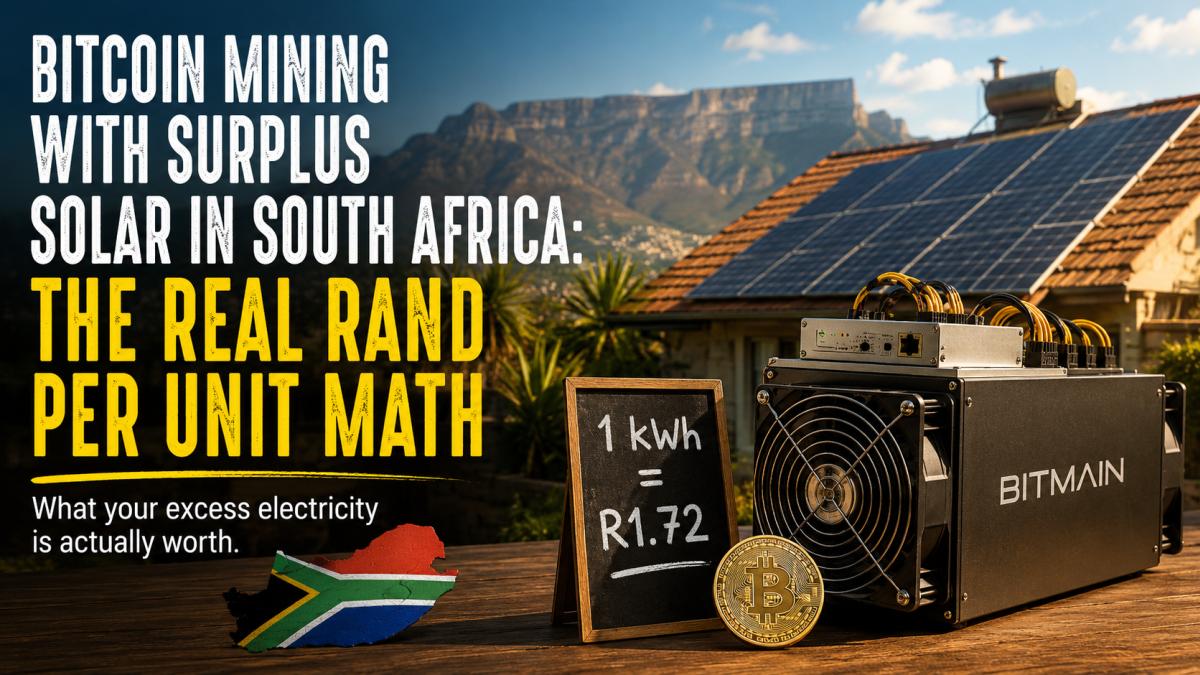
That machine earns about fourteen and a half dollars a day while consuming 136 kilowatt hours. Divide one by the other and you get roughly eleven US cents of Bitcoin per kilowatt hour, which at current exchange rates is about R1.72 a unit.
That is the ceiling. The most efficient Bitcoin mining hardware you can buy converts electricity into R1.72 of Bitcoin per kilowatt hour. The cheapest residential unit anywhere in South Africa costs R2.70, and most of us are paying north of R4.
This is why serious mining operations are in Texas, Paraguay and Ethiopia rather than anywhere on this continent’s southern tip. The business needs industrial power around R1.20 to R1.60 a unit. At every South African residential tariff, the machine loses money on every single unit it consumes, and not narrowly.
The industry is also in an awkward stretch. Network hashrate has slipped from its late 2025 peak as operators convert sites to AI hosting contracts, and difficulty has printed a rare negative year on year reading. Current figures are on minerstat’s Bitcoin network hashrate tracker, and Bitcoin Mining Stock’s hashrate page breaks down how much belongs to listed miners. When professionals with cheap power are repurposing their buildings, that tells you something about the margins.
Bitcoin has been out of reach for graphics cards since roughly 2012. A modern mid range GPU manages perhaps two gigahash per second on Bitcoin’s algorithm. A small dedicated device costing under a thousand rand does six hundred times that on a fraction of the power. If you are thinking of pointing a gaming rig at Bitcoin, stop there.
Altcoins are different. Profitability trackers such as Kryptex’s device listing for a 16GB mid range card and the equivalent page on MiningBoard currently put such a card at between one dollar twenty and one dollar forty five a day gross, drawing about 110 watts.
That works out to roughly R7 to R9 of coin per kilowatt hour, which beats the Bitcoin ASIC fourfold and beats every grid tariff in the country. On paper this is the only option here that wins.
The catch is in those two words: on paper. Those earnings are denominated in a small, thinly traded token, and the calculator assumes you can sell it at the quoted price, in the quantity you are producing, whenever you like. For a coin with a modest market that assumption often does not survive contact with reality. Difficulty also climbs hard on anything that becomes briefly profitable, so today’s figure is not next month’s.
Then there is the route home. Getting an obscure token into a South African bank account means converting it to Bitcoin, moving that to a local exchange, and selling to rand, with a spread and a fee at every hop. Budget on keeping meaningfully less than the headline.
People with a cupboard of retired machines often wonder whether they should all be mining something. The answer is no, and it is not close.
Old CPUs can realistically only mine Monero, which uses an algorithm designed to resist specialised hardware. Current figures on the minerstat Monero page show close to six gigahash per second of network capacity against a block reward of 0.6 XMR every two minutes.
Three older quad core laptops together might contribute four kilohash per second, and that is generous because laptop chassis throttle badly under sustained load. Their combined share is about R64 a month. Their combined consumption, at roughly 45 watts each running flat out, is 3.2 kilowatt hours a day, which is over R400 a month at typical metro rates.
That is R0.65 of value per kilowatt hour, the worst ratio anywhere in this article, and it comes with hot lithium batteries sitting next to tired fans for months on end. Monero also has an unresolved concentration problem, with one mining platform having crossed 51 percent of network hashrate in August, briefly prompting exchanges to pause deposits.
Those laptops are worth more sold, or repurposed as low draw always on nodes for home automation and backups. Idling as a headless server, one draws twelve watts rather than forty five.
Two things vary by region, and both push the same way.
The first is tariff. A Durban household on R4.17 flat and an Eskom Direct smallholder on R2.70 are looking at very different benchmarks. Mining loses to both, but the margin of defeat is far wider in the metros.
The second is seasonality, and this is the part that catches people out. Mining rewards constant uptime. A machine that runs six hours a day earns a quarter of what the calculators quote, because those figures assume it never stops. Load shifting does not care: heating water at midday is exactly as valuable in June as in December, you just do less of it.
South African production swings hard. Gauteng, which is about as good as it gets locally, still drops to roughly five or six peak sun hours a day in June and July, and a large array can fall to one to three kilowatts of output on a long overcast stretch. Winter rainfall regions in the Western Cape have a deeper and longer trough than that, while KwaZulu-Natal trades a milder winter for summer cloud and humidity.
The practical upshot is that the more seasonal your production, the worse mining performs relative to everything else on the list, because your surplus arrives in bursts rather than a steady stream. Nowhere in this country has the flat, year round, industrial supply that mining economics assume.
Here is the full list, ranked by rands of value per kilowatt hour of surplus solar.
Heating water comes first, at whatever your marginal tariff is, so R2.70 to R5.12 depending on where you live. Whether you use a geyser element on a timer, a diverter that dumps excess PV into the element, or a heat pump that multiplies the effect three or four times over, you are displacing your most expensive grid units with something you were going to throw away. It is certain, it needs no counterparty, and the payback is measured in months.
Shifting your pool pump, dishwasher, washing machine and any electric vehicle charging into the eleven to three window comes second, at the same rate, for the cost of setting a timer.
Altcoin mining on a GPU comes third on paper at R7 to R9, but drops below the top two once you discount for liquidity and volatility.
Bitcoin mining comes fourth at R1.72, well under half what heating water is worth in most of the country.
CPU mining comes last at R0.65.
Curtailing the array, which is the default for most people, is worth zero. That is the only thing mining actually beats.
American mining content is full of advice about forming an LLC and expensing hardware through bonus depreciation. None of it transfers.
SARS treats crypto assets as intangible assets rather than currency, and mined coin is included in gross income at the value it had when you received it, taxed at your marginal rate. The SARS crypto assets and tax page sets out the framework, and a draft guide published in July 2026 went further, covering mining, staking and swaps explicitly. Note that the taxable event happens on receipt, not on conversion to rand, so holding the coin does not defer it.
Speak to an accountant before relying on any of this. The point here is narrower: the American tax argument for mining does not exist in South Africa.
None of the above says do not do it. It says do not do it for the money.
A small solo miner on a shelf, drawing eighteen watts, costing perhaps sixty rand a month to run, is a perfectly good thing to own if you find it interesting. You will learn more about how the network functions in a week of running one than in a year of reading about it. The odds of it finding a block sit around one in fourteen thousand years, which is a number worth understanding rather than glossing over, but the entry price is low and the electricity is rounding error.
Bought as a hobby, it is cheap. Bought as an energy strategy, it is a poor one. Those are different purchases and the videos tend to blur them, usually because there is an affiliate link involved.
If you are watching production get clipped every clear day, the fix is not a mining machine. It is a heat pump geyser, or a PV diverter on the element you already have, or a timer that moves your heavy loads into the middle of the day.
Do that first. It costs less, pays back faster, carries no counterparty risk, generates no tax event, and does not depend on the price of anything. It is the same principle that applies when you are putting the system together in the first place, where the money goes furthest on the unglamorous components rather than the interesting ones.
Then, if you still want a Bitcoin miner on the shelf, buy one. Just call it what it is.