Physical Address
304 North Cardinal St.
Dorchester Center, MA 02124
Physical Address
304 North Cardinal St.
Dorchester Center, MA 02124

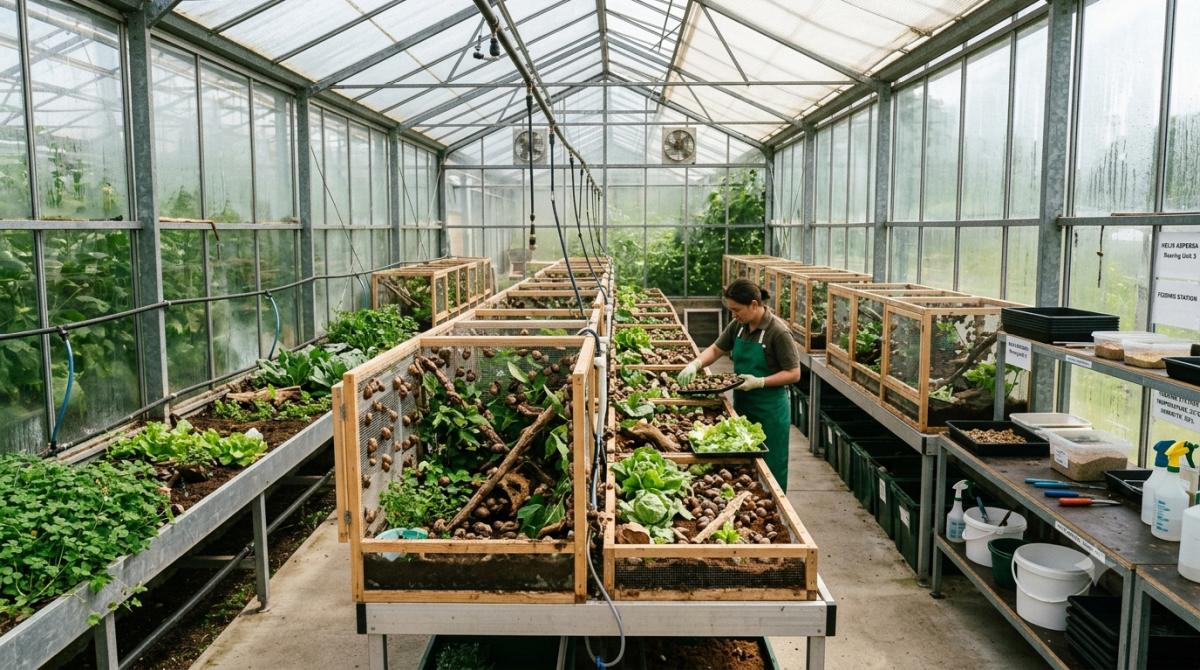
A snail farm near Centurion has been quietly turning a backyard greenhouse into a working business, and the headline numbers from operations like it are eye-catching enough to pull anyone in. But before you picture a money tree made of shells, it helps to flip the question around. Strip out the sales pitch and ask what a small snail colony actually does for a self-sufficient homestead, and you land somewhere more useful than a get-rich-quick scheme. Snails are not really a casual food crop in our climate. They are, however, a genuinely interesting node in a closed-loop garden system, a source of a high-value skincare ingredient, and only then, with serious infrastructure, a possible income stream.
Let’s build it up from the ground, in that order.
The most defensible reason to keep snails on a smallholding has nothing to do with selling them. It is what they plug into. A snail colony eats kitchen and garden greens, and what comes out the other end is useful three times over. The shells are roughly 98 percent calcium carbonate, which crushed makes a perfectly good calcium supplement for laying hens or a soil amendment for calcium-hungry beds. The droppings are a rich nitrogen source. And the snails pair naturally with a worm bin sitting underneath them, where the worms process the snail waste into one of the best soil amendments you can make at home.
That worm layer is doing real work. Worm castings improve soil structure, feed the microbial life in your beds, and release nutrients slowly enough that they will not burn tender roots. Gardeners who have run the comparison find that a modest percentage of vermicompost mixed into growing soil can outperform the same bed fed with raw compost, because the castings carry humic acids, plant growth compounds and a far denser community of microorganisms. Stack a snail tray over a worm bed and you have a two-storey nutrient factory running on scraps, with the snails as the visible product and the soil amendment as the quiet dividend.
Framed this way, even a small colony earns its keep. You are not betting on a market. You are closing a loop you already have running in your garden.
Here is the part the upbeat farm tours tend to underplay. The snail species used commercially, Helix aspersa maxima, is a Mediterranean animal that wants warmth and damp air. The published climate band for productive snail farming is mild and humid, roughly 15 to 24 degrees Celsius with relative humidity up around 75 to 95 percent. Drop below about 10 degrees and growth simply stops. Push the air too dry or too hot and the snails seal themselves up and go dormant. Commercial breeders targeting this species aim for a steady 21 degrees and humidity near 80 percent, and they hold it there with sensors and automation.
Now put that against a Highveld backyard. Centurion swings cold and bone-dry through winter, exactly the conditions that stall a colony or kill it outright. Every successful local operation solves this the same way: a sealed greenhouse with shade net and plastic, plus an automated misting and humidity system that runs day and night. That is not a casual backyard add-on. It is a capital project with a power bill attached.
This is the honest reason snails are a weak pure-food play here. The effort and infrastructure needed to keep a tropical mollusc alive through a Gauteng winter is the same whether you are eating ten snails a week or selling ten tons. The local garden snails that would survive our climate unaided are a different proposition entirely, and not the ones you want to be harvesting for the table without understanding parasite risk first. So if free backyard protein is the goal, your amaranth, your chickens and a worm bin will all give you more calories per rand and per hour than a snail greenhouse will.
If there is a single reason to take snails seriously beyond the closed loop, it is mucin, the slime. This is where the value density lives, and it is the part most home growers overlook because they are fixated on meat.
Snail secretion filtrate is a genuinely unusual substance. It carries a rare combination of compounds that almost never occur together in nature: glycoproteins, glycolic acid, allantoin, antimicrobial peptides, antioxidants and hyaluronic acid, the last of which is the same humectant the skincare industry pays a premium for. Dermatology researchers reviewing the evidence note that snail mucin supports wound healing, hydration and skin repair by encouraging fibroblast activity and collagen production. It is the active ingredient behind a whole category of imported “snail” face creams and serums.
For a homestead with any interest in making your own products, this changes the maths. A small, well-kept colony becomes a feedstock for DIY skincare or a cottage-scale product, where the value comes from a few grams of slime rather than kilograms of meat. The extraction can be done with non-lethal methods, so the same snails keep producing. That is a far more sensible self-sufficiency justification for the greenhouse infrastructure than eating the animals, and it sidesteps the awkward fact that South Africa currently lacks an easy route to process snail meat at small scale anyway.
Snail farming in South Africa is not the easy backyard protein it is sometimes sold as, not on the Highveld and not without serious humidity control. But reframed, it holds up well. As one storey of a snail-over-worm closed loop, it turns scraps into calcium, fertiliser and rich vermicompost. As a feedstock for high-value skincare, a small colony punches far above its size. And as a business, it is a genuine opportunity for those willing to treat it like the demanding, capital-heavy enterprise it really is. Start with the loop, value the slime, and let the big numbers stay where they belong, as the upside, not the reason.
Disclaimer: This article is general information for educational purposes only and is not business, financial, veterinary or agricultural advice. It is not affiliated with, endorsed by, or produced in cooperation with any snail farm, training provider or business mentioned or alluded to, and any reference to such operations reflects publicly described practices in the industry rather than the specifics of any one enterprise. Figures relating to setup costs, yields, buy-back prices and profit margins are illustrative estimates circulating in the sector and are not guarantees of any kind. Actual results vary widely with climate, infrastructure, management, market access and many other factors, and snail farming carries real financial and operational risk. Always do your own research and consult qualified professionals before making any investment or farming decision. The author and publisher accept no liability for any loss arising from reliance on this content.