Physical Address
304 North Cardinal St.
Dorchester Center, MA 02124
Physical Address
304 North Cardinal St.
Dorchester Center, MA 02124

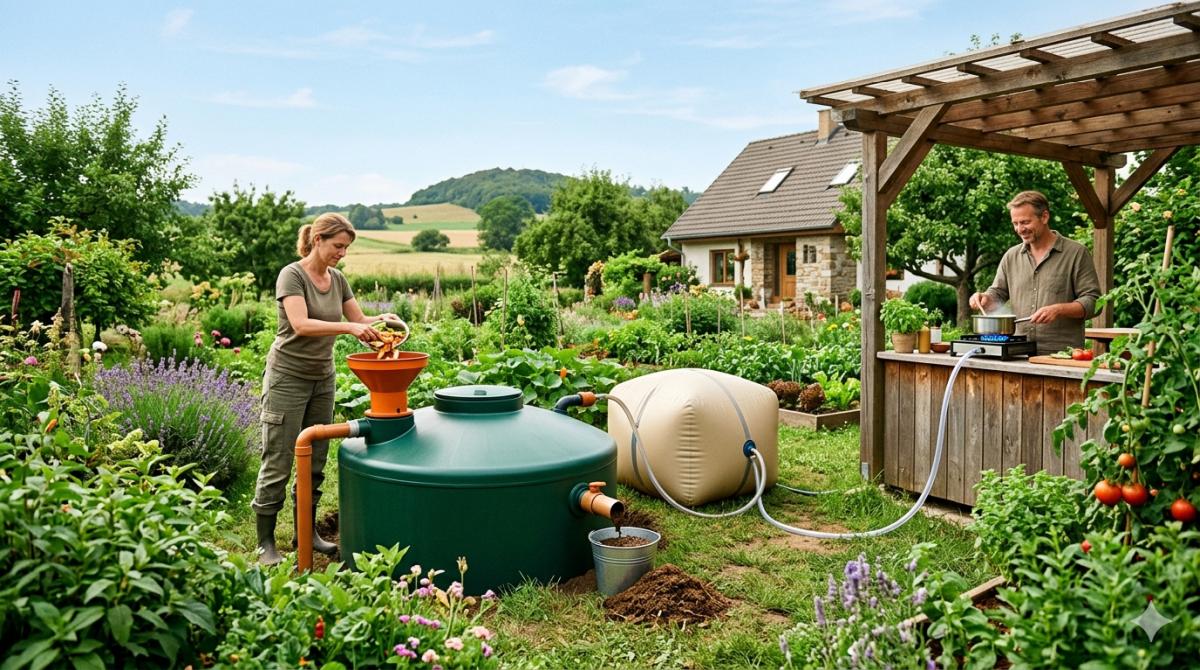
Every South African home throws away two things at once: a bin full of food scraps headed for the landfill, and money on a gas bottle or an electricity account that climbs every year. A biogas digester closes that loop. You feed it the peelings, the plate scrapings and the garden waste, it hands back gas you can cook on, and what’s left over comes out as a rich liquid fertiliser for the veg patch. Nothing wasted, the cycle running on what your household already produces daily.
It sounds almost too tidy, and there are real catches worth understanding before you spend a cent, especially if you live on the Highveld where winter does unkind things to the bacteria doing the work. But this is proven technology in South Africa, not a fringe experiment, and for the right property it earns its keep. Here’s how it actually works and whether it fits your setup.
Strip away the jargon and a digester is just an airtight tank where bacteria eat organic matter in the absence of oxygen. That anaerobic breakdown produces two useful outputs: a gas that is roughly two-thirds methane, and a nutrient-dense liquid called digestate that drains off the bottom.
The gas is the headline. It is the same combustible methane that makes up natural gas, and it burns with a clean blue flame on an ordinary gas hob fitted for it. One cubic metre of biogas gives you somewhere around two hours of cooking. Worth being clear on one point that trips people up: this is raw biogas piped straight from the tank to your stove. It is not bottled, compressed or liquefied — that is industrial territory and nothing a household needs to worry about. You make it and you burn it, on site, the same day.
The bacteria need a starter culture to get going, usually established over several weeks after the first loadings, before the tank settles into steady production. After that, it runs as long as you keep feeding it.
The self-sufficiency case is strong. A digester takes the wettest, smelliest portion of your household rubbish — the food waste that rots and releases methane in a landfill anyway — and turns it into something useful instead. You cut what goes to the kerb, you offset part of your cooking fuel, and you get fertiliser as a bonus.
That fertiliser deserves a mention of its own. Unlike a normal compost heap, which loses much of its nitrogen to the air as it breaks down aerobically, a digester captures those nutrients in the liquid digestate. The result is a high-quality, ready-to-use plant food you can run straight onto the garden. Smallholders who have set this up describe lush vegetable patches fed entirely on digester output. For anyone already growing their own food, that pairing of free cooking gas and free fertiliser from the same waste stream is the whole appeal.
Be realistic about where it fits, though. A digester wants a steady daily supply of organic input and some outdoor space — it suits a smallholding, a house with a garden, or a property with a few animals far better than a townhouse or a flat. South Africa’s own field deployments back this up: a Free State trial documented in the Journal of Energy in Southern Africa ran entirely on cattle dung from households that kraaled their animals, with the digestate going straight onto household gardens to grow vegetables and improve food security.
Digesters are forgiving but not infinitely so. They happily take kitchen scraps, food waste, animal manure and garden greens. What they choke on is anything that won’t readily rot: bones, fruit pits, sand, and large quantities of oil or fat. Heavy citrus loads can knock the bacteria off balance too, so go easy there.
The daily routine is genuinely light. For most home setups it is a five-minute job each morning — tip in the day’s waste, give it a stir, done. The catch is consistency. The single biggest cause of failure in real installations is not feeding the tank properly: skip days, feed it at the wrong ratio, or let it run dry, and production stalls or the unit blocks. A digester is a living system, and it rewards routine.
One practical note on manure-fed systems: mix the dung with water at roughly a one-to-one ratio before feeding. The bacteria work in a wet environment, and getting that balance right is part of keeping output steady.
Here is the section most glossy biogas marketing skips, and the one that matters most if you live in Gauteng or the Free State. Digester bacteria are temperature-sensitive. They are happiest at around 35°C, they slow markedly below 10°C, and when the mercury drops toward freezing they all but stop.
This is not a minor footnote. The Free State study mentioned above tracked household digesters through a full year, and the finding was blunt: in summer, two-thirds of the households met about 80% of their cooking needs from biogas, with some cooking for over two hours an evening. In winter, production at every single site fell to a level the researchers described as not worth the effort of feeding the tank. The eastern Free State’s sub-zero mornings simply shut the process down. The authors went as far as calling unheated digesters unsuitable for that region on those grounds alone.
So what do you do about it? A few things help. Burying the tank underground buffers it against the day-night temperature swing and holds warmth far better than an above-ground unit. Siting it where it catches winter sun helps at the margin. And sizing up matters: the same study found larger units consistently outperformed small ones. Bigger tanks held their temperature and output more reliably, while undersized units struggled. Heating and insulating a digester is technically possible but usually wrecks the economics for a home user, so the honest planning assumption for the Highveld is this: treat biogas as a strong three-season supplement that tapers off in the coldest months, and keep a gas bottle or another backup for deep winter. Plan around that and you won’t be disappointed.
Two routes, depending on your budget, skills and appetite for a project.
Off-the-shelf is the low-hassle path. South Africa actually manufactures a strong option: the AGAMA BiogasPro, a prefabricated tank that bundles feeding, gas storage and slurry handling into one unit with no moving parts to fail, sold with a multi-year factory guarantee and designed to be buried as a permanent install or containerised so you can move it later. Suppliers like AT&D in Johannesburg carry it alongside smaller portable options such as the EZ-Digester — a 1.5m³ above-ground floating-dome unit that handles roughly 25kg of organic waste a day and yields around two hours of daily cooking gas, which is a sensible starting size for a single household. BiogasSA, which has commissioned over 200 small-scale digesters across Southern Africa, also supplies the locally made AGAMA unit. Going through an established supplier gets you a site assessment, correct sizing and installation, which is money well spent given how much siting and sizing affect whether the thing works.
Building your own is cheaper and very much in the self-sufficiency spirit, but it is a real undertaking. The two durable home-build approaches are HDPE tanks and in-situ cast concrete. Concrete domes have proven the more reliable over time — brick-built domes tend to crack as they age, and a cracked dome means gas leaks. As Popular Mechanics South Africa has documented through local DIY builders, a competent self-build runs to roughly six weeks if you know what you are doing. Two failure modes to design out from the start: cracking on masonry domes, and the blockage-prone tangle of connections you get if you try to chain several small tanks together instead of running one properly sized unit. The Free State trial ran into exactly this — parallel small units created too many inlet, gas and effluent connections and blocked constantly, while single larger tanks ran clean.
What does it cost? South African installations have historically ranged widely — one academic review put prefabricated household digesters somewhere between roughly R8,000 at the small DIY end and R80,000 for larger supplied-and-installed systems, depending on size and materials. A supplied off-the-shelf domestic unit sits well up that range once you add delivery and installation. Treat any figure you read, including these, as indicative only and confirm current pricing directly with a supplier, since equipment prices move.
On payback, be clear-eyed. At household scale a digester is a slow financial return if you measure it purely on the gas it offsets, and the winter slowdown stretches that further. The honest framing is that the real returns are the ones that don’t show up on a single line: less waste leaving your property, a free and continuous supply of quality fertiliser, and a degree of energy resilience that doesn’t depend on a tariff or a delivery truck. A home digester supplements your cooking fuel rather than fully replacing it, especially through a Highveld winter. Go in expecting that, and it’s a genuinely satisfying piece of a self-sufficient setup.
A biogas digester is one of the cleaner expressions of the closed-loop thinking that self-sufficiency is built on: your waste becomes your energy becomes your soil becomes your food. It won’t carry your whole kitchen single-handed, and it’ll ask for a daily five minutes and a realistic attitude to winter. But for a property with a garden, a steady stream of organic waste and a bit of space, it turns a daily disposal problem into a daily resource.
If the idea appeals, the sensible first step is a sizing and site assessment rather than a purchase — get the tank big enough and sited right, and you’ve solved most of the problems before they start. From there it slots neatly alongside the solar, the veg beds and everything else already pulling its weight on the property.