Physical Address
304 North Cardinal St.
Dorchester Center, MA 02124
Physical Address
304 North Cardinal St.
Dorchester Center, MA 02124

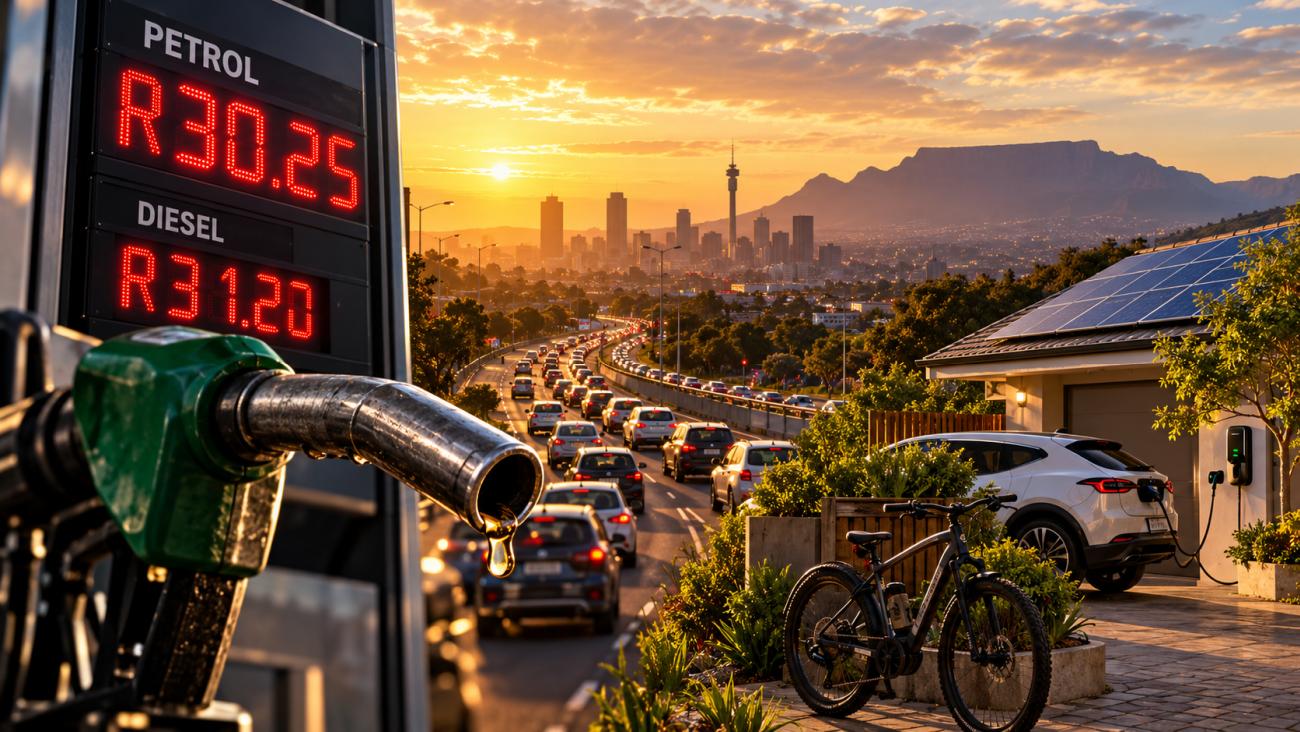
Petrol crossed R30 a litre this month for the first time in South African history. From 7 October, inland 95 octane went to R30.25 while coastal motorists now pay R29.38, and diesel climbed even higher. For most households the shock isn’t the occasional long road trip. It’s the daily drive to work, repeated twenty-odd times a month, every month, with no end date.
Self-sufficiency usually gets framed around food, water and electricity. Transport rarely makes the list, yet for many families it is the single biggest recurring cost they have some control over. This article looks at what commuting really costs at today’s prices, where in the country the burden falls, and the practical steps that cut a household’s dependence on the pump.
Fuel bills hide well because they arrive in small, frequent amounts. Running the numbers for a full month tells a different story. The figures below assume a typical family car using 7 litres per 100km, 21 working days a month, and a return trip each day.
A 20km commute each way adds up to about 840km a month and roughly 59 litres of petrol. That comes to around R1,780 inland and R1,730 at the coast.
At 40km each way, the distance doubles to about 1,680km and 118 litres. Inland drivers spend roughly R3,560 a month, coastal drivers about R3,450. Over a year that is more than R42,000, before a single service, tyre or licence disc.
At 60km each way the monthly bill reaches around R5,340 inland and R5,180 at the coast, or upwards of R64,000 a year.
These aren’t extreme cases. A Pretoria resident working in Johannesburg covers about 60km between the two CBDs each way. Someone driving from Somerset West or Paarl into central Cape Town, or from Ballito into Durban, is in the 45km to 60km range. Pietermaritzburg to Durban is further still. Long commutes are a national pattern, not a Gauteng quirk.
Coastal households pay slightly less per litre because fuel doesn’t have to travel inland from the refineries and ports, but the gap is under a rand. On a 40km commute it saves about R100 a month. That is real money, but it doesn’t change the basic picture: wherever you live, a long daily drive now costs thousands.
[Also Read: Can a Small Solar Setup Charge an EV in South Africa]
Some motorists also carry extra costs on top of fuel. Frequent toll users on certain routes, such as the ramp plazas north of Pretoria, can add hundreds of rand a month, and the cost of tyres, brake pads and more frequent services rises with every kilometre.
It is tempting to wait for relief. The trouble is that most of what you pay per litre is set by forces no household can influence: global oil prices, the rand exchange rate, and a stack of taxes and levies. One of those, the Road Accident Fund levy, has risen from 9c a litre in 1997 to R2.25 a litre this financial year.
The RAF recently asked to push that levy up to R3 a litre. Transport Minister Barbara Creecy has said she won’t take that request to Treasury while she holds the post, which is welcome news. But the same report notes that a separate levy on vehicle registrations and licence renewals is still being discussed. The direction of travel is clear. Running a car in South Africa is not getting cheaper, and the self-reliant response is to need less fuel rather than hope for lower prices.
The cheapest kilometre is the one you never drive. If your job can be done from home even part of the time, negotiating remote days is the single most powerful fuel saving available.
Two days a week at home cuts commuting distance by 40%. On a 40km commute at inland prices, that saves about R1,420 a month, or roughly R17,000 a year. Very few household changes deliver that kind of return with no upfront cost.
This isn’t a fringe arrangement either. A University of Pretoria study of large Cape Town employers found that staff were still working from home on average 0.7 to 1.7 days a week in 2024, and many said they would do more if allowed. When you approach your manager, put the case in business terms: fewer hours lost in traffic, lower stress, and better retention. The fuel saving is yours, but the productivity gain is theirs.
Carpooling has an image problem, but the maths is hard to argue with. Three colleagues sharing a 40km commute and splitting the fuel each pay about R1,190 a month instead of R3,560. That’s a saving of over R2,300 per person, per month.
It works best with people who live within a few kilometres of each other and keep similar hours. Neighbourhood WhatsApp groups and workplace notice boards are good places to find a match. Agree up front how you’ll split costs, how long you’ll wait for latecomers, and what happens when someone works late. Clear rules keep the arrangement from falling apart after a month.
Commuting is only part of a household’s fuel use. The rest disappears into small, scattered errands: a dash to the shop for bread, a separate run to the pharmacy, another for school supplies. Each one involves a cold engine, which burns noticeably more fuel over the first few kilometres.
A simple weekly plan helps. Keep a running shopping list on the fridge, do one main shop a week, and group errands geographically so you drive a loop rather than several out-and-back trips. Families who grow some of their own vegetables and herbs find this easier, because fewer items run out midweek. A productive garden doesn’t just lower the grocery bill. It quietly removes trips from the calendar.
For short local errands under three or four kilometres, a bicycle or e-bike is worth considering where roads and security allow. The running cost is close to zero and the exercise is a bonus.
If you’re due to replace a vehicle anyway, fuel efficiency deserves far more weight than it did when petrol was R20 a litre.
Hybrids are the easiest switch. A car using around 4.5 litres per 100km instead of 7 saves about R1,270 a month on a 40km commute at inland prices. Several hybrids now sell for under R500,000 in South Africa, which brings them within reach of buyers who would otherwise be looking at a mid-range petrol hatch or crossover.
Fully electric cars have also become far more affordable. In 2023 the cheapest EV here cost close to R800,000. Today, the most affordable models start at around R340,000, thanks largely to Chinese brands competing hard on price.
This is where transport and energy independence meet. A small EV uses roughly 15kWh per 100km. On a 40km commute that is about 250kWh a month.
Charged from the grid, that energy costs between roughly R750 and R1,260 a month, depending on your municipality and tariff. Most metro residential tariffs fall somewhere between about R3 and R5 per kWh, so check your own bill. Prices keep rising too: NERSA approved an 8.76% increase for Eskom direct customers from April, and municipal increases this July ranged from 6.7% in Cape Town to 9% in eThekwini and Ekurhuleni. Even so, grid charging works out at a third or less of the equivalent petrol bill.
Charging from rooftop solar takes the marginal cost close to zero. There is a catch, though. Solar produces during the day, and a commuter’s car is usually parked at the office during those hours. The households that make it work tend to use one or more of these approaches:
An EV paired with solar is a significant investment, and it won’t suit every budget. But for households already planning a solar system and a vehicle change, combining the two can turn fuel from a monthly drain into something close to a fixed, paid-off cost.
The most radical option is also the most permanent. Moving closer to work, or finding work closer to home, removes the problem at its root. For some families the savings on fuel and time outweigh a higher rent or a smaller garden. For others, a home-based business or a local job at slightly lower pay leaves them better off once the commute is gone.
This isn’t a decision to make lightly, but it deserves a proper calculation. Add up a year of fuel, tolls, extra maintenance and the value of the hours spent in traffic, then compare it honestly with the alternatives.
None of these steps requires waiting for government relief or a lucky drop in oil prices. Start with what is free: a conversation about remote days, a carpool, and a weekly errand plan. Then work toward the bigger changes, such as a more efficient car or solar charging, as your budget and timing allow.
Self-sufficiency has always been about reducing dependence on systems you cannot control. At R30 a litre, the fuel pump belongs firmly on that list.