Physical Address
304 North Cardinal St.
Dorchester Center, MA 02124
Physical Address
304 North Cardinal St.
Dorchester Center, MA 02124


Every preserving guide you will find online was written for somebody living near the sea. That is not a small detail. It is the reason a jar of Highveld tomato sauce can look perfect, seal with a satisfying pop, and still be quietly unsafe six months later. Before you buy a single glass jar, you need to understand what altitude does to your kitchen, what a dry inland winter does to drying racks, and why the fermentation traditions already sitting in this country are better suited to our climate than anything imported from a Brooklyn cookbook.
This is the practical version. Regional timings, load-shedding-proof methods, and honest expectations for a country where the pantry hits 30°C in February.
Water boils at about 100°C at sea level, including coastal cities such as Durban and Cape Town. In Pretoria, at roughly 1,350 m, it boils at about 95°C. In Johannesburg, above 1,700 m, it is closer to 94°C. Bloemfontein sits in the same band. The water is bubbling furiously. It is simply not as hot. Every processing time printed in an American or British recipe assumes a heat that inland South Africans are not actually reaching.
The fix is not complicated, but it is not optional. Penn State Extension’s guidance on knowing your canning altitude is the starting point, and Colorado State’s explanation of why elevation matters spells out the consequences of skipping it. For water bath canning, you add time. The adjustment depends on your exact altitude and the tested recipe you are using, so use the altitude table supplied with that recipe rather than applying a blanket provincial rule. Coastal readers below 300 m need no adjustment. Healthy Canning publishes the adjustment tables in metres rather than feet, which saves you the conversion headache.
Look up your own altitude rather than guessing from your province, write it on a label, and stick it inside your kitchen cupboard. You will use it every single time.
The one thing that separates safe home preserving from a genuinely dangerous hobby is pH. Clemson’s explanation of the pH factor in canning is worth reading twice. Foods that are naturally high-acid, or that have been properly acidified to pH 4.6 or below, may be suitable for water bath canning, but safety depends on following a laboratory-tested recipe and process. Acidity alone does not determine whether a food can be safely canned: density, jar size, heat penetration and ingredient ratios all matter, which is why tested recipes specify them.
Plain vegetables, meat, stock, and every “mixed” jar of vegetables in oil fall on the wrong side of that line. This matters more in South Africa than elsewhere because pressure canners are genuinely hard to source locally, expensive when you find them, and often sold second-hand with unverified gauges. The National Centre for Home Food Preservation is blunt about why that line cannot be crossed, and the USDA’s food safety service explains how Clostridium botulinum survives boiling water in a sealed low-acid jar.
So here is the honest advice for a South African household: build your entire canning practice around high-acid products made from tested recipes. Dry or freeze the rest. You lose almost nothing and you remove the only failure mode that can actually kill someone.
Two local notes. Check your vinegar label, because spirit vinegar is usually 5% acetic acid but some brown and grape vinegars sit lower, and below 5% the recipe maths breaks. And acidify tomatoes without exception, using bottled lemon juice or citric acid rather than fresh lemons, since fresh fruit varies too much to trust.
Important: the examples below are preserving ideas, not complete tested recipes. Use a current tested recipe from a recognised food-safety authority for exact ingredient quantities, processing times, jar sizes and altitude adjustments. Do not rely on these summaries as stand-alone canning instructions.
Preserved lemons. The easiest genuine win in a South African kitchen. Lemons are cheap, most suburbs have a neighbour with a tree groaning under them by June, and the method is salt rather than heat. The traditional approach quarters the lemons almost through, packs them hard with coarse salt, and presses them into a sterilised jar until the juice covers everything before a period of curing. Storage life varies with the recipe, salt concentration and storage conditions, so follow the recipe you are using and discard any batch that develops signs of spoilage. Done properly, they transform winter stews, roast chicken and any grain dish.
Tomato passata. February and March give you the tomato glut. The general shape is cook down, sieve, acidify every jar, and process with your altitude correction applied. Penn State’s basics of home canning covers the mechanics properly, and a tested tomato recipe will give you the exact acid quantity per jar size.
Chutney. This one is ours already. Green mango, peach and apricot chutneys are part of the South African pantry going back generations, and the high vinegar and sugar content makes them among the most forgiving things you can put in a jar. Start here if you are nervous, but still work from a tested recipe.
Here is the counterintuitive part. An inland South African winter is the best drying weather in the country. June and July across Gauteng, the Free State and the Karoo bring relative humidity down into the twenties, skies stay clear for weeks, and the air is desperate to pull moisture out of anything you leave in it. Coastal readers in Durban or the Garden Route fight humidity all year and will lean more on a dehydrator with a fan.
The catch inland is the temperature swing. A Highveld winter day can reach 20°C and drop below 4°C overnight, and anything left on a rack after sunset reabsorbs moisture and can spoil. The rule is simple: trays come inside at dusk, every night, without exception.
Electricity makes this easier and also makes it fragile. An electric dehydrator halfway through an eighteen-hour apple run is a liability when the schedule shifts. Passive solar drying has no such problem. Wikipedia’s overview of direct and indirect solar dryers explains the distinction that matters most: direct dryers expose food to sunlight, while indirect dryers heat air in a collector first and pass it over food kept in shade. Indirect is better for colour, vitamin retention, and keeping flies off.
Utah State Extension publishes free plans for a passive downdraft solar dehydrator that translate almost directly to South African conditions, with one adjustment. Those plans put the solar collector on the south side. In the southern hemisphere you flip that. Your collector faces north, and the shaded south wall of your house becomes the cool storage side.
A workable weekend build: a glazed collector panel with the inside painted matt black, angled at roughly your latitude, feeding a shaded chamber holding stacked trays of food-grade mesh, venting through a chimney at the top. No fan, no power, no schedule to worry about.
What to load it with, by season on the Highveld: peaches, apricots and plums from December to February, tomatoes and chillies through March, apples and pears in autumn, and morogo, spinach and herbs whenever you have a surplus. Dried morogo in particular is worth more than most people realise, because it puts leafy greens on your plate in August when the garden has given up.
Test for dryness by tearing a piece rather than squeezing it. No moisture beads at the tear, and it should be leathery rather than brittle for fruit.
We do not need to import a fermentation tradition. We have several.
Umqombothi, the maize and sorghum beer, is a live lactic fermentation with a documented regional recipe lineage. Amahewu, also called mageu, is a soured maize drink that many households still make. Ting is fermented sorghum porridge. On the Afrikaans side, suurdeeg and mosbolletjies carry a wild-yeast baking tradition that predates the current sourdough revival by well over a century.
For bread specifically, a starter is flour, water and patience. Taste’s South African sourdough starter method is calibrated to local flour, which matters because our cake flour and stone-ground wholewheat behave differently from American all-purpose. Our warm summers mean a starter on the counter will need feeding twice a day from November to March, and once a day or less through winter.
Cabbage is at its best and cheapest here in winter, which is exactly when you want it, because temperature is the variable that makes or breaks a ferment. Colorado State’s guide to understanding and making sauerkraut sets out the salt ratio by weight that tested recipes rely on, and the NCHFP’s tested sauerkraut process gives the temperature window: too cold and fermentation may not start, too warm and the kraut goes soft. Follow the ratio and range in the recipe you use rather than eyeballing either.
An inland winter kitchen sits close to ideal. An inland summer kitchen does not, which is why summer ferments turn to mush and winter ferments turn out crisp.
Keep everything under the brine. That single rule prevents most mould problems. A cabbage leaf and a small water-filled bag as a weight costs nothing and works as well as any imported fermentation kit.
Printed storage guidance assumes conditions around 20°C. A west-facing South African kitchen can sit at 30°C for weeks. Heat does not usually make a properly sealed high-acid jar unsafe, but it destroys quality fast: colour dulls, texture collapses, and vitamin content drops sharply.
Quality and storage life vary widely with the food, the recipe, the processing method and the storage conditions, so follow the storage guidance supplied with the tested recipe you used. What holds everywhere is that heat, light and fluctuating temperatures shorten it, and that a jar stored well past its recommended window may still be safe but will not be worth eating.
Store on the south side of the house, the coolest wall we have, off the floor, and in the dark. Date every jar. Rotate honestly.
Not from the things they worry about. A slightly soft pickle is usually a quality problem rather than the kind of hazard people should fear most. People get hurt from low-acid vegetables water bathed because a blog said it was fine, from ignoring altitude for years and getting away with it until the batch that mattered, from reused lids that seal without sealing, and from tasting something to check whether it turned.
Never taste to test. If a lid is domed, if the contents are cloudy when they should be clear, if the seal releases with a hiss, throw it out without opening it further.
Preserving is a chemistry discipline that happens to produce food. Respect the numbers, adjust for where you live, and this becomes one of the most genuinely useful skills a South African household can own.
This article is provided for general educational and informational purposes only. It is not a tested preserving recipe, food-safety instruction manual, or professional advice. Home food preservation carries inherent risks, including the risk of botulism, foodborne illness, injury and property damage. Readers should use only current, laboratory-tested recipes and procedures published by recognised food-safety authorities and follow them exactly, including ingredient quantities, processing times, jar sizes, equipment requirements and altitude adjustments. No information in this article should be relied upon as a substitute for a tested recipe. Conditions, ingredients and equipment vary, and outcomes cannot be guaranteed. Selfsustain.co.za, its authors and publishers accept no liability for any illness, injury, loss or damage arising directly or indirectly from the use of information contained in this article. If a preserved food shows any sign of spoilage, damage, leakage, an unsealed lid, unusual appearance, odour or texture, discard it without tasting. When in doubt, throw it out.



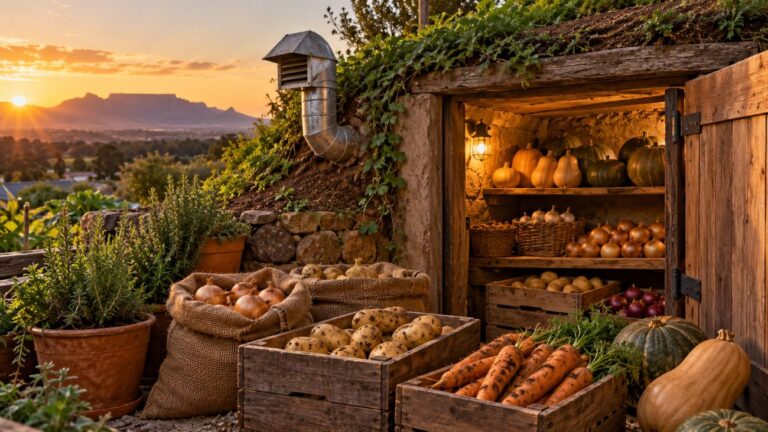





[…] cool nights, low humidity, steady breeze and few flies. It is the same dry winter air that makes solar-drying fruit and vegetables so effective inland, and it is why biltong-making traditionally clusters around May to August, […]