Physical Address
304 North Cardinal St.
Dorchester Center, MA 02124
Physical Address
304 North Cardinal St.
Dorchester Center, MA 02124

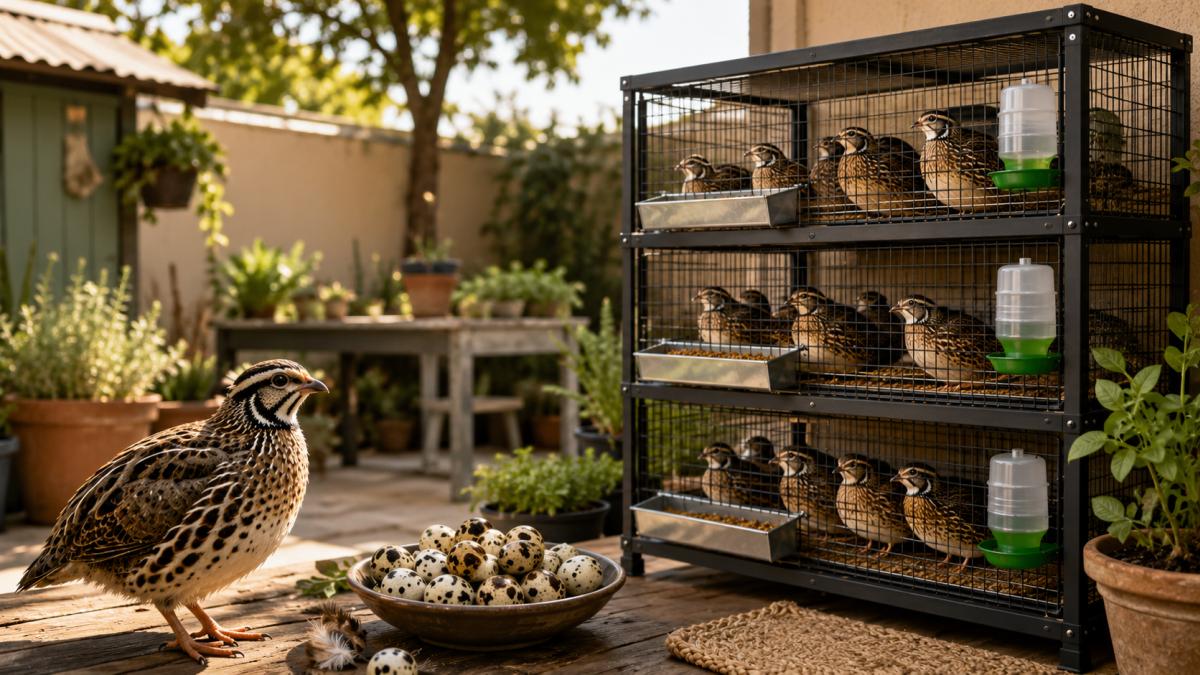
For years, the backyard chicken has been the poster bird of suburban self-sufficiency in South Africa. But for anyone living on a small erf, in a townhouse complex, or in a sectional title unit, chickens are often more trouble than they are worth. They are noisy, they need space, the roosters get you reported to the body corporate, and you wait the better part of six months before you see a single egg.
There is a quieter, faster, more space-efficient alternative that most South Africans have never seriously considered: the Coturnix quail. These compact little birds are becoming the homesteader’s secret weapon, and they fit into urban Gauteng, Cape Town and coastal living in a way chickens simply cannot. If you have a patch of patio, a corner of a courtyard, or even a well-ventilated garage, you can keep quail.
This guide walks you through why quail beat chickens for small-space South African living, how to house and feed them when local quail feed is hard to come by, and what you need to know about the bylaws before you start.
The single biggest advantage of quail is footprint. A laying hen wants a minimum of about a square metre of run space to stay healthy and happy, plus a coop and scratching area. A Coturnix quail needs roughly one square foot per bird, and a vertical cage system can stack several tiers into the space of a cupboard. A single pair of Coturnix quails can thrive in as little as 2 to 3 square feet of enclosure space. That means a covey of a dozen birds takes up less room than a single chicken coop.
The second advantage is speed of return. With chickens you are committing to months of feeding before the first egg arrives. Chickens begin to lay eggs once they are between 18 and 26 weeks of age. A single quail hen can lay between 72 and 120 eggs during that same time frame. Quail reach maturity and start laying remarkably early. A Coturnix quail hen will usually begin laying somewhere between 5 and 8 weeks of age. She will lay one egg almost every day. She will probably lay at least 300 eggs per year or more.
That production density is extraordinary for the space involved. Three quail hens can keep a small household in eggs, and while quail eggs are smaller, three to four of them roughly equal one chicken egg in volume, with a richer yolk-to-white ratio and a higher concentration of nutrients.
This is the deal-breaker for most complex and sectional title residents, and it is exactly where quail shine. Roosters crow loudly enough to start a feud with the neighbours, which is why most South African municipalities ban them outright in residential zones. Quail are an entirely different proposition. In regard to the noise factor, quail are much quieter than chickens, turkeys or ducks.
Even the males are manageable. Unlike chicken roosters, the crow of a male quail is not as loud, nor does it carry as far. This makes the quail a neighbor-friendly choice for anyone who wants to start quail farming, even for those living in the city. A male quail’s call is a soft, brief trill rather than the dawn alarm of a rooster. For egg production you do not even need a male unless you intend to hatch your own chicks, so you can keep an all-female covey and have near silence.
You have two basic options: a raised cage system or a ground pen. For small-space South African living, the raised cage usually wins. It keeps droppings falling away from the birds, makes cleaning faster, stays predator-proof, and can be tucked onto a patio or into a garage.
Whatever you build, predator-proofing is non-negotiable in South Africa, where rats, mongoose, genets, domestic cats and birds of prey will all take a quail given the chance. A solid roof, fine mesh on all sides, and a secure latch are essential. Allow for shade in summer. Our Highveld and coastal heat can be brutal, so position the cage to catch morning sun but stay shaded through the worst afternoon heat.
Ventilation matters enormously. Quail droppings are high in nitrogen and the ammonia builds up fast in an enclosed space. Good airflow keeps the birds healthy and keeps the smell down, which keeps your neighbours happy. The droppings themselves are a bonus: rake them up, compost them well, and you have a potent nitrogen-rich fertiliser for your vegetable beds.
Lighting is the lever that controls egg production. Quail need long days to keep laying. Quail hens require 14 hours of light per day in order to produce eggs. Through a South African winter the natural day length drops below this, so a simple LED on a timer in the cage will keep your hens productive year-round if you want consistent eggs.
Here is the practical challenge local keepers face. Unfortunately, in South Africa, we don’t have the convenience of ready made quail food to feed our birds, so we feed a high quality broiler feed and supplement it with additional sources of protein and minerals. This is the single most important thing to get right.
Quail need much higher protein than chickens. A laying hen does fine on 16 to 18 percent protein, but quail want considerably more. For peak production, feed them a turkey or game bird diet that is 24-30% protein. Extra calcium in the form of crushed eggshells, powdered calcium carbonate, and dark leafy greens like kale and broccoli should be added to the diet as well.
In practice, most South African quail keepers buy a good game bird or broiler starter crumble and boost the protein with supplements: dried mealworms, black soldier fly larvae (which you can farm yourself), and the occasional scrambled egg. For calcium, crush their own eggshells fine and mix them back in, or grind oyster shell in a food processor since whole pieces are too big for such small birds. Always provide clean water in a shallow or nipple drinker, as quail chicks can drown in an open dish.
One quirk of domesticated quail is that generations of selective breeding have bred the broodiness out of them. Unlike poultry, domesticated quail are not prone to becoming broody to hatch their eggs. They will lay beautifully but almost never sit on the eggs themselves, so if you want a self-sustaining covey you will need a small incubator.
The payoff is a very fast breeding cycle. With an incubation time of 17 days and egg production starting within 6 weeks of hatching, you can’t go wrong with raising quail. That means you can go from setting eggs to a new generation of layers in roughly two months, far faster than any chicken. Sexing is straightforward once they feather up: males show rusty-red breast feathers while hens have a speckled, dotted chest pattern. Keep only one male per group if you are breeding, since multiple males will fight viciously over the hens.
Before you order your first batch of hatching eggs, check your local rules. South African municipal bylaws on poultry vary, but they generally allow residential keeping within limits. Most municipalities in South Africa allow residents to keep between 5 to 10 hens in residential areas. Many bylaws set a threshold around poultry numbers and housing standards. For example, some require that no person keep more than ten poultry birds on a premises unless specific housing requirements are met.
The good news for quail keepers is that the rules are written mainly with noisy, smelly chickens and roosters in mind. A small, quiet, odour-controlled quail cage on a patio is far less likely to attract a complaint. That said, if you are in a sectional title scheme or estate, your body corporate’s conduct rules may be stricter than the municipal bylaw, so read your rules and have a quiet word with your trustees before you start. The clincher in any conversation is exactly what makes quail so appealing: no crowing, no smell, and a footprint smaller than a dog kennel.
For South Africans chasing a little more food independence without the space, noise and waiting period that chickens demand, quail are close to the perfect starter livestock. They lay faster, take up a fraction of the room, stay quiet enough for complex living, and turn a high-protein feed into a steady supply of nutrient-dense eggs in under two months. Start with a covey of half a dozen hens, get your feeding and lighting right, and you will be collecting your own eggs before a chicken keeper has even finished building the coop.