Physical Address
304 North Cardinal St.
Dorchester Center, MA 02124
Physical Address
304 North Cardinal St.
Dorchester Center, MA 02124

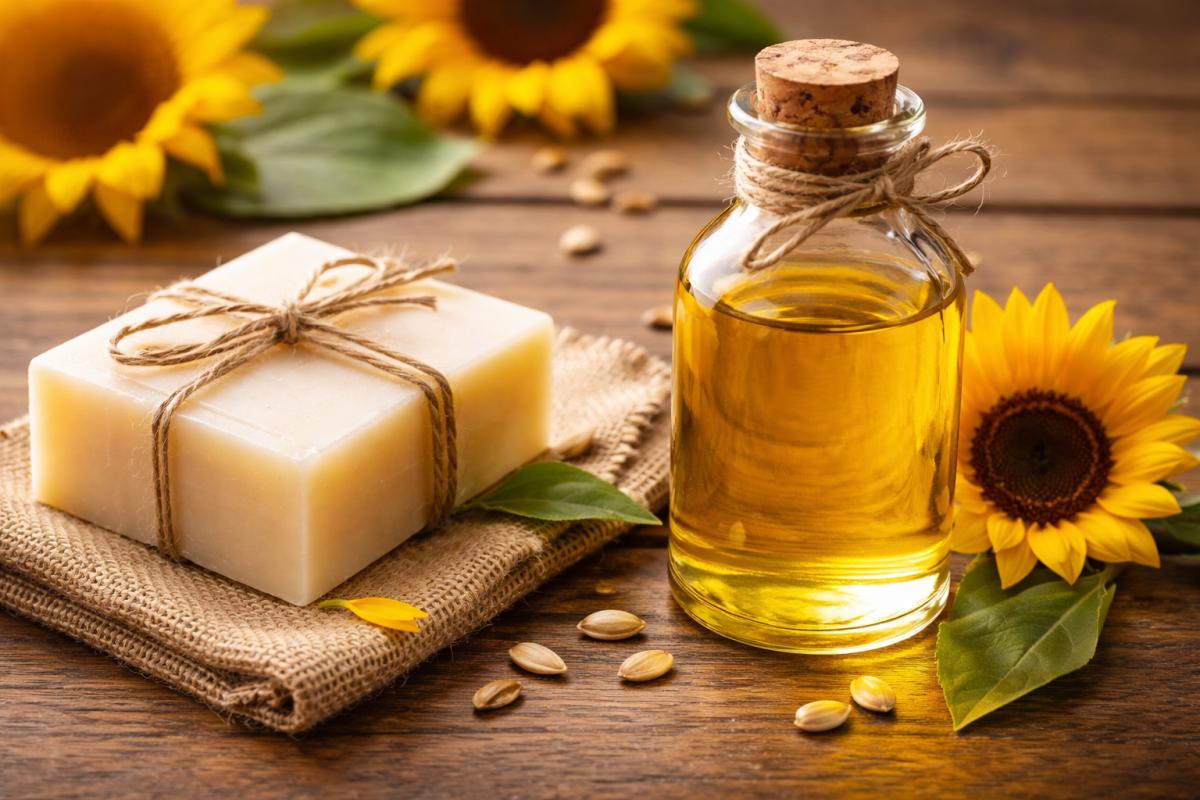
Most store-bought soap is loaded with synthetic detergents, artificial fragrance, and preservatives that your skin was never designed to handle. The alternative is simpler, cheaper, and more satisfying than you might think. Making your own soap from sunflower oil is one of the most accessible home chemistry projects you can tackle, and in South Africa it is particularly practical because sunflower oil is widely available, grown locally, and costs a fraction of the imported specialty oils that most soap tutorials call for.
This guide walks you through everything you need: the science, the safety, the equipment, the recipe, and the process from start to finish.
Sunflower oil is pressed from the seeds of Helianthus annuus, a crop South Africa produces in significant volumes, particularly in the North West and Free State provinces. The oil is high in linoleic acid, an omega-6 fatty acid, and oleic acid, which is the same fatty acid that makes olive oil prized in Castile soap. This composition means sunflower oil soap is naturally conditioning and gentle on skin.
[Also see: Grow Your Own Protein at Home]
The trade-off compared to coconut oil soap is that sunflower oil produces a softer bar with a milder, creamier lather rather than the big, bubbly foam coconut oil is known for. It is also slower to harden and benefits from a longer cure. But for everyday use, especially for sensitive skin, that mildness is a genuine advantage rather than a compromise.
For context on the chemistry, the American Oil Chemists’ Society has extensive published research on vegetable oil fatty acid profiles and their soap-making properties. The science is well-established: different oils produce different soap characteristics, and sunflower oil sits firmly in the conditioning, moisturising category.
Soap is made through a chemical reaction called saponification. When a fat or oil is combined with a strong alkali, in this case sodium hydroxide (also known as lye or caustic soda), the molecules break apart and recombine to form soap molecules and glycerol. The lye is completely consumed in the reaction. Properly made soap contains no lye at all by the time it is finished curing.
This is the point that intimidates most beginners, but the chemistry is on your side. What matters is using the correct quantity of lye for the amount of oil you are working with. This ratio is calculated using what soapmakers call the saponification value, which differs for every oil. For sunflower oil, the saponification value for sodium hydroxide is approximately 0.134, meaning you need roughly 134 grams of lye to fully saponify one kilogram of oil.
Most recipes include a small percentage of excess oil called the superfat, typically 5 to 8 percent. This means you use slightly less lye than the full saponification amount, leaving a small amount of unsaponified oil in the finished bar. That residual oil improves skin feel and acts as a buffer against any minor measurement imprecision.
Lye is a caustic substance that must be handled with respect. The National Institute for Occupational Safety and Health classifies it as a corrosive material that can cause serious burns on skin and eyes. Always wear rubber gloves and eye protection when handling lye. Work in a ventilated space. Never use aluminium containers or utensils, as lye reacts violently with aluminium. Store it in a sealed container away from children and pets. Follow these precautions consistently and the process is straightforward.
You do not need to buy specialist soap-making equipment. Most of what you need is likely already in your home, though you will want to designate certain items as soap-only to avoid cross-contamination with food.
You will need a stainless steel or heat-safe plastic mixing bowl or pot of at least two litres capacity for mixing your lye solution, a second container for your oils, a stick blender (immersion blender), a kitchen scale that reads in grams, a thermometer (a basic candy or cooking thermometer works well), rubber or silicone spatulas, rubber gloves and safety glasses, and a mould to pour your finished soap into. A loaf pan lined with baking paper works perfectly for a starter batch. Silicone cake moulds and small cardboard boxes also work well.
Do not use cast iron, aluminium, or tin containers. Stainless steel, high-density polyethylene plastic, and glass are all suitable.
This is a simple, reliable recipe for a 500-gram oil batch with a 6 percent superfat. It produces a mild, creamy bar that is suitable for face and body use.
Ingredients:
The lye amount is calculated at the 0.134 saponification value with a 6 percent superfat reduction. If you scale the recipe up or down, always recalculate your lye quantity accordingly. The SoapCalc lye calculator is a free and widely trusted online tool for this purpose.
Step 1: Weigh everything accurately. Soap making is a chemistry process, not a cooking one. Estimating quantities introduces risk. Weigh your oil, water, and lye separately before you begin.
Step 2: Prepare your mould. Line your loaf pan with baking paper and set it aside in a stable spot where it will not be disturbed for 24 to 48 hours.
Step 3: Make the lye solution. Put on your gloves and eye protection. Pour the measured water into a heat-safe container. Slowly add the lye to the water, never the other way around. Stir gently as you add. The solution will heat up rapidly to around 80 to 90 degrees Celsius and may release steam. This is normal. Place it somewhere safe to cool, ideally outside or near an open window, and allow it to reach between 40 and 50 degrees Celsius before proceeding.
Step 4: Warm your oils. If your sunflower oil is at room temperature (roughly 20 to 25 degrees Celsius in a South African kitchen), it is likely already close to the working temperature you need. Gently warm it if necessary until it reaches approximately 40 to 50 degrees Celsius, matching the temperature of your lye solution as closely as possible.
Step 5: Combine and blend. Pour the cooled lye solution slowly into the oil, not the other way around. Use your stick blender to mix, alternating between short bursts of blending and hand stirring. You are looking for a state called “trace,” which is when the mixture thickens to the consistency of thin custard and leaves a visible trail when you drizzle some across the surface.
Step 6: Add fragrance or additives (optional). At trace, you can add up to 3 percent of the total oil weight in essential oils or fragrance. Lavender, rosemary, and peppermint are all popular choices and widely available at health shops and Dischem. Stir well but quickly as the batter will continue to thicken.
Step 7: Pour into your mould. Pour the soap batter into your prepared mould and smooth the top with a spatula. Cover the mould loosely with a piece of cardboard or cloth and set it in a spot where it will not be disturbed.
This is where patience becomes an ingredient. After 24 to 48 hours, your soap will be firm enough to remove from the mould and cut into bars. Wear gloves for this step as the saponification reaction may not yet be complete and the soap can still be caustic at this stage.
Once cut, stack the bars with space between them for airflow and allow them to cure for a minimum of four weeks. During this time, the remaining saponification completes, excess water evaporates, and the bar hardens significantly. Sunflower oil soap benefits from a longer cure than coconut oil soap, and six weeks produces a noticeably harder, longer-lasting bar than four.
The Handcrafted Soap and Cosmetic Guild recommends testing finished soap with pH strips before use. Properly cured soap should read between pH 9 and 10. Anything significantly higher indicates incomplete saponification and the batch should be given more time.
Soap is still soft after 48 hours. This is normal for high-linoleic oils like sunflower oil. Give it more time before cutting. If it remains soft after a week, the issue may be excess water or a lye calculation error.
White powdery coating on the surface. This is called soda ash and is a cosmetic issue caused by the surface soap reacting with carbon dioxide in the air. It does not affect the quality or safety of the soap. It can be planed off with a vegetable peeler or simply ignored.
Soap separated or has pockets of liquid. This is called a false trace or, more seriously, a lye-heavy mixture. If large liquid pockets are visible or the soap smells strongly chemical, it may have linseed-like separation. You can attempt to reheat and stick-blend the batch (a process called hot process rescue) or start again.
Lather is minimal or slimy. Pure sunflower oil soap is known for its low, creamy lather. If you want more bubbles, blend in 10 to 20 percent coconut oil in your next batch and recalculate the lye for the combined oil blend.
Once you are comfortable with the basic recipe, the variables are yours to adjust. Adding a tablespoon of honey at trace produces a softer, moisturising bar. Replacing a portion of the water with strong brewed rooibos tea introduces antioxidants and gives the bar a warm amber colour. Ground oats added at trace create a gentle exfoliant. A small percentage of castor oil, between 5 and 10 percent of total oils, significantly boosts lather without making the bar too soft.
If you want more hardness without buying expensive coconut oil, beef tallow from your local butchery is an excellent substitute. Render the suet yourself by melting it slowly in a pot, straining out the solids, and allowing the pure fat to solidify. Tallow soap has centuries of history and makes a hard, long-lasting bar.
Sunflower oil is available at every major supermarket in South Africa. Choose a refined oil rather than cold-pressed for soap making, as the unrefined version may give the finished bar an undesirable scent.
Sodium hydroxide is sold in most hardware stores and plumbing supply shops as drain cleaner. Check the label carefully: it must be 100 percent sodium hydroxide with no additives. It is also available through online chemical suppliers who ship within South Africa.
Distilled water can be purchased at pharmacies or made at home using the solar or electric distillation method.
Making soap at home is a practical skill with immediate returns. You control exactly what goes onto your skin, you reduce your dependence on commercial products, and you end up with something genuinely useful. A 500-gram batch at sunflower oil prices costs a fraction of artisan soap from a market stall. Once you have made your first batch, you will understand why home soap making tends to become a long-term practice rather than a one-time experiment.
* This article is for informational and educational purposes only. Sodium hydroxide (lye) is a caustic substance that requires careful handling. Always wear appropriate protective equipment and work in a ventilated area. The author and selfsustain.co.za accept no liability for any injury, damage, or loss arising from the use of information in this article. If you are unsure about any step in the process, consult an experienced soap maker before proceeding.