Physical Address
304 North Cardinal St.
Dorchester Center, MA 02124
Physical Address
304 North Cardinal St.
Dorchester Center, MA 02124

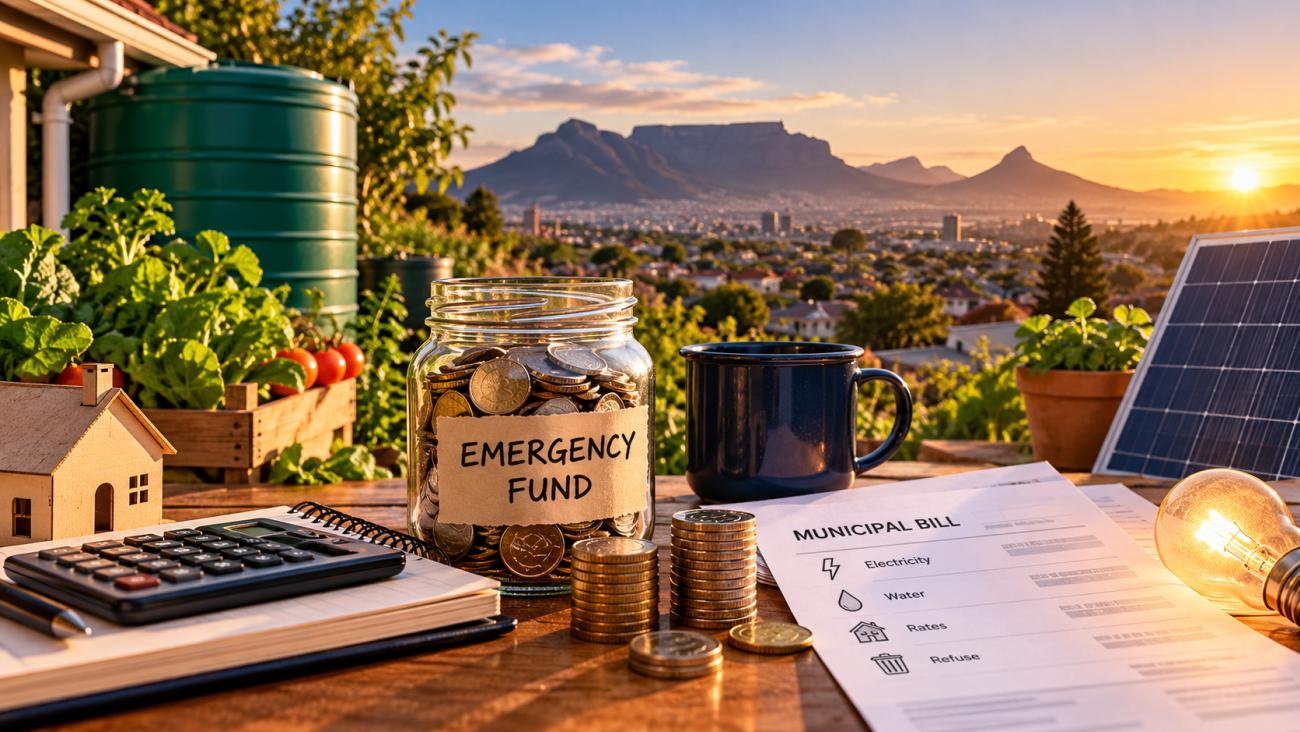
Most self-sufficiency projects start with something you can touch. A vegetable bed, a rainwater tank, a row of panels on the roof. Money resilience is less photogenic, but it is the layer that holds everything else up. A thriving garden does not help much if a burst geyser or a retrenchment letter pushes you onto a credit card to get through the month.
2026 has not been kind to household budgets. Electricity went up again in April and July, fuel prices climbed again in September, and the Reserve Bank has raised the repo rate twice this year, taking prime to 10.75%. Anyone with a bond, a car loan or a store account is paying more every month for the same debt.
This guide covers the money side of self-sufficiency: building a cash buffer that actually works, checking and shrinking the municipal bill, claiming relief that many households qualify for but never apply for, and adding a small income stream that fits a homestead lifestyle. It builds on our earlier piece on why mampara week won’t fix itself, which tackles the fixed costs that swallow a salary on payday.
An emergency fund is the unglamorous foundation of everything else. Without one, every surprise expense turns into debt, and debt is the opposite of self-sufficiency.
The standard guidance, which Sanlam’s 2026 emergency fund guide bases on FSCA consumer education material, is three months of essential expenses for a single person with a stable job, and six months for households with dependants, a single income, or irregular earnings from freelancing or informal trade. Essential means rent or bond, food, transport, school fees, utilities and insurance. Not streaming subscriptions, and not takeaways.
For many households that target feels out of reach, so break it into stages:
Revisit the number once a year. With inflation above 4% and electricity rising faster than that, a target calculated two years ago will no longer cover three real months.
The whole point of an emergency fund is that the money is there on a bad Tuesday. Safety and access matter more than returns. A separate savings account, notice deposit or money market account with a bank or registered provider does the job. Keep it apart from your everyday account so it does not quietly fund month-end. A practical split is a small instant-access portion for same-day emergencies and the rest in a 32-day notice account, which pays a little more and builds in a pause before you spend.
Tax-free savings accounts are useful, but they work better as a second layer. SARS confirms that the annual contribution limit rose to R46,000 from 1 March 2026, while the lifetime cap stayed at R500,000. Interest, dividends and growth inside the account are not taxed. The catch is that withdrawals cannot be topped back up without using more of your annual and lifetime allowance, and going over either limit costs a 40% penalty on the excess. Use a TFSA for longer-term money that sits behind the emergency fund, not as the fund itself.
The two-pot retirement system is the trap door many households have already fallen through. You can draw from the savings pot once per tax year, with a R2,000 minimum, but the withdrawal is added to your income for the year and taxed at your marginal rate. TaxTim’s worked example shows a R25,000 withdrawal shrinking to under R15,000 after tax at 31%, an administration fee and an outstanding SARS debt were deducted. SARS also will not approve the payout if your tax returns are behind. Treat the savings pot as a last resort that comes after your buffer and before expensive debt, never as a replacement for saving.
Most households pay the municipal account the way they pay a debit order, without reading it. That is a costly habit, because billing errors are common and the most frequent culprit is the estimated meter reading.
When a meter reader cannot get to your meter, the municipality bills you on a guess based on past usage. If the guess is too high, you are lending the city money. If it is too low, a catch-up bill arrives later, often at the worst possible time. Check every bill for whether the reading is marked as actual or estimated, then compare it with what your own meter shows.
The fix is usually straightforward. The City of Johannesburg’s guide to understanding your municipal bill tells residents to take a dated photo of the meter to a customer service centre or upload it on the e-Joburg portal, and confirms the account must be corrected once a real reading is taken. Cape Town, eThekwini, Ekurhuleni, Tshwane and smaller municipalities run similar processes through their own portals and walk-in centres. Wherever you live, the same principles apply:
Your water meter also doubles as a free leak detector. Close every tap, write down the reading and check it again an hour later. If the number moved, you are paying for water that is disappearing into the ground.
This is where negotiating with the municipality really happens. Tariffs are set once a year and are not up for haggling, but the support you may be entitled to has to be applied for, and most people never do.
Free Basic Electricity has existed since 2003, yet it remains badly under-used. According to Briefly News’ round-up of what the metros offer, the electricity minister estimated in August 2026 that roughly 10 million households could qualify, while only about two million are registered. Allocations vary by city. City Power in Johannesburg gives 50kWh a month to households earning under R7,800, eThekwini gives 65kWh to low-use households on its Scale 12 tariff, Cape Town gives between 25kWh and 60kWh depending on usage, and Tshwane offers 100kWh along with 12 kilolitres of water and a full rates rebate for qualifying households. Applications generally need your ID, meter or account number, proof of income or a SASSA letter, recent bank statements or an affidavit, and proof of residence.
If you buy power directly from Eskom rather than through a municipality, the same benefit applies in Eskom supply areas. Eskom told Parliament in 2025 that about 2.1 million households in its areas qualified but fewer than half a million were receiving it, so it is worth asking whether your household is registered.
Pensioners have an additional route through property rates. In Cape Town, owners aged 60 or older with a household income of up to R27,000 a month can qualify for a rates rebate on a sliding scale, and households under R7,500 can apply for full indigent support. The rebate is not automatic and must be renewed after each general valuation. The city’s latest notice on pensioner and indigent relief sets out the current deadlines, with new indigent applications open until 30 December 2026. Other metros and district municipalities run their own versions with different thresholds and forms, so phone your municipality or check its website before assuming you do not qualify.
Nersa approved an 8.76% increase for Eskom’s direct customers from 1 April 2026 and a 9.01% bulk increase for municipalities from 1 July. What you actually pay depends on where you live. EWN’s metro breakdown shows Buffalo City households facing about 14%, Ekurhuleni 12.7%, Nelson Mandela Bay just over 10%, eThekwini 9%, Tshwane 8.8%, Johannesburg 8.63% and Cape Town between 6.7% and 7.5%. Eskom direct customers already have a further 8.83% approved for April 2027.
In practical terms, an Ekurhuleni household that spent R1,500 a month on electricity last year is now paying roughly R190 more every month for exactly the same usage.
The cheapest wins have not changed: a geyser timer and blanket, LED lighting throughout, shifting cooking to gas, and keeping consumption inside the lower tariff blocks where your municipality uses stepped pricing. Bigger moves such as solar or rainwater tanks pay back well, but they need capital, which is exactly why the buffer comes first. When you are ready, our guides to the more affordable way to go solar and rainwater harvesting that actually pays back work through the numbers, and what it really costs to live in South Africa shows how those savings lower the income a household needs.
Cutting costs only goes so far. The other half of resilience is a second income stream, even a modest one, so that one retrenchment does not take the household to zero. The best side incomes for a self-sufficient home grow out of skills and assets you are already building.
Garden produce and seedlings. A productive bed regularly grows more spinach, herbs or chillies than one family can eat. Selling the surplus to neighbours, a workplace WhatsApp group or a Saturday market is the lowest-risk way to start, and trays of seedlings or cuttings of hardy plants add a good margin. If you plan to trade from a public space, read your municipality’s informal trading by-law first, because the rules differ from place to place and some cities are tightening up. In Tshwane, the first permits under a new informal trading by-law went to 77 traders in Olievenhoutbosch in August 2026, most of them selling fruit and vegetables, after each attended a free compliance workshop.
Preserved and value-added food. Pickles, chutneys, dried fruit, rusks and ferments sell for far more than raw produce. Our guide to preserving food in South African conditions covers the techniques. Selling food to the public brings hygiene and labelling rules into play, so start small, sell to people who know you, and check the requirements with your municipality’s environmental health office before you scale up.
Solar-adjacent services, done legally. Rooftop solar is everywhere and so is demand for help with it, but the legal line matters. Property Professional’s report on the updated compliance rules explains that solar work counts as electrical installation work, that adding panels, batteries or an inverter requires a fresh certificate of compliance, and that the certificate must come from an electrician registered with the Department of Employment and Labour. Anything that touches the wiring is off-limits unless you hold that registration. What stays open is panel cleaning, simple energy audits that show a household where its power goes, backup and load planning, or working as a trained assistant under a registered electrician. A new SAQA occupational qualification for standalone PV installers also creates a formal route for anyone who wants to turn it into a trade.
Skills you already have. Repairs, tutoring, sewing, baking, small engine maintenance, pet sitting and bookkeeping all trade well locally and need very little start-up money.
Side income is taxable, however small or informal it feels. Sanlam’s side hustle tax explainer notes that SARS counts freelance, contracting and small trading income as part of your total income, usually captured in the Local Business section of the ITR12 return. Legitimate expenses tied to earning that income can be deducted, provided you keep the receipts. If a meaningful share of what you earn is not taxed through PAYE, provisional tax may apply, so set some money aside as you go. For the 2026/27 tax year, people under 65 with total taxable income below R99,000 pay no income tax, but if you already earn a salary, side income stacks on top of it and is taxed at your marginal rate.
The habit that ties this whole guide together is simple: send side income straight into the emergency fund until it reaches its target. Money that never touches your spending account is far harder to spend.
Month one. Open a separate savings or notice account and set up a debit order, however small. Photograph your meters, read your last three municipal bills, and log a query on any estimate that looks wrong.
Month two. Check whether your household qualifies for free basic electricity, indigent support or a pensioner rebate, and apply for anything that fits. Fit a geyser timer if you do not already have one.
Month three. Test one side income idea with a single small batch: a tray of seedlings, a dozen jars of chutney, or a handful of panel-cleaning jobs. Record every rand in and out, and send the profit to the buffer.
Financial resilience is not built in one month, and it will not come from one big move. Like a garden, it grows from small, regular effort, and it pays off most when the season turns against you.
This article is general information, not personal financial or tax advice. For decisions about your own situation, speak to a registered financial adviser or tax practitioner.