Physical Address
304 North Cardinal St.
Dorchester Center, MA 02124
Physical Address
304 North Cardinal St.
Dorchester Center, MA 02124

There is a widespread belief in South Africa that growing your own food requires a house with a garden. That you need beds, soil, compost heaps, space for rows of mealies, and a bakkie to haul bags of potting mix from the nursery. That food production is something for people with property and weekends to spare.
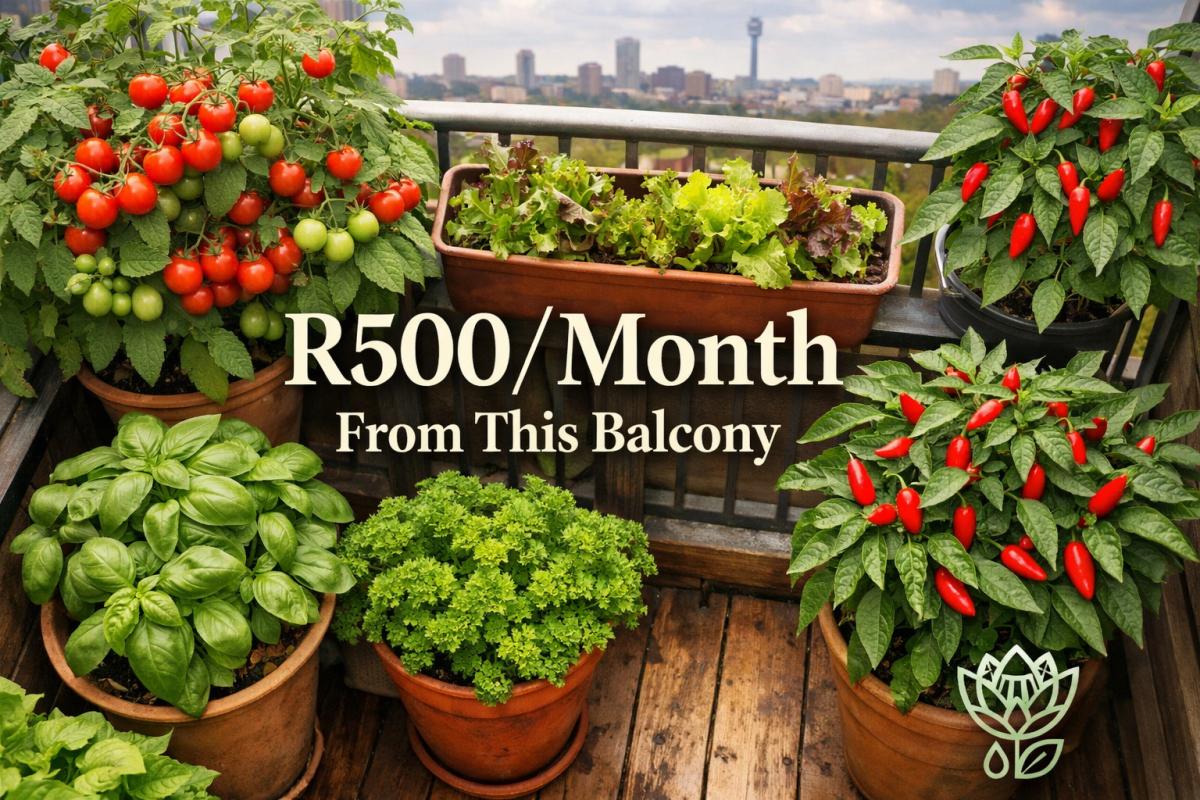
This is not true. You can grow a meaningful amount of food on a single apartment balcony in Johannesburg, and the numbers work out to roughly R500 worth of fresh produce every month once your plants are established. Not because balcony gardening is some kind of miracle, but because the most expensive items at the supermarket, fresh herbs, salad greens, tomatoes, chillies, and spring onions, are also the easiest and cheapest things to grow in containers.
The maths is simple. A small pack of fresh basil at Woolworths or Checkers costs R15 to R25. A single basil plant on your balcony, grown from a R5 seedling, produces the equivalent of two to three of those packs every week for months. Scale that logic across six to eight container plants and you are replacing a significant chunk of your monthly fresh produce spend with food that is fresher, chemical-free, and costs almost nothing after the initial setup.
Here is exactly how to do it on a Joburg balcony with a realistic budget and the Highveld climate in mind.
Johannesburg sits at roughly 1,750 metres above sea level. This gives it warm summers with afternoon thunderstorms, cold dry winters with frequent frost, and intense UV radiation year round. These conditions are actually excellent for growing food in containers because the Highveld gets abundant sunshine, the summer rainfall keeps things moist, and the dry winters mean fewer fungal problems than coastal areas.
The first thing to figure out is your balcony’s sun exposure. Most vegetables and herbs need at least five to six hours of direct sunlight per day. North-facing balconies in Joburg get the most sun and are ideal. East-facing balconies get good morning light and are also suitable. West-facing balconies receive hot afternoon sun, which can scorch tender plants in summer but works well in winter. South-facing balconies are the most challenging because they get limited direct sun, though you can still grow shade-tolerant greens like lettuce, rocket, and mint.
Wind is the other factor. Joburg apartments, particularly on upper floors, can get strong winds that dry out containers fast and damage plants. If your balcony is exposed, position your containers against the building wall where they get some protection, and consider a simple wind barrier using shade cloth or a repurposed pallet leaned against the railing.
The key to making R500 per month work is growing what costs the most at the shop relative to how easy it is to produce at home. This is not about growing potatoes or butternut, which take huge containers and produce a few rands’ worth of food. This is about growing the high-value items that drain your grocery budget week after week.
Fresh herbs are the single biggest money saver. A potted basil plant produces leaves worth R15 to R25 per week at retail prices. Flat-leaf parsley produces for months before it bolts. Coriander (dhania) is fast-growing and can be succession-sown every three weeks for a continuous supply. Rosemary and thyme are perennials that survive Joburg winters and produce year after year. Mint is almost impossible to kill and spreads aggressively, which is why it should always be kept in its own pot. Chives come back every spring without replanting. A collection of six herb pots on your balcony replaces R80 to R120 worth of supermarket herbs every month, month after month.
Salad greens and leafy vegetables are next. Loose-leaf lettuce varieties grow quickly in containers and can be harvested by picking outer leaves, allowing the plant to keep producing for weeks. A single window box of mixed salad greens yields the equivalent of two or three R25 supermarket bags per month. Swiss chard and perpetual spinach are outstanding in pots on the Highveld because they handle both the summer heat and the winter cold. Rocket grows fast and self-seeds if you let a few plants flower. These greens replace R60 to R100 of your monthly shop.
Tomatoes are the star performer for Joburg balconies. Cherry tomato varieties and compact bush types like Tumbling Tom or Roma VF produce prolifically in large containers (at least 30 cm diameter). A single healthy cherry tomato plant can produce 2 to 4 kg of fruit over a season. At R40 to R60 per kilogram retail, that is R80 to R240 from one pot. Two or three tomato plants on a sunny balcony easily replace R100 to R200 worth of tomatoes over summer.
Chillies and peppers are high-value, compact, and perfectly suited to containers. A single chilli plant produces dozens of chillies over a season, worth R30 to R60 at retail. They love the Highveld sun and handle the dry winters surprisingly well if brought close to the building wall. Bird’s eye chilli, jalapeno, and sweet mini peppers all do exceptionally in pots.
Spring onions are one of the easiest vegetables to grow in a small space. Plant them in a window box or small pot, harvest by cutting above the root, and they regrow. A single planting gives you multiple harvests. They replace R10 to R15 per bunch at the supermarket, and you will always have them on hand.
Adding it up conservatively: herbs (R100), salad greens (R80), tomatoes (R150), chillies and peppers (R60), spring onions (R40), plus occasional bonuses from anything else you trial. That is R430 to R530 per month during peak growing season, and R200 to R300 even in winter when your perennial herbs and cold-tolerant greens keep producing.
Here is a realistic once-off budget to get started. This is not the cheapest possible approach, but it is practical, durable, and will produce food for years.
Containers: You do not need fancy pots. Five-litre paint buckets (free from any building site or hardware store, just drill drainage holes in the bottom), recycled 20-litre cooking oil containers cut in half, or polystyrene fruit boxes from your local greengrocer all work perfectly. If you want to buy proper pots, a set of six to eight plastic containers in various sizes costs R150 to R300 from a nursery or Builders Warehouse. Use the largest containers you can fit for tomatoes and peppers (minimum 30 cm diameter and 30 cm deep).
Growing medium: Never use soil dug from a garden. For containers, you need a proper potting mix that drains well and holds nutrients. A 30-litre bag of quality potting mix costs R50 to R80. You will need two to three bags to fill your initial setup. Adding perlite or vermiculite (R40 to R60 per bag) improves drainage and moisture retention. Total: R150 to R250.
Seedlings or seeds: Buy seedlings for your first round because they save you two to three weeks and reduce failure risk. A punnet of six vegetable seedlings costs R15 to R30 at most nurseries. Herb seedlings cost R15 to R35 each. Seed packets cost R10 to R25 and give you hundreds of seeds for succession planting. Budget R100 to R200 for your first batch of plants.
Fertiliser: Container plants need regular feeding because nutrients wash out with every watering. A bottle of liquid seaweed fertiliser (R60 to R90) or a bag of slow-release granular fertiliser (R50 to R80) will last months. Worm tea or compost tea are even cheaper if you can source them locally.
Total once-off setup cost: R400 to R750. This pays for itself within the first one to two months of harvesting. After that, your only ongoing costs are occasional fertiliser top-ups and new seed packets, which amounts to R30 to R50 per month at most.
The Highveld climate splits neatly into a warm, wet growing season (October to March) and a cool, dry season (April to September). Your planting schedule should follow this rhythm.
August to September (late winter, pre-spring): Start your herb pots. Plant rosemary, thyme, parsley, and chives. These handle the last of the cold and will be established by the time spring warmth arrives. Sow lettuce and rocket seeds directly into window boxes. Start your first coriander sowing.
October to November (spring into summer): Plant tomato and pepper seedlings into their large containers. This is the most important planting window for Joburg because it gives warm-season crops the longest possible growing period. Add basil (it is frost-tender, so wait until frost risk is past). Plant spring onions.
December to February (peak summer): Harvest heavily. Succession-sow lettuce, rocket, and coriander every three weeks to maintain supply as older plants bolt in the heat. Keep tomatoes and chillies well watered, especially during hot spells. Feed all containers every two weeks with liquid fertiliser.
March to April (autumn): Plant Swiss chard and perpetual spinach, which will carry you through winter. Sow another round of lettuce and rocket. Your chilli plants will keep producing well into autumn.
May to July (winter): Harvest from your cold-tolerant greens: Swiss chard, spinach, rocket, lettuce. Perennial herbs like rosemary, thyme, and chives continue producing. Move frost-tender pots like basil and chillies against the building wall and cover with frost cloth on cold nights, or accept they will die back and replant in spring.
Balcony space is limited, so every square centimetre counts. Here are the techniques that make the biggest difference.
Go vertical. A simple tiered shelf or a set of wall-mounted pot holders doubles or triples your growing area without taking up floor space. A wooden pallet leaned against a wall with pots wedged into the slats creates an instant vertical garden. Hanging baskets are perfect for trailing cherry tomatoes and strawberries.
Stack your planting. In a large container, plant a tall tomato or pepper in the centre and surround it with low-growing herbs like thyme, chives, or lettuce around the edges. The tall plant gets its sun, the smaller plants benefit from partial shade during the hottest part of the day, and you get multiple crops from a single pot.
Use every surface. Railings can hold railing planters or repurposed guttering for shallow-rooted crops like lettuce, radishes, and herbs. Window ledges hold small herb pots. Even the floor beneath a raised shelf can hold shade-tolerant mint or parsley.
Succession sow. Do not plant all your lettuce or coriander at once. Sow a small batch every two to three weeks so that as one batch is harvested, the next is coming up. This gives you a continuous supply instead of a feast-or-famine cycle.
Container plants dry out faster than garden plants because there is less soil volume to hold moisture. On a hot Joburg summer day, you may need to water daily. In winter, every two to three days is usually sufficient.
Water in the morning rather than the evening to reduce fungal problems. Water thoroughly until it runs out the drainage holes, then let the container drain. Do not leave pots sitting in saucers of standing water as this causes root rot.
Self-watering containers are worth the investment if your budget allows. They have a built-in reservoir that wicks moisture up to the roots, reducing watering frequency to every two or three days even in summer. You can also DIY a self-watering system using a two-litre plastic bottle with holes poked in the cap, inverted into the soil. The Gardening in South Africa resource on container vegetables recommends adding water-retaining crystals or coco coir to your potting mix to reduce drying out.
Feed container plants with a liquid fertiliser (seaweed extract or fish emulsion work well) every two weeks during the growing season. Slow-release granular fertiliser mixed into the potting soil at planting time provides a baseline that reduces the need for frequent liquid feeding. SA Garden and Home’s guide to container vegetables recommends a combination of compost, loam, and vermiculite for the best results in pots.
Growing R500 worth of food on a Joburg balcony is not going to make you fully self-sufficient. It is not going to replace your monthly grocery shop entirely. But that is not the point.
The point is that R500 per month adds up to R6,000 per year in food you did not have to buy. That is the equivalent of two to three months of Eskom payments for a small flat. It is a meaningful amount of money for any household, and it comes from a space that was previously doing nothing.
More importantly, it changes how you think about food. When you grow your own tomatoes, you taste the difference. When you pick fresh basil for a pasta sauce, you notice how much better it is than the wilted pack from the supermarket. When you watch a chilli plant produce 50 chillies from a single pot, you start to understand that the grocery system is not the only way to eat.
For South Africans living in apartments and complexes, balcony food growing is the entry point to a much larger self-sufficiency journey. Once you have grown your first crop in a pot, you start seeing possibilities everywhere. A communal garden in the complex. A herb-growing side hustle selling to neighbours. A deeper interest in foraging, preserving, and reducing your dependence on systems that are getting more expensive every month.
Start with one pot. One herb plant. One tomato seedling. See what happens. You might discover that the most productive piece of land you own is a concrete slab three floors up with a view of Sandton.