Physical Address
304 North Cardinal St.
Dorchester Center, MA 02124
Physical Address
304 North Cardinal St.
Dorchester Center, MA 02124

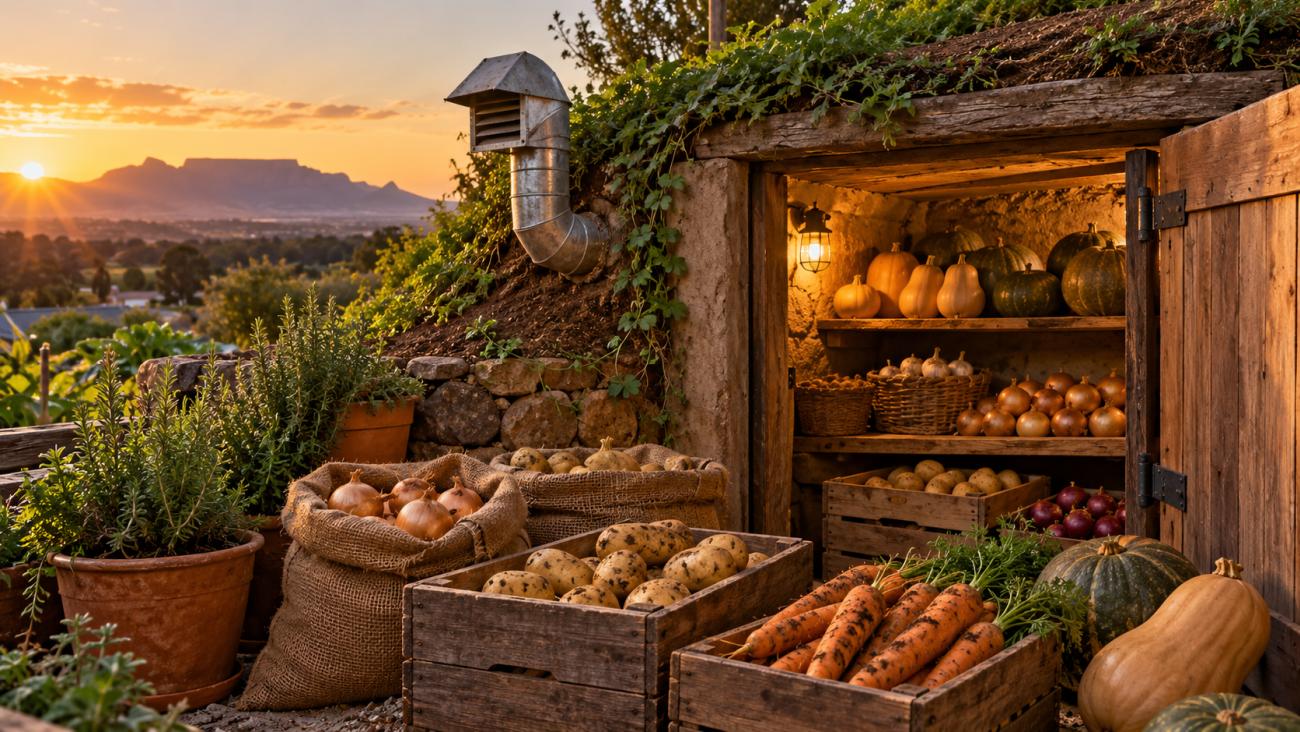
Every root cellar guide you will find online starts with the same number: keep your vegetables between 0°C and 4°C. The University of Alaska Fairbanks Cooperative Extension guide to root cellar storage gives exactly that range as the optimum for most stored crops, and in Alaska the ground itself does the work because the soil stays cold all year.
South Africa is not Alaska. Before you dig a hole in the back garden and fill it with potatoes, it helps to understand why the classic underground cellar does not behave the same way here, and what actually works instead. The good news is that a South African household can still keep a winter’s worth of vegetables in good condition for months without a fridge. It just takes a different toolkit: night air, damp sand, the right crops, and the soil you grew them in.
A few metres down, the soil settles at roughly the average air temperature of the whole year. Daily swings disappear within the first metre, and even seasonal swings fade the deeper you go, which is the same principle that ground source heat pumps rely on. In cold countries that annual average sits in single digits, so a buried cellar is naturally chilly.
Here the annual average is much higher. Looking at the long-term figures on the climate of South Africa, Johannesburg averages a July maximum of about 17°C and a minimum of about 4°C, Pretoria runs a degree or so warmer, Cape Town’s July nights average around 7°C, and Durban’s sit near 11°C. Averaged across a full year, the soil under most South African homes settles somewhere in the mid to high teens, and higher still in the Lowveld and along the KwaZulu-Natal coast.
That means an underground cellar here will keep your vegetables dark, humid and protected from summer heat spikes, which is useful, but it will not hold them at fridge temperature. Anyone promising 0°C to 4°C for months without electricity in Gauteng, Durban or Cape Town is selling a Northern Hemisphere idea that does not survive our climate.
The real cold resource in much of South Africa is not the ground. It is the winter night sky. On the Highveld, the Free State, the Northern Cape interior and inland Eastern Cape, clear winter nights regularly drop close to freezing. Bloemfontein’s July minimum averages below zero, and Kimberley, Upington, Polokwane and Pietermaritzburg all sit in the 3°C to 4°C range.
A well-insulated storage space that is flushed with that cold air overnight and sealed during the day can hold around 6°C to 10°C through June, July and August in the interior. That is not textbook cellar temperature, but it is excellent for potatoes, perfectly good for several weeks to a couple of months of root vegetables in damp sand, and ideal for crops that dislike real cold, such as sweet potatoes and pumpkins.
At the coast, night venting will get you closer to 12°C to 15°C. That still counts for a lot, because the crops that store best in warm regions (butternut, boer pumpkin, sweet potato, cured onions and garlic) actually prefer those temperatures.
Very few South African houses have basements, so work with what you have. The rules are simple: keep it dark, keep it away from the sun, and keep it away from heat sources.
The south side of the house. In the Southern Hemisphere, the south-facing wall gets the least direct sun. A cupboard, lean-to or enclosed corner on that side is your first choice.
Under the stairs. An under-stairs cupboard works if it backs onto an outside wall, ideally a south or east one, and is nowhere near the geyser, the stove, or the back of a fridge.
A shaded stoep or verandah. A sturdy insulated box or cupboard on a covered, south-facing stoep takes full advantage of cold night air. A dead chest freezer makes a surprisingly good ready-made insulated box for this, as long as you prop the lid open at night and wipe out condensation.
A buried drum or clamp. For warm regions and for summer storage, a food-grade 210-litre plastic drum laid on its side in a shaded spot, with a well-drained bed underneath and 50cm or more of soil mounded over the top, gives you dark, stable, humid storage. The traditional clamp, a mound of straw and soil over a pile of potatoes or roots, does the same job. The SDSU Extension guide to vegetable storage life lists outdoor banks, pits and mounds alongside cellars as workable storage spaces.
This is the heart of a South African cold store, and it costs nothing to run.
Fit two vents covered with fine mesh to keep out rats and insects: one low down to let cold air in, and one high up to let warm air out. Cold air sinks and pushes the warmer air out the top. Open both vents in the evening once the outside air is colder than the inside, which on the Highveld usually means from about 9pm, and close them first thing in the morning before the sun warms things up.
Add thermal mass inside. Large bottles of water, bricks or old paving stones soak up the cold overnight and slowly release it during the day, flattening the temperature curve. Insulate any wall or roof that gets sun, using ceiling insulation or polystyrene sheeting, and keep the door well sealed.
Buy a cheap digital min/max thermometer with a humidity readout. Without it you are guessing, and a week of readings will tell you more about your space than any article can.
Winter on the Highveld is not only cold, it is very dry, and dry air pulls moisture out of stored vegetables until they turn limp and rubbery. Extension guidance, including the University of Maine storage conditions bulletin, puts the humidity target for most fresh produce between about 80% and 95%, and notes that poor storage can cost growers anywhere from a tenth to four tenths of their harvest.
The simplest fix is to bury root vegetables in damp sand:
Coir or slightly damp sawdust works as a lighter alternative. For cabbages, the same SDSU guide suggests lifting the whole plant and standing the roots in moist sand, which keeps the head fresher than cutting it.
Other ways to raise humidity are a brick or earth floor that you sprinkle with water, or wet hessian draped over crates. That wet hessian also cools through evaporation in dry winter air, which is the same principle a zeer pot uses. Keep one part of your store dry, though, because onions, garlic and pumpkins rot in damp conditions.
Potatoes are the one crop where colder is not better. Below roughly 7°C, stored potatoes slowly convert starch to sugar, which makes them taste oddly sweet and brown too quickly when fried. A storage trial published in Potato Research comparing storage conditions found that tubers held at room temperature for three months sprouted almost completely and lost far more weight, while those kept at 7°C held their physical quality best but built up the most sugar. If your potatoes do turn sweet, a week or two at kitchen temperature reverses much of it.
Cure potatoes before storing them by leaving them unwashed in a dark, airy spot for about ten days to two weeks so the skins toughen and small nicks heal. Store in complete darkness, since light turns them green, and keep them away from apples, bananas and other ripening fruit. Ripening fruit gives off ethylene gas, and the University of Missouri Extension root cellar guide notes that potatoes stored near fruit are especially quick to sprout.
Long storage starts in the garden. Late-maturing crops harvested fully ripe keep far better than early ones, so time your sowing for the storage window your region actually has. The regional winter vegetable lists from The Gardener are a useful starting point for what grows where.
Interior (Highveld, Free State, Northern Cape, North West, inland Eastern Cape). Sow pumpkins, butternut and sweet potato slips in spring and early summer, from about September to November, for an autumn harvest that you cure and store through winter. Sow carrots, beetroot, turnips and parsnips from February to April so they mature just as it turns cold. A late-summer potato planting, where frost timing allows, gives you tubers harvested right as the cold store comes into its own.
Western Cape and southern coast. With mild, wet winters, root crops can be sown for much of the year, so storage matters less for roots and more for summer squash crops, onions and garlic. Wet winter soils can rot roots left in the ground, so raised beds help.
KwaZulu-Natal coast and subtropical areas. Storage here leans on warm-tolerant crops: sweet potatoes, hard-skinned pumpkins and well-cured onions. You can grow roots through the cool months, but keep expectations short for storing them.
There is also an option that needs no building at all. In frosty interior regions the soil does not freeze solid, so carrots, beetroot, turnips and parsnips can stay where they grew, under a thick layer of mulch, and be dug as needed through winter. The catch arrives in spring: as the weather warms in September, these crops start to go woody and bolt, so lift and use or sand-store whatever is left before then.
The table below compares textbook storage conditions with what a South African household can realistically expect from passive storage. The ideal figures follow published extension guidance, while the realistic figures assume a well-managed, night-cooled store in winter and a shaded, dark space in warmer regions. Use them as planning estimates, and let your own thermometer readings refine them.
| Vegetable | Ideal conditions | Interior winter, night-cooled store | Coast or warmer months |
|---|---|---|---|
| Potatoes (cured) | 7 to 10°C, very humid, dark | 2 to 4 months | 4 to 8 weeks |
| Carrots | 0 to 2°C, very humid | 6 to 10 weeks in damp sand | 2 to 4 weeks |
| Beetroot | 0 to 2°C, very humid | 2 to 3 months in damp sand | 3 to 4 weeks |
| Turnips | 0 to 2°C, very humid | 6 to 8 weeks in damp sand | 2 to 3 weeks |
| Parsnips | 0 to 2°C, very humid | In the ground until spring | 2 to 4 weeks |
| Cabbage (roots in sand) | 0 to 2°C, very humid | 4 to 8 weeks | 2 to 3 weeks |
| Onions (pungent, cured) | Cool or warm, dry | 3 to 5 months | 2 to 4 months |
| Onions (sweet, such as Texas Grano) | Cool or warm, dry | 4 to 8 weeks | 3 to 6 weeks |
| Garlic (cured) | Cool or room temperature, dry | 4 to 6 months | 3 to 5 months |
| Butternut (cured) | 10 to 15°C, dry | 2 to 3 months | 2 to 3 months |
| Boer pumpkin (cured) | 10 to 15°C, dry | 3 to 6 months | 3 to 6 months |
| Sweet potatoes (cured) | 13 to 15°C, humid, never below 10°C | 2 to 4 months | 2 to 5 months |
A few notes on the table. Sweet potatoes suffer chilling damage in cold storage, so keep them in the warmest part of an interior store or in the house itself. Onions sprout most readily at mild in-between temperatures, so they last longest either properly cold or warm and dry. Pumpkins and butternut benefit from a week or two of warm curing in the sun after harvest, with a short stub of stem left on.
You do not need to convert half the house into a cellar to get started. Pick one spot on the south side, add two vents, a few bottles of water and a thermometer, and run it through one winter with a crate of sand-packed carrots and a sack of cured potatoes. Record temperatures, count losses, and adjust.
Within a season you will know exactly what your space can do, which crops are worth growing for storage in your region, and how much of your winter food can come from your own garden rather than a supermarket fridge.