Physical Address
304 North Cardinal St.
Dorchester Center, MA 02124
Physical Address
304 North Cardinal St.
Dorchester Center, MA 02124

Most South Africans have been sold green upgrades badly. The pitch usually arrives wrapped in polar bears and carbon guilt, and it lands on a household that is already watching the municipal bill climb faster than the salary. If you have ever rolled your eyes at a solar quote, that reaction is reasonable. Plenty of eco spending in this country is expensive theatre.
But the arithmetic has shifted, and it has shifted specifically in South Africa, for reasons that have very little to do with the environment. Electricity and water are getting more expensive on a fixed schedule that the regulator publishes in advance. A house that uses less of both has a lower running cost, and a lower running cost is now something buyers put a number on.
Property professionals have started saying this out loud. In an IOL Property report on green living trends, Real Estate Services South Africa’s chief executive described energy and water efficiency as having moved from luxury add-on to buyer priority, and noted that homes with proper water management were selling meaningfully faster than comparable properties without it. That is the part that matters for anyone planning to sell. It is not only about price. It is about the offer arriving at all.
The timing matters too. News24 reported on why Gen Z cannot afford homes and cars the way Millennials could two decades ago, and the buyers coming into the market now are running the total monthly cost, not just the bond repayment. A house with a R2,800 utility bill and a house with a R900 utility bill are not the same house to that buyer, even at the same asking price.
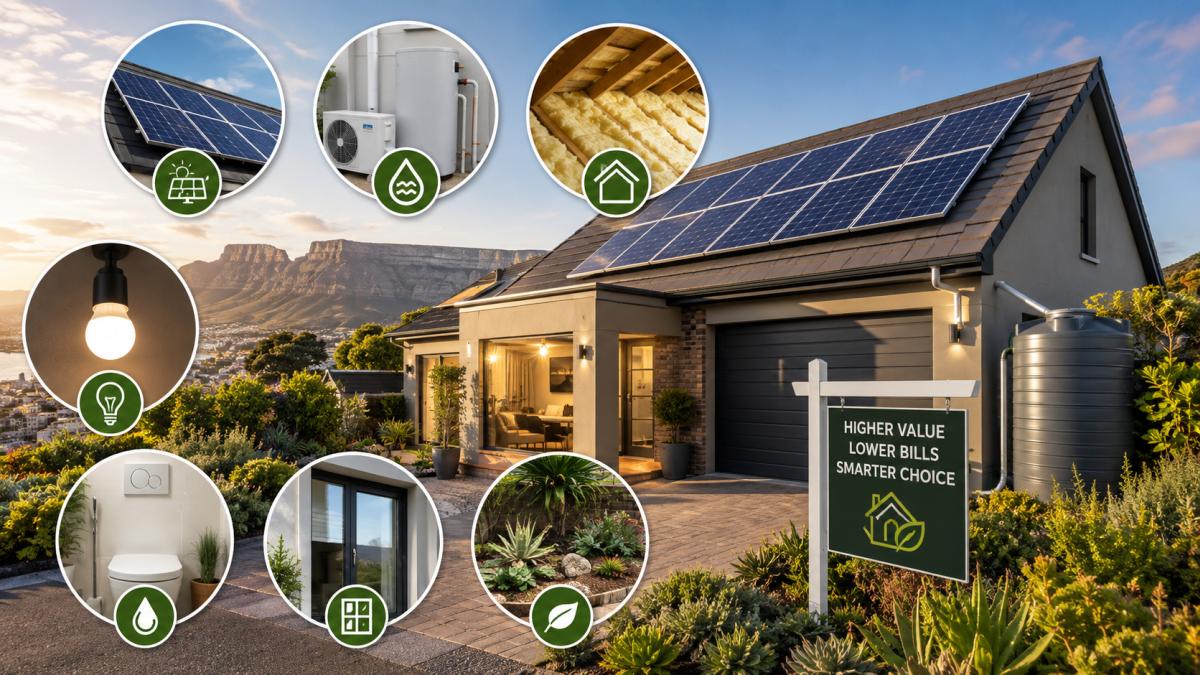
Here are seven swaps ranked by how well the money actually comes back.
Eskom has made the case better than any installer could. NERSA approved an average 8.76% increase for Eskom direct customers from 1 April 2026, with municipal bulk purchasers implementing around 9.01% from 1 July. The regulator’s decision covered both customer categories and follows a court-ordered redetermination of Eskom’s asset base, which means further increases are already locked into the schedule rather than being a matter of speculation.
Against that, a 5kW system, the most common residential size, runs roughly R75,000 to R110,000 fully installed with a battery, and around R75,000 to R100,000 without one. Payback across most installer quotes lands in the four to seven year band for a household currently spending R1,500 to R2,500 a month on electricity. Every tariff increase shortens that window without you touching the system.
Two things separate a solar installation that adds value from one that adds a liability at sale. The first is a valid electrical Certificate of Compliance. Without it your conveyancer will stall, and a nervous buyer will discount. The second is registration: Eskom requires small embedded generation to be registered through its Small Scale Embedded Generators process, and most metros have an equivalent requirement. An unregistered system is a negotiating weapon in the buyer’s hands.
On tax, be realistic. The 25% personal rebate capped at R15,000 applied only to panels brought into use between 1 March 2023 and 29 February 2024, and SARS has kept the guidance up as a historical record rather than an active incentive. It excluded inverters and batteries even then. Budget as though there is no rebate, because for a new installation there is not.
This is the swap most households should do before solar, and almost nobody does.
Water heating accounts for somewhere between 30% and 40% of a typical South African home’s electricity consumption. It is the single largest line item on the bill, and it runs whether the sun is out or not. A heat pump moves heat instead of generating it, and cuts that portion by roughly 60% to 75%.
The numbers: a heat pump costs about R25,000 to R45,000 installed against R8,000 to R15,000 for a replacement element geyser. The gap is R20,000 to R30,000. Monthly saving on a four person household is commonly R600 to R900. That recovers the difference in three to five years, and the unit lasts ten to fifteen.
If the capital is not there, the City of Cape Town’s electricity saving guidance points at the cheap version. Drop the thermostat from 70°C to 60°C for roughly a 5% cut in hot water costs, and do not go below 55°C for health reasons. Wrap the tank in a geyser blanket at R200 to R400 and lag the pipes at under R100 a metre, which the city puts at R500 or more a year in avoided heat loss. Add a timer, from around R900 plus the electrician, set to skip the morning and evening peaks. The whole package lands under R2,500 and starts paying back inside the first year. A solar geyser sits between that and a heat pump at roughly R15,000 to R35,000 installed.
Water is the upgrade where the value argument is strongest and the payback argument is weakest. Be honest with yourself about which one you are buying.
A basic setup, meaning a 2,500 litre tank, a first flush diverter and a garden tap, costs around R18,000 to R25,000 installed. A proper Gauteng system sized for a three or four bedroom house, at 5,000 to 10,000 litres with plumbing integration, runs R35,000 to R55,000, plus R1,500 to R3,000 a year in maintenance. Payback on water tariffs alone is typically four to seven years, and slower than that if your household is frugal already.
What you are really buying is resilience. Toilet flushing, laundry and garden irrigation account for roughly half to sixty percent of household consumption, and all three can run on rainwater without any treatment. When restrictions land, or when the reservoir in your area drops, that is the difference between inconvenience and a genuine problem.
Two rules. Anything plumbed into the house must comply with SANS 10252-2, which requires proper backflow prevention between the rainwater supply and the municipal mains, and the work needs a registered plumber issuing a compliance certificate. Cross-contaminating the municipal supply is a serious matter, not a technicality. And rainwater is not drinking water without UV and carbon filtration, so do not let an installer imply otherwise.
Gardens consume somewhere between 30% and 50% of all domestic water in South Africa. A conventional lawn and a bed of imported ornamentals is the most expensive thing on most properties that nobody counts as an expense.
Indigenous planting is not a compromise here. Spekboom, aloes, wild garlic, agapanthus, dietes, clivia and indigenous grasses handle Highveld and Cape conditions because they evolved in them. SANBI’s Waterwise Garden demonstrates the principle that does most of the work: hydrozoning, meaning you group plants by water requirement and irrigate each zone separately instead of watering everything to suit the thirstiest thing in the bed.
The saving is ongoing and immediate. Less irrigation, less fertiliser, fewer replacements, and less of your Saturday. Replace shaded lawn with gravel, mulch or indigenous groundcover, because lawn struggles there anyway. Mulch the beds properly, and skip grass cuttings in favour of bark or compost.
For resale this reads as a low maintenance garden, which is what most buyers actually want when they say they want a nice garden. The one caution: a garden mid-transition looks neglected. Do it eighteen months before you list, or do it properly in one go.
The cheapest real saving in the house, and the one people skip because it feels too small to bother with.
Run the sum yourself. Twenty halogen downlights at 60W burning four hours a day is about 144 kWh a month. The LED equivalents at 8W each use around 19 kWh. At roughly R3.00 to R3.50 a unit on most residential tariffs, that is close to R400 a month. A partial retrofit of ten fittings running three hours a day still gets you to about R150. That is the R150 to R400 band, and it costs under R2,000 to capture.
Appliances are slower but real. Eskom’s energy saving guidance covers the behavioural side, and the IOL report noted that induction cooking uses substantially less energy than gas, while cold-wash cycles now clean as effectively as warm ones on modern machines. Do not replace a working appliance to chase efficiency. Replace it with the efficient version when it dies, which is where the actual decision gets made.
Unglamorous, invisible to buyers, and one of the best rands-per-degree investments available in a country where most homes were built with almost no thermal envelope.
Roughly 40% of a home’s heat loss goes through the roof. Proper ceiling insulation slows that transfer enough to make a house several degrees cooler in summer and warmer in winter, and the City of Cape Town puts the annual saving at up to 16% of the electricity used for heating and cooling. In a Highveld house with electric heaters running through June and July, that shows up on the bill within one season. Combine it with draught sealing on doors and windows, and heavy curtains, and you reduce the demand before you spend anything on generating supply. This is the step that makes every other upgrade on this list smaller and cheaper, which is why it belongs before solar in the sequence and almost never appears there in practice.
Here is where I part company with most articles on this subject.
Formal green certification is real and it works, but it is aimed at a different building than yours. The Green Building Council South Africa’s rating tools cover Green Star as the local flagship, Net Zero, and EDGE, which is the residential system and the one the IOL report highlighted for requiring at least 20% savings in energy, water and embodied materials. EDGE is certified at design and construction stage, for developments, through GBCSA. LEED is an American system with essentially no relevance to a suburban South African resale. Neither is available to you retrofitting a thirty year old house in Centurion, and any number you see quoted for the resale premium a certification adds to an existing single family home should be treated as marketing until someone shows you the South African transaction data behind it. The strongest local evidence, from the MSCI index GBCSA cites, is about commercial offices.
What does move a residential sale is documentation. Assemble a folder before you list: twelve months of utility bills showing the actual consumption, the electrical CoC, the solar registration confirmation, the plumbing compliance certificate for the tank, installation invoices, and every warranty. That folder converts a vague claim about a green home into a verifiable running cost the buyer can put into their affordability calculation. It costs nothing and it is the thing agents wish more sellers had.
Geyser blanket, pipe lagging, geyser timer, LED retrofit, draught sealing. Under R5,000 total, and it will take R800 to R1,500 a month off the bill in most houses. Do that first, measure the result for three months, then decide whether the heat pump or the solar quote makes sense against your actual consumption rather than an installer’s assumed household.
The order matters more than the enthusiasm. Reduce the demand, then replace the biggest single load, then generate. Anyone selling you a solar system before asking what your geyser costs to run is selling you a system, not a saving.