Physical Address
304 North Cardinal St.
Dorchester Center, MA 02124
Physical Address
304 North Cardinal St.
Dorchester Center, MA 02124

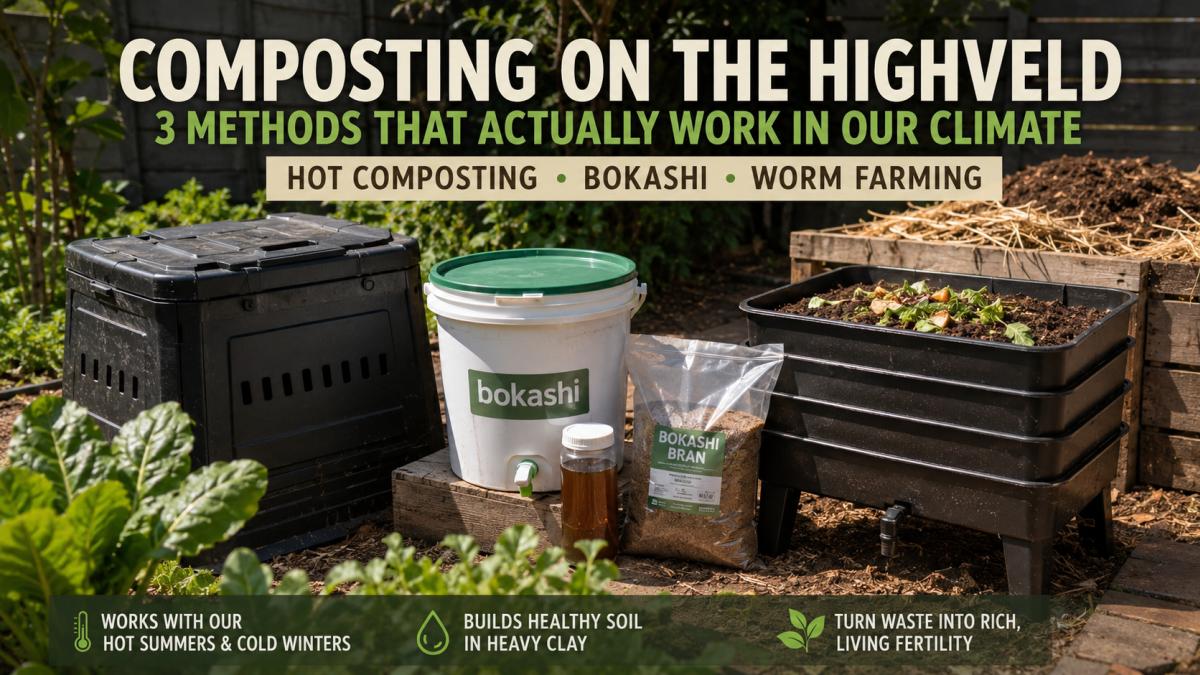
Every South African gardener who has tried to make compost knows the frustration. You build a tidy heap in spring, full of good intentions, and by midsummer it has either baked into a dry brown brick or collapsed into a sour, fly-ridden mess. The Highveld punishes half-measures. Our summers bring fierce afternoon heat and violent thunderstorms, while winter nights routinely drop below freezing across Gauteng, the Free State, and Mpumalanga. Add load-shedding, water restrictions, and our notoriously heavy clay soils, and it becomes clear that composting advice written for the mild English garden simply does not apply here.
The good news is that turning kitchen and garden waste into rich, living fertility is entirely achievable on the Highveld. You just need to match your method to your conditions. There is no single best way to compost. There are three proven approaches, each with its own strengths, and the smart self-sufficient household often runs more than one at the same time. This guide compares hot composting, bokashi fermentation, and worm farming, with the practical adjustments that make each one work in our demanding inland climate.
Before choosing a method, it helps to understand what we are actually fighting. The Highveld sits at high elevation, which gives us our crisp sunny days and bitterly cold nights. Winter temperatures regularly reach the freezing point at altitude, while summer days climb well into the thirties. This swing matters enormously because decomposition is driven by microorganisms, and those organisms are temperature sensitive.
The bacteria that break down organic matter are most productive between roughly 15 and 65 degrees Celsius. Below that range they slow dramatically, and below freezing they pause almost entirely, though they do not die and will resume once the soil warms. This means a compost heap left exposed through a Highveld winter effectively stops working for two or three months, then has to restart from cold in spring. Meanwhile our soils present their own problem. Inland clay compacts easily and drains poorly, eroding under summer storms, which is exactly why the finished compost is so valuable for opening up that heavy ground. The challenge is producing it efficiently despite the climate working against you.
Hot composting is the powerhouse method. When done correctly it produces finished compost in around four to six weeks rather than the six to eighteen months a passive heap takes. The principle is straightforward. You build a large pile with a careful balance of materials, and the sheer volume of microbial activity generates internal heat. A properly constructed heap will reach its core temperature of 55 to 70 degrees Celsius through that microbial activity alone, and this heat is what kills weed seeds and pathogens, leaving you with clean, safe compost.
The non-negotiable requirement is size. A hot heap needs to be at least one metre wide, one metre deep, and one metre tall to retain enough heat at its core. Anything smaller simply will not reach temperature. You layer carbon-rich browns such as dry leaves, shredded cardboard, straw, and small twigs against nitrogen-rich greens like vegetable peels, fresh grass clippings, and coffee grounds, aiming for roughly two parts brown to one part green. Keep the whole pile as moist as a wrung-out sponge, no wetter, and turn it every few days to reintroduce oxygen and even out the temperature.
This method shines in the Gauteng summer when garden waste is abundant and warmth helps the process along. Materials are everywhere after a season of growth, and the ambient heat means your pile reaches working temperature quickly. The catch is winter. On the Highveld a hot heap loses its battle against freezing nights unless you protect it. Build the pile larger going into the cold months, at least one and a half to two metres across, because a bigger mass insulates its own heat far better than a small one. Cover it with a thick layer of cardboard, straw, old hessian, or a heavy tarpaulin to trap the warmth generated inside, and position it to catch the morning winter sun so it warms early in the day. A guide to building and managing a hot compost heap through the seasons is worth keeping handy as the temperatures drop.
Hot composting suits the household with a decent-sized garden, a steady supply of both greens and browns, and the time to turn a heap regularly. It is labour intensive, but nothing else produces so much finished compost so fast.
Bokashi solves a problem the other two methods cannot. It handles all your kitchen waste, including the things traditional composting refuses, namely meat, dairy, bones, and cooked food with fats and oils. It does this through fermentation rather than rotting. The word comes from a Japanese practice, and the process relies on lactobacillus bacteria that predigest the waste in an airtight container, eliminating odour and cutting composting time dramatically.
The method is genuinely simple. You layer food scraps into a sealed bucket, sprinkling each layer with inoculated bokashi bran, then press it down and close the lid tightly. Over about two weeks the contents ferment into what is best described as pickled food waste rather than soil. You will see white mould appear, which is the sign that the beneficial microbes are doing their work, and the bucket produces a leachate or “tea” that you drain off, dilute heavily at around 1 part to 300 parts water, and use as a potent liquid fertiliser. Several South African suppliers stock bokashi bran and buckets locally, which makes getting started easy.
Here is the part newcomers often miss. Bokashi does not produce finished compost on its own. The fermented material is a pre-compost that still needs to be buried to complete its transformation. Dig a trench about a spade deep, place the fermented waste in, mix it with a couple of shovels of garden soil, and cover it with at least 15 centimetres of soil. Because the material is acidic, give it two weeks in the ground to neutralise before planting roots into that spot. Within a month it becomes barely recognisable, and burying it about 15 centimetres deep also attracts earthworms that improve the soil further. If you have a dog like my beagle Ned who treats freshly dug soil as an invitation, cover the trench with chicken wire for a few weeks.
Bokashi is the ideal method for flat dwellers, anyone short on outdoor space, and households that generate a lot of cooked-food waste. It works indoors, controls odour, and stockpiles your scraps so you compost on your own schedule rather than racing to add material before it putrefies. The fermented output also makes an excellent activator for a hot heap, which is where running two systems together starts to pay off.
A worm farm produces the most concentrated, microbially active soil food of the three methods. The worms convert organic waste into castings, often called vermicompost, alongside a liquid called vermileachate or “worm tea”, both of which are exceptional for plant growth. The workhorse species is the red wiggler, Eisenia fetida, a tough and adaptable worm that tolerates a temperature range between roughly 0 and 35 degrees and breeds prolifically, doubling its population every couple of months in good conditions. These worms are surface feeders that eat decomposing organic matter, and they can consume up to half their body weight in waste each day.
The temperature tolerance figure deserves a closer look, because it is the key to running a worm farm on the Highveld. While red wigglers survive a wide range, they grow and process waste best in a much narrower band of around 15 to 25 degrees. This is precisely where our climate becomes the enemy. A worm bin left in full summer sun will cook its inhabitants, and one left exposed on a frosty winter night will see them go dormant or die. The entire art of Highveld worm farming is buffering that temperature swing.
Keep your worm farm in deep shade through summer, ideally against a south-facing wall or under a tree where direct afternoon sun never reaches it. A worm farm built from a repurposed old bath or a large container with plenty of thermal mass holds a steadier temperature than a thin plastic bin. In winter, move smaller farms into a shed or garage, or insulate the bin heavily with hessian and a thick bedding layer the worms can burrow into. Chop food scraps small so they break down faster, feed in thin layers on top, and avoid overfeeding, which causes the bin to heat up and turn sour. Several established South African worm farm suppliers provide both the worms and ready-built systems, and they can advise on local conditions.
Worm farming suits the patient gardener who wants premium quality over quantity and has a shaded, temperature-stable spot to keep the bin. It produces less volume than hot composting but a far richer product, and because vermicompost is so concentrated you only need to apply it sparingly.
For most Highveld households the honest answer is not to choose at all. The three methods complement each other beautifully. Bokashi handles the kitchen waste that hot heaps and worms cannot take, then its fermented output feeds either of the other two. Hot composting chews through the bulk of your garden waste in the warm months when material is abundant. Worm farming ticks along year-round in its shaded corner, producing small amounts of the highest-quality castings for seedlings and special plantings.
A practical setup for a typical Centurion or Johannesburg garden might run a bokashi bucket in the kitchen for daily scraps, a hot heap that fires up through spring and summer, and a worm bin tucked into permanent shade for steady premium compost. The bokashi pre-compost gets buried directly into beds or added to the hot heap as an activator, and everything ultimately feeds back into improving that stubborn Highveld clay.
Whichever route you take, the principle behind all three is the same one that underpins genuine self-sufficiency. Waste is only waste when you throw it away. Composting closes the loop in your own backyard, cutting what goes to landfill, reducing your reliance on bought fertiliser, and steadily building the living soil that every other part of a productive garden depends on. Start with one method that fits your space and your waste stream, get comfortable with it, and add the others as you go. Your soil, and everything you grow in it, will tell you it was worth the effort. For broader context on composting methods adapted to different South African regions and microclimates, it is worth seeing how gardeners elsewhere in the country adapt the same principles to very different conditions.