Physical Address
304 North Cardinal St.
Dorchester Center, MA 02124
Physical Address
304 North Cardinal St.
Dorchester Center, MA 02124

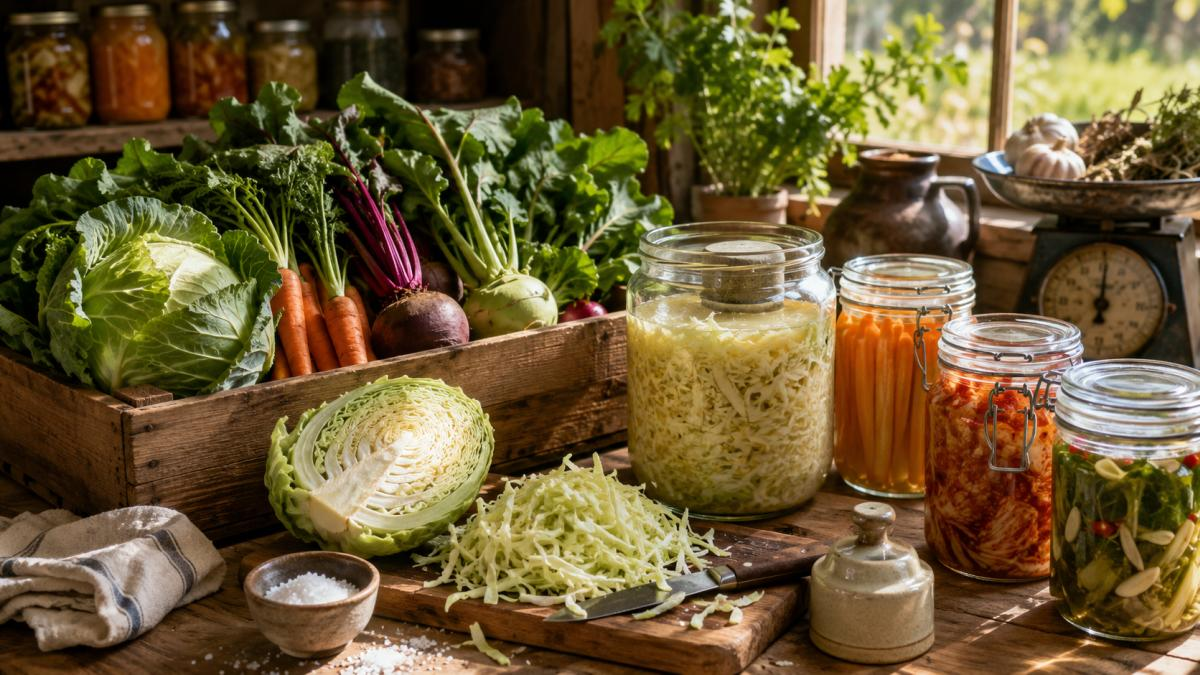
A full box of vegetables from your garden is a wonderful problem to have until week two, when half of it is soft and the other half has gone to the compost heap. Fresh produce keeps you honest for a few days and then it starts working against you. Fermenting changes that maths completely. With nothing more than salt, water, and a jar, you can turn a summer glut of cabbage or a winter surplus of carrots into food that stays good on a shelf for months, needs no electricity, and quietly rebuilds the kind of pantry that stops you running to the shops every time a recipe calls for something.
This is the first of a two-part series. Here we cover the case for fermenting as part of a home food-security plan, the simple science that makes it safe, how the Highveld climate helps and where it trips people up, and your foundation ferment: a proper Highveld sauerkraut. Part two moves on to kimchi and a set of budget condiments you can build from garden produce.
The financial argument is hard to ignore right now. According to the Pietermaritzburg Economic Justice and Dignity Group’s own reporting, the average household food basket has hovered above R5 400 through the first half of 2026, and while month-to-month food inflation has cooled, price levels never actually came back down after the last inflation cycle. A submission to the South African Human Rights Commission drawing on the same index puts the longer trend in sharp relief: the basic food basket rose roughly 33 percent in nominal terms between January 2021 and January 2026. That is the volatility a home garden already helps you sidestep, and fermenting extends the win by letting you bank the harvest instead of watching it rot.
There is a second, quieter benefit. When you grow and ferment your own cabbage, you know exactly what touched it. No wax coatings, no post-harvest sprays, no cold-chain mystery. You control the salt, the water, and the time, and everything else the vegetable brought with it from your own soil.
And then there is the part most people do not expect: the food is genuinely good for you. A widely cited Stanford School of Medicine clinical trial found that adults eating a diet rich in fermented foods showed increased gut microbial diversity and reduced markers of inflammation over ten weeks, with larger servings producing stronger effects. The follow-up work is catalogued under Stanford’s FeFiFo study for anyone who wants to read the detail. You are not just preserving calories. You are producing something with real nutritional upside.
The whole process rests on one clever trick. Every vegetable pulled from your garden already carries lactic acid bacteria on its surface, mostly species of Lactobacillus, Leuconostoc, and Pediococcus. You do not add anything. You simply create conditions where those bacteria win and everything that would spoil the food loses.
Salt is how you rig the contest. As the North Carolina State Extension guide to lactic acid fermentation explains, salt draws juice out of the vegetable to form the brine, limits available moisture, and suppresses the yeasts and moulds that cause rot, all while the salt-tolerant lactic acid bacteria carry on quite happily. Those bacteria eat the natural sugars in the vegetable and excrete lactic acid, which is the sour tang you taste and also the preservative.
The safety threshold is not a matter of opinion. As the lactic acid builds, the pH of the brine drops, and once it falls below 4.6 the botulism organism cannot grow; most active ferments push well below 4.0, at which point almost nothing harmful survives. A good working rule from beginner fermentation guides is a salt concentration of roughly two to five percent, which inhibits the bad actors while leaving the Lactobacillus comfortable. Two things do the heavy lifting: enough salt, and keeping the vegetables fully submerged so oxygen-loving spoilage organisms never get a foothold.
Temperature drives the speed and flavour of a ferment more than it drives safety. On the Highveld you effectively get two fermenting seasons in one year, and it pays to work with each rather than against it.
In the warm summer months, fermentation runs fast. A batch that would take three weeks in a European cellar can be ready in a matter of days here, which is convenient but demands attention. The higher the temperature, the quicker the acid develops and the faster a neglected jar can turn soft. Aim to keep summer ferments out of direct sun, ideally in the coolest room in the house, and taste them early.
Cooler winter conditions are, if anything, better for flavour. A slower, cooler ferment develops a rounder, more complex sour. This is not just folklore: reference work on kimchi fermentation notes that temperatures around 10 degrees are preferred over anything above 20, producing the balanced acidity that makes the end product pleasant rather than harsh. Your unheated pantry or a shaded pantry cupboard in a Centurion or Highveld winter is close to ideal.
The one trap is summer heat combined with too little salt. Above roughly 24 degrees, an under-salted jar is the classic recipe for mushy, off vegetables. When in doubt during a hot spell, err slightly higher on salt and slightly shorter on time.
This is where fermenting earns its place in a self-sufficient kitchen: the barrier to entry is almost nothing.
No crock, no airlock, no imported starter culture, no electricity. Everything on that list you likely already own.
There are two ways to get vegetables under brine, and knowing which to use covers almost everything you will ever ferment.
Dry salting suits watery vegetables like cabbage. You salt the shredded vegetable directly, massage it, and it releases enough of its own liquid to form the brine. This is the sauerkraut method.
Wet brining suits firmer or lower-moisture vegetables like carrots, beans, or whole chillies. You dissolve salt in water and pour it over. For a reliable two percent brine, dissolve 20 grams of salt in one litre of water. That single ratio, held roughly, is the backbone of most vegetable ferments.
Start here. Cabbage is cheap, grows well across the Highveld, and is the most forgiving vegetable to learn on.
In summer it may be pleasantly sour within four to seven days; in winter, closer to two or three weeks. When it tastes right to you, seal it and move it somewhere cool. It keeps for months and only deepens in flavour.
The daily check for the first week matters. Reliable home fermentation guides describe exactly what healthy activity looks like: active bubbling within about 36 to 48 hours, brine turning cloudy from day three or four, and a sour, clean, sauerkraut-like smell. A thin white film on the surface is usually kahm yeast, which is harmless and cosmetic; skim it off and carry on. What you do not want is a fuzzy, coloured, fuzzy-textured patch, which is mould, or a genuinely putrid, rotten smell. Trust your nose. Lactic fermentation smells sharp and sour, never rotten.
Keep a simple log too: vegetable, salt percentage, start date, and how it turned out. That one habit is what turns lucky first batches into a repeatable skill.
[Read Part 2: Fermenting Vegatbles at Home – Kimchi]