Physical Address
304 North Cardinal St.
Dorchester Center, MA 02124
Physical Address
304 North Cardinal St.
Dorchester Center, MA 02124

Most South African households already own an emergency food supply. It is sitting in the freezer, it is worth several thousand rand, and it will be worthless about forty-eight hours after the power stops for real.
That is the uncomfortable gap in the way we prepare. Load shedding trained an entire country to plan for two-hour and four-hour interruptions, and a full freezer shrugs those off without complaint. What it does not survive is the other kind of outage: the substation that burns, the cable that gets stolen, the flood that takes out a feeder for a week, the small-town municipality that cannot pay its bulk account. Those events are not theoretical here, and a food plan that depends on a compressor running continuously is a food plan with a single point of failure.
This guide is about building the opposite: a reserve that holds its value when the grid is gone, uses cold strategically rather than continuously, and treats ice as something you manufacture with surplus sunshine rather than something you hope stays frozen.
Start with the honest numbers. The USDA’s Food Safety and Inspection Service puts a closed fridge at roughly four hours of safety and a full freezer at about forty-eight hours, dropping to twenty-four hours if it is only half full. Their guidance on keeping food safe during emergencies is blunt about what happens after that, and the companion food safety chart for power outages works through it item by item. Those figures were measured in temperate northern-hemisphere conditions. In a Gauteng garage in February, or a Lowveld kitchen in January, you get less.
Scheduled outages are not the problem. Eskom’s own stage announcements describe blocks of two to four hours, cable thefts are longer, and a well-packed chest freezer barely notices. The scenario worth designing for is the unscheduled multi-day one, where nobody can tell you when supply returns.
There is a legal dimension worth knowing too, because it tells you what the professionals consider safe. Commercial operators work to chilled temperatures at or below 5°C and frozen at or below minus 18°C, and the practical reading of R638 and South African cold chain obligations is that perishable food must be held under conditions that stop it becoming a hazard, with the actual numbers coming from product-specific standards. Your household is not inspected, but the thresholds are the same biology.
A reserve that works has two layers, and they are built differently.
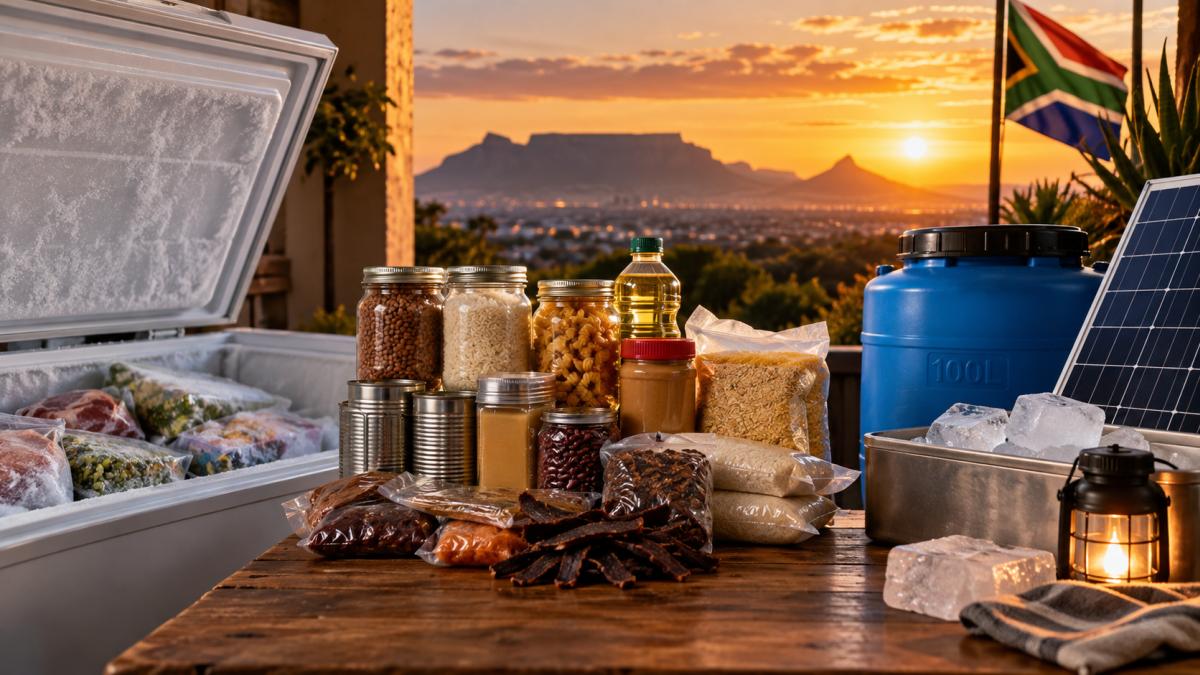
The bottom layer is the core: food that never needs cold, ever. Dried legumes, white rice, maize meal, pasta, salt, sugar, oil, tinned fish and meat, long-life milk, peanut butter, honey, biltong, dried fruit, rusks, and whatever you have canned or fermented yourself. This layer carries the calories. It is the reason the article title says no freezer required.
The top layer is cold-assisted. These are items that needed cold at some point in their life but not right now: freeze-dried meals, food that was frozen and then processed into something shelf-stable, and the small volume of genuinely perishable food you want to save during the first two days of an outage. This layer carries the morale, the protein quality, and the nutrition that dried staples alone cannot deliver.
Build the bottom layer first. People almost always do it backwards, buying a bigger freezer before buying a bigger pantry.
Use 2,100 kcal per person per day as your planning figure. That is the internationally accepted emergency ration level, and it is generous enough to keep people functional rather than merely alive.
For water, plan 8 to 10 litres per person per day covering drinking, cooking, and minimal washing. Three days for a family of four is therefore roughly 100 to 120 litres, which is one JoJo-style 100L drum or six 20L containers. Bare survival drinking alone is around 3 litres per person per day, but planning to that figure means planning to be miserable.
Translated into groceries, a three-day reserve for four people is about 25,000 kcal, which is genuinely small: five kilograms of rice and beans gets you most of the way there. The reason people fail at this is not quantity. It is palatability, preparation fuel, and rotation discipline.
Then extend it. Seventy-two hours is the standard floor because it matches most utility restoration times. South African experience suggests seven to ten days is the more realistic target, and the cost of extending from three days to ten is surprisingly low once the infrastructure exists.
This is where national advice falls apart, because the country does not share a climate. The temperature and rainfall tables in the overview of South Africa’s climate show the spread clearly: Upington averaging 36°C in January against Cape Town’s 26°C, Durban’s winter minimum of 11°C against Bloemfontein’s near-zero.
For stored food, the rule of thumb is that shelf life roughly halves for every 10°C rise in storage temperature. That single fact should determine where your reserve lives. A closed roof void or an unventilated garage in Polokwane, Kimberley or Nelspruit will sit at 40°C to 50°C on a summer afternoon, which can cut the usable life of tinned and dried goods by three quarters. An interior cupboard on a south-facing wall, or a concrete-floor storeroom, may run fifteen degrees cooler for free.
Humidity splits the country the other way. On the Highveld, the Karoo and the Northern Cape, winter relative humidity drops into the forties and drying food is almost effortless. Dried and freeze-dried products stay dry. Along the KZN coast, the Garden Route and the Eastern Cape seaboard, the same product will reabsorb moisture through any imperfect seal, go leathery, and then mould. Coastal preparers need better packaging rather than better drying: foil-laminate barrier bags, correctly sized oxygen absorbers, and a hard outer container against rodents. Salt air also attacks tin seams, so rotate tinned goods faster within sight of the sea.
Inland dryness has its own trap. Very dry air makes dried food brittle and it makes people complacent about seals, because failures show up slowly.
Here is the shift in thinking that matters most. Cold is not electricity. Cold is stored energy, and you can store a lot of it in water.
Melting one kilogram of ice absorbs about 334 kilojoules of heat, which is roughly 0.09 kWh of cooling. Getting tap water at 20°C down to solid ice and then chilled to freezer temperature takes around 456 kilojoules of heat removal per kilogram. Because a domestic freezer’s coefficient of performance at those temperatures is poor, call it 1.3 to 1.8, you are spending somewhere near 0.09 to 0.10 kWh of electricity per kilogram of ice made.
Now work out what that buys you. A decent 50-litre cooler box in a 30°C room leaks heat at something like 20 watts. Over a day that is about 1,700 kilojoules, which melts roughly five kilograms of ice. Over 72 hours, budget 15 to 20 kilograms of ice to hold a good cooler at safe chilled temperature, and double that for a cheap thin-walled one. So the entire three-day cold requirement for your perishables costs under 2 kWh of stored energy, made in advance.
That is dramatically cheaper than trying to run a fridge for three days, and it needs no inverter, no battery, and no functioning appliance.
Practical implications follow directly. Freeze two-litre bottles of water and keep them permanently in the freezer, filling every gap. A full freezer is both a better freezer and a battery. Prefer chest units over uprights, because cold air does not fall out of a chest when you open it. If you want more capacity, build a box: a plywood or OSB carcass lined with 50mm to 100mm polyisocyanurate or expanded polystyrene, taped at every joint, will outperform any commercial cooler at a fraction of the cost. Insulate the lid properly, since that is where most home-built boxes fail.
Anyone with a rooftop array and no export tariff is throwing away energy in the middle of the day. Most inverters simply clip production once the batteries are full and the house load is met. That clipped energy is free, and it has two natural homes.
The geyser is the first. Heating 150 litres from 20°C to 60°C stores about 7 kWh of thermal energy at a cost per stored kilowatt-hour that no lithium battery can approach.
Ice is the second, and it is the one almost nobody uses deliberately. Put a dedicated chest freezer on a timer or a smart relay that runs it hard through the solar peak, roughly 10:00 to 15:00, and lets it coast the rest of the day. Set it to its coldest setting during that window. A 300-litre chest freezer draws 100 to 150 watts while the compressor runs, consuming somewhere between 0.7 kWh per day in mild conditions and 1.8 kWh per day in a hot South African garage. Loaded with water containers and driven on surplus, that freezer becomes a cold battery that is charged by sunlight and discharged over days of darkness.
The practical output is modest but sufficient: a domestic chest freezer will convert roughly 10 to 20 kilograms of water to ice per day without straining. Two days of deliberate ice-making covers a full 72-hour cold requirement.
One wiring note. Freezer compressors have a starting surge several times their running current, so size any inverter for locked-rotor current rather than nameplate watts, or use a soft-start unit.
Add it up for a three-day event with a single chest freezer:
Running the freezer normally for 72 hours costs roughly 2 to 5 kWh depending on ambient temperature and how well packed it is. That is within reach of a 5 kWh battery if you are disciplined about other loads.
But you do not have to run it continuously. A full, well-insulated chest freezer holding at minus 18°C and left closed will stay below freezing for two days on its own. Give it two hours of compressor time per day, timed to the solar peak, and it will hold indefinitely on perhaps 0.4 to 0.6 kWh per day. That is a single 400W panel’s worth of daylight, with no battery at all.
This is the whole argument in one line: an insulated, ice-loaded freezer run intermittently on daytime solar needs roughly a tenth of the backup capacity that people assume, and it fails gracefully rather than suddenly.
Freeze-drying is the only home preservation method that produces food which is genuinely light, stores for years, keeps most of its nutrition, and tastes close to fresh once rehydrated. It works by sublimation: water goes from ice straight to vapour under vacuum without passing through liquid. The University of Minnesota’s explanation of freeze-drying as home food preservation covers the chemistry, including the key point that the finished water activity typically lands between 0.08 and 0.33, which is what buys the shelf life.
Three cautions matter more than the technique.
First, there is no heat step, so freeze-drying kills nothing. Pathogens present before the cycle are present after it, in a dormant state, and they reactivate if moisture returns. Utah State University’s assessment of what can and cannot be freeze-dried safely is worth reading before you spend money: cooked meats, fruit, vegetables and starches do well, while raw meat, oily foods, high-sugar items and anything with a casing or crust do badly or dangerously. Rehydrated food should be cooked before eating.
Second, the product is only shelf-stable if it is hermetically sealed. Freeze-dried food left in a permeable bag on a humid Durban shelf will be ruined within months. Foil-laminate barrier bags with oxygen absorbers, stored dark and cool, are not optional.
Third, home-produced freeze-dried food is not the twenty-five-year commercial product. Five to ten years is the realistic ceiling before nutrient and quality loss becomes significant.
On the economics for a South African household: a domestic freeze dryer draws roughly 1 to 1.5 kW for a 20 to 40 hour cycle, so 25 to 45 kWh per batch producing perhaps three to five kilograms of dry weight. That is a serious solar ask. It makes sense if you have substantial clipped midday production and a real garden surplus to process. It does not make sense as a way to preserve supermarket food.
Two lower-cost routes exist. The dry ice method places food in loosely sealed bags inside a cooler, packed with roughly its own weight in dry ice, and left for around twenty-four hours; dry ice is available from industrial gas suppliers in most metros. Never handle it bare-handed, and never use it in an unventilated room, because sublimating carbon dioxide displaces oxygen. The freezer method simply leaves food uncovered on trays in a deep freezer for one to three weeks, letting the frost-free cycle carry moisture away. It works best in dry inland winter air, it is slow, and the result is usually partial rather than true freeze-drying. Treat it as an experiment before you rely on it.
For most households, the honest recommendation is to master ordinary dehydration first. The National Center for Home Food Preservation’s guidance on drying food at home produces lightweight, no-refrigeration-required stock for a tiny fraction of the energy and equipment cost.
When there is no ice left and no power, evaporative cooling still works, and it works particularly well in the drier half of the country. A pot-in-pot cooler, two unglazed clay vessels with damp sand between them, achieves cooling efficiencies around two thirds and drops internal temperature well below ambient while raising humidity, which is exactly what leafy vegetables want. The overview of evaporative cooling devices gives the performance data, and there is a practical build guide for the clay pot cooler with material options.
The physics are unforgiving about location. Evaporative cooling depends on dry air, so it performs beautifully in the Northern Cape, the Karoo, the Free State and Highveld winter, and poorly on the humid subtropical coast in summer. Water consumption runs around two litres per day for a household-sized unit, which matters if water is also short.
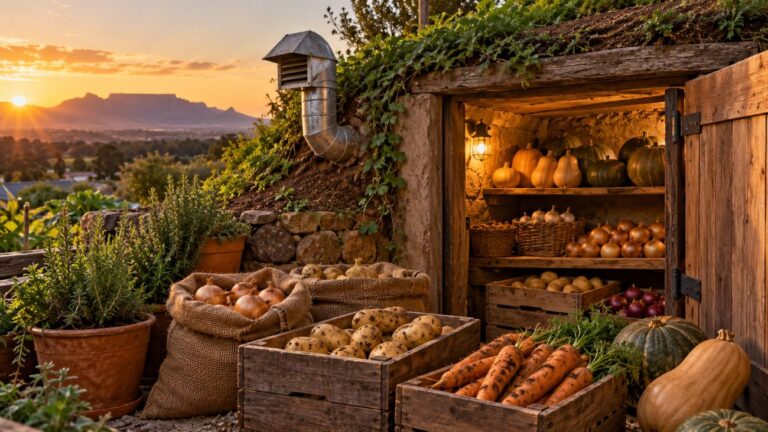
The other zero-power option is depth. Soil temperature at a metre and a half is remarkably stable, which is why root cellars work. A partially buried, well-drained storeroom will hold root vegetables, pumpkins, onions and cured squash for months without any input at all.
Every failed reserve fails the same way: it was bought once and never touched.
Write the seal date on everything, without exception, because six months later all the bags look identical. Work first in, first out, with the oldest stock in front. Keep a cheap logging thermometer in the storage area for a full summer so you know what the space actually does rather than what you assume. Audit quarterly, which is four dates in the calendar.
Most importantly, cook from the reserve. Once a month, make a full meal using only what is stored, with the water and the fuel you have set aside. That is when you discover that nobody in the house will eat the lentils, that the gas bottle is empty, or that you own no manual tin opener. Finding that out on a Sunday afternoon is free. Finding it out on day two of a blackout is not.
And when something has spent an unknown period at an unknown temperature, throw it out. Foodborne illness during an infrastructure failure, when clinics are also struggling and water may be suspect, is a far worse outcome than losing a kilogram of mince.
Start with the pantry, because it is cheap and it needs no power. Then add water storage. Then buy a chest freezer rather than a bigger fridge, fill its dead space with frozen water bottles, and put it on a timer aligned with your solar peak. Then build or buy one properly insulated cooler box. Only after all of that does a freeze dryer make any sense, and only if you have surplus production and surplus produce to justify it.
Done in that order, each step works on its own. Done in reverse, you end up with an expensive appliance guarding food you cannot eat once the lights go out.