Physical Address
304 North Cardinal St.
Dorchester Center, MA 02124
Physical Address
304 North Cardinal St.
Dorchester Center, MA 02124

You do not need a farm or a forest to find free food in South Africa. It grows in the cracks of pavements. It lines the verges of gravel roads. It pushes through fences and spills across vacant lots. Wild edible plants are everywhere, and most people walk right past them every day.
Roadside foraging is not a survival gimmick. It is an old skill that generations of South Africans practised before supermarkets existed. Grandmothers knew these plants by name. Children were taught to recognise them before they could read. That knowledge is still relevant. In fact, with food prices rising and interest in self-sufficiency growing, it is becoming relevant again.
This guide covers five of the most common edible plants found along South African roadsides. Each one is widely distributed, easy to identify, and genuinely nutritious. Before you pick anything, though, there are two rules. First, never forage from roadsides that are sprayed with herbicide or adjacent to heavy industrial activity. Second, be absolutely certain of your identification before eating anything. When in doubt, leave it out.
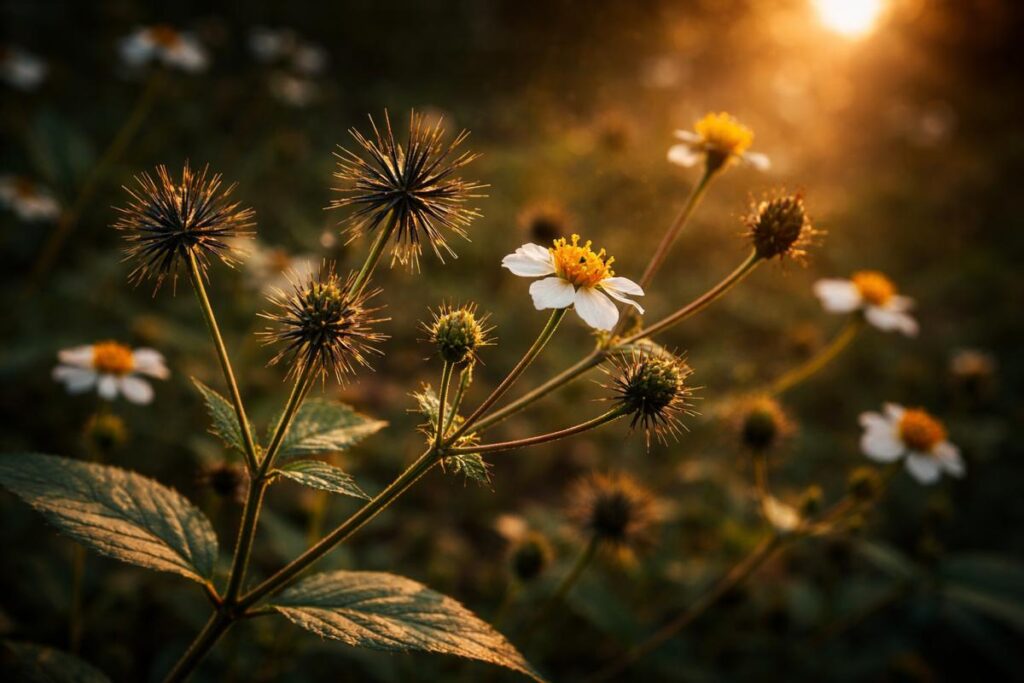
Blackjack is the plant everyone hates in the garden. The seeds stick to socks, to dog fur, to shoelaces. You have pulled it out a hundred times. You have cursed it.
Start eating it instead.
Blackjack is one of the most common edible weeds in sub-Saharan Africa. The young leaves are tender, mild, and packed with nutrients. Studies have shown significant levels of iron, calcium, and antioxidants. The plant has been used as a food source across rural South Africa, Zimbabwe, and East Africa for centuries.
Young plants are the ones to target. Pick the top growth before the plant flowers. The leaves are small, bright green, and slightly hairy. Once the plant matures and sets those infamous seed heads, the leaves become tough and bitter.
Use young blackjack leaves like spinach. Boil them briefly and toss with butter and garlic. Add them to stews. Mix them into a morogo pot. They wilt down considerably, so pick more than you think you need.
The entire plant is edible. Roots have been used medicinally. Flowers attract pollinators. But for eating, the young leafy tops are where the value is.
Blackjack thrives in disturbed soil. Road verges, building sites, and field edges are prime habitat. In Gauteng, KwaZulu-Natal, and Mpumalanga you will find it almost anywhere. It grows year-round in warmer areas and bounces back fast after rain.
For more information on the nutritional profile of wild African greens, the South African Journal of Botany publishes ongoing research on indigenous and naturalised edible plants.
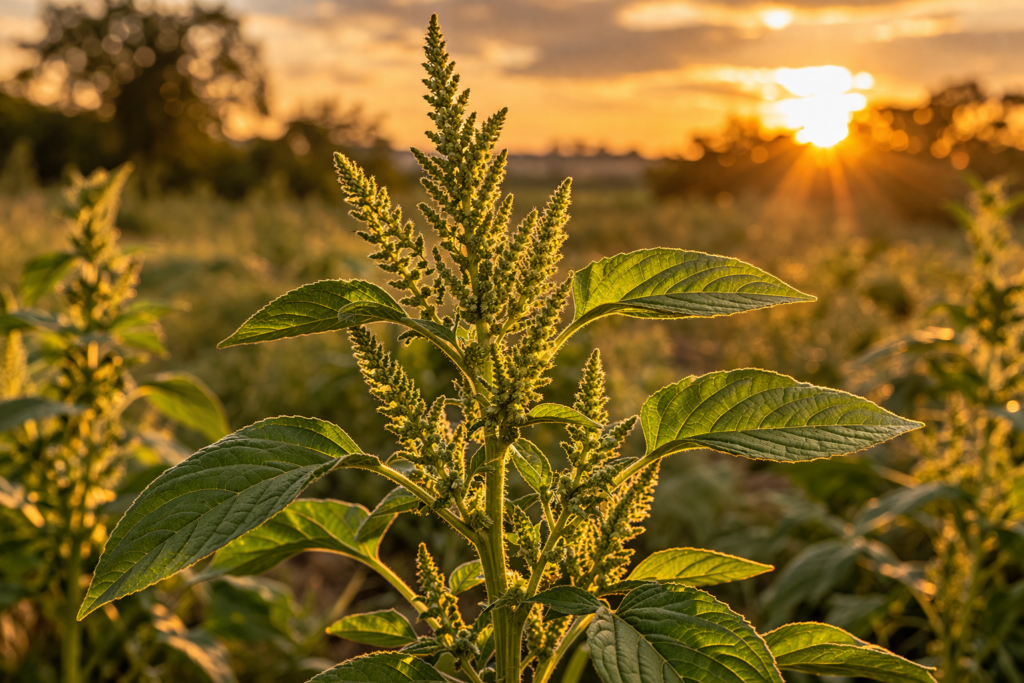
Morogo is not one plant. It is a category. In South Africa the word is used to describe a range of edible wild greens, but Amaranthus hybridus is one of the most commonly eaten species and one of the easiest to find next to roads.
The plant is tall, robust, and upright when mature. Leaves are oval to diamond-shaped with slightly wavy edges. Young plants are smaller and more manageable. The colour ranges from bright green to reddish-green depending on growing conditions.
Morogo has deep roots in South African food culture. It is eaten across the country. Limpopo, the Eastern Cape, and rural KwaZulu-Natal communities have gathered it for generations. It is nutritious in ways that rival commercial vegetables. High in iron, folate, calcium, and vitamin C.
The seeds are also edible. Mature Amaranthus produces enormous quantities of tiny seeds that can be ground into flour or cooked like a grain. This is the same genus used to produce commercial amaranth grain. The roadside version is just a wilder cousin.
Harvest the young leaves and growing tips. Strip them from the stems. Wash thoroughly. Cook like spinach. The flavour is mild and slightly earthy. It pairs well with peanut butter in the traditional style, or simply with salt and oil.
One important note. Amaranthus can accumulate nitrates in soils with high nitrogen content. Avoid picking near heavily fertilised agricultural land or anywhere with obvious contamination. Clean roadside verges with loose disturbed soil are fine.
Crops for the Future has excellent background on Amaranthus as a food crop, including its global significance and nutritional data.
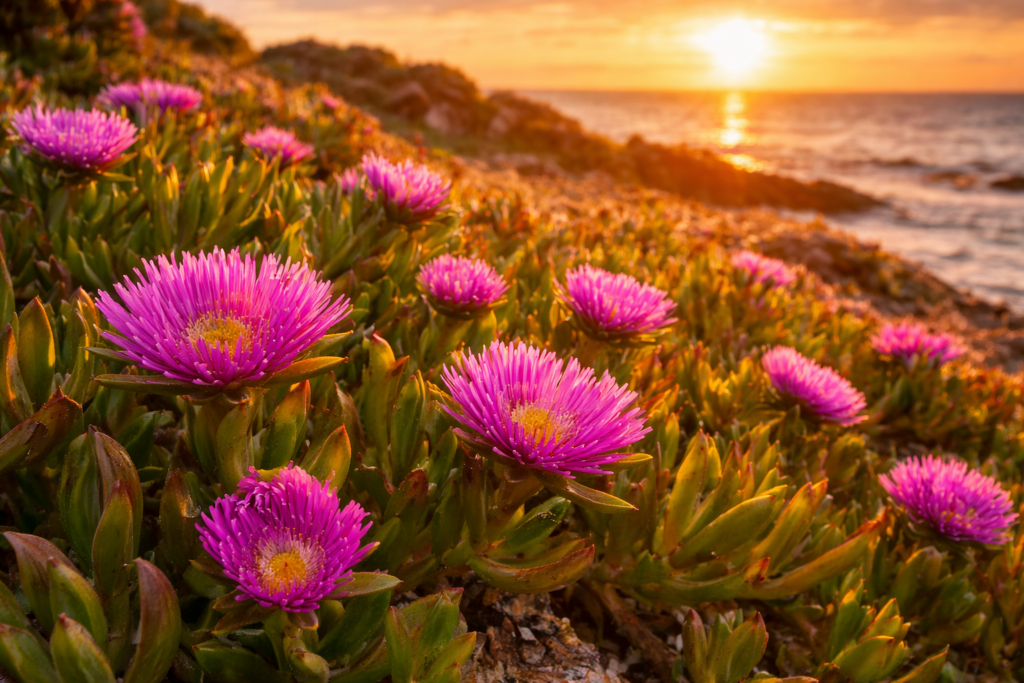
This one is unmistakable. Fat, triangular, succulent leaves that grow in dense mats across sandy soil. Bright pink or yellow flowers in season. And fruit that tastes like a cross between a fig and a strawberry.
Carpobrotus edulis is indigenous to the Western Cape but has naturalised across much of coastal South Africa. It is widely planted on road embankments and highway verges for erosion control. Drive the N2 near Cape Town or along the Garden Route and you will see kilometres of it.
Every part of the above-ground plant has a use. The fruit is the obvious prize. When ripe, it turns yellowish and slightly soft. The outer skin is tough. Bite into it and squeeze out the sweet, sticky pulp. It is genuinely delicious. You can eat it raw, dry it into a preserve, or cook it down into a jam. Traditional Cape communities made a fermented condiment from the pulp.
The leaves are edible too. Raw and slightly salty due to the plant’s salt-tolerance. They can be used in salads or eaten as a snack. The juice from squeezed leaves has been used as a sore throat remedy and a skin soother.
The flowers are also edible. Mild and slightly sweet. Add them to a salad for colour.
Avoid picking in areas heavily trafficked by vehicles where roadside contamination is obvious. Coastal sites away from urban congestion are ideal. Look for plants with undamaged fruit showing that yellowish ripening colour.
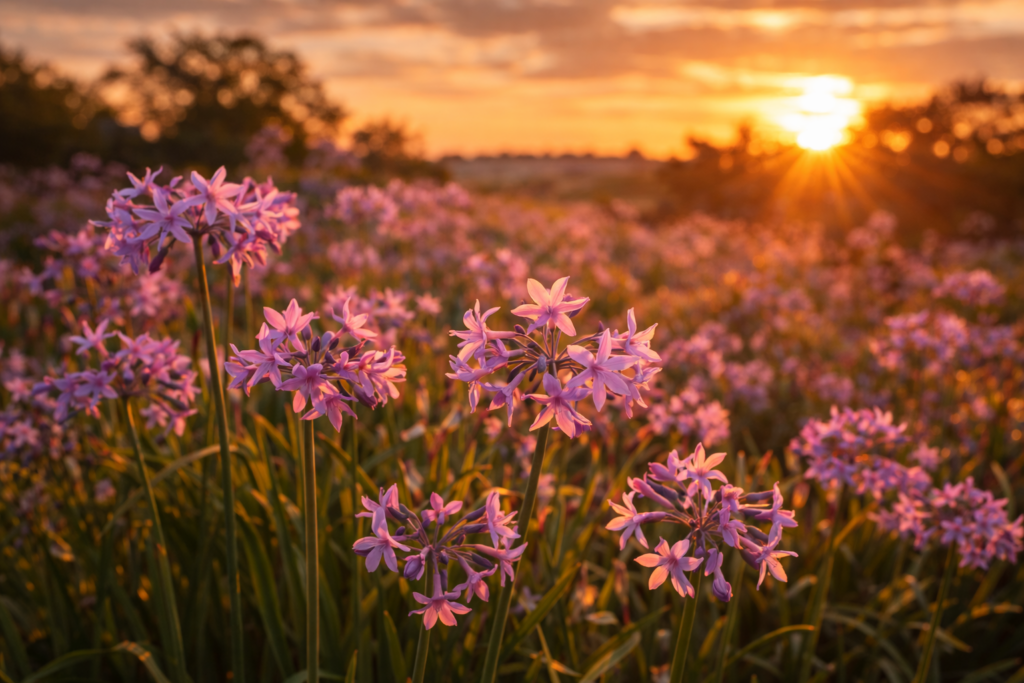
Tulbaghia violacea is a South African native with a strong garlic smell and soft, grass-like leaves. It grows in clumps. Produces small purple flowers on upright stems. It is planted in gardens deliberately, but it also naturalises along roadsides, stream banks, and disturbed ground throughout Gauteng, the Eastern Cape, and KwaZulu-Natal.
If you crush a leaf and it smells of garlic, you have found it.
Every green part is edible. The leaves can be used exactly like chives. Chop them into eggs. Mix them into soft cheese. Toss them through a salad. The flowers are edible too and make a striking garnish. The underground corms are edible but mild and small. The leaves are the practical harvest.
Wild garlic has significant antimicrobial properties. Traditional medicine has used it to treat infections and boost immunity. Modern research has confirmed garlic-family compounds across Tulbaghia species. It is not merely food. It is functional food.
The plant is evergreen in most of South Africa. You can harvest leaves almost year-round. Cut individual leaves from the outside of the clump and it will regrow. Never uproot the whole plant. Sustainable harvesting keeps the resource alive.
Tulbaghia is also easy to cultivate at home from corms or divisions if you want a permanent supply. Growing your own from roadside divisions is completely viable. See our guide on starting an edible garden with indigenous plants for more on bringing foraged plants into a home setup.
SANBI (South African National Biodiversity Institute) has species profiles on Tulbaghia violacea including distribution maps and ecology.
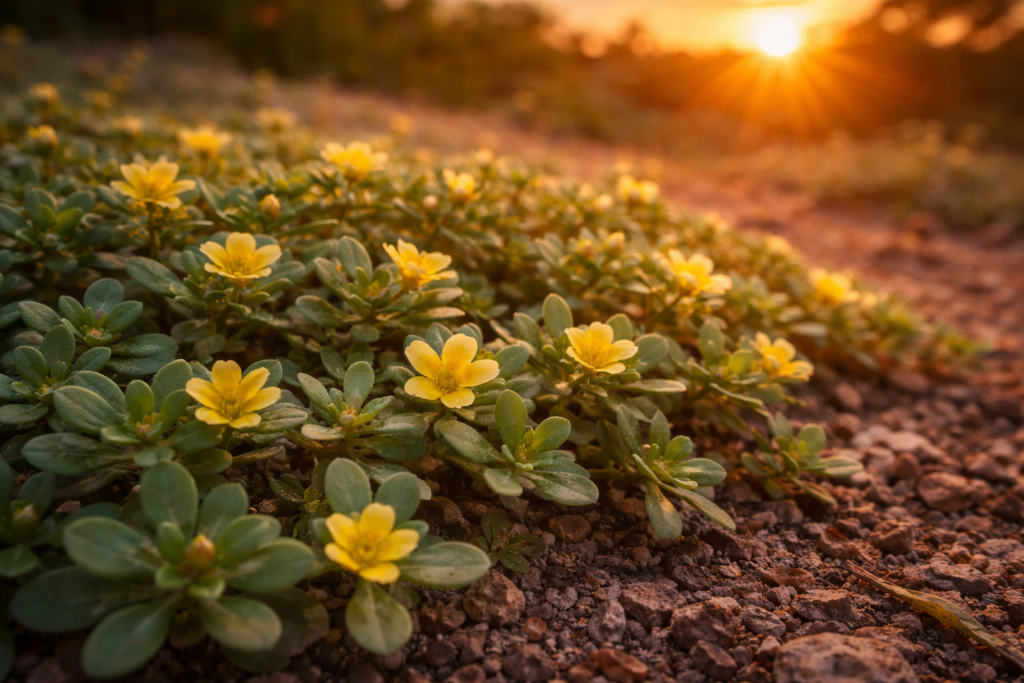
Purslane is probably the most nutritionally dense plant on this list. Research has identified it as one of the few plant sources with meaningful levels of omega-3 fatty acids, specifically alpha-linolenic acid. It also contains significant vitamin E, vitamin C, and beta-carotene.
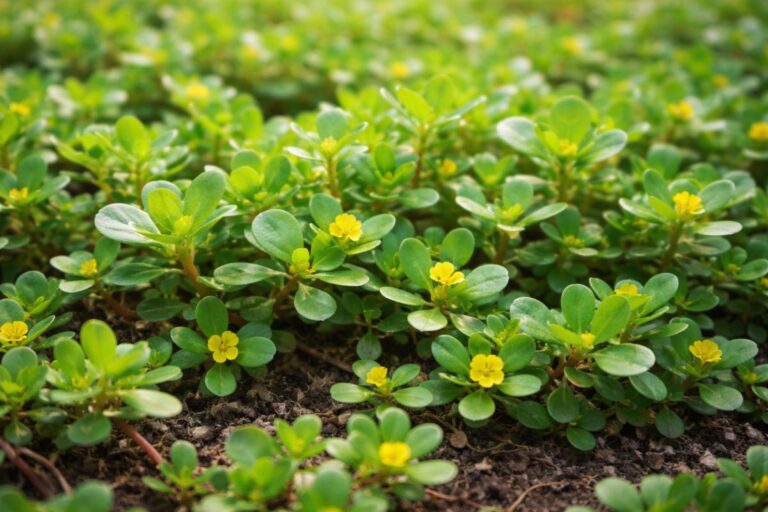
It looks humble. A sprawling, low-growing succulent with small, paddle-shaped leaves. Reddish stems. Tiny yellow flowers. It creeps along the ground in dense mats and often goes entirely unnoticed.
In South Africa it grows as a common weed in gardens, cultivated land, and road verges across the country. It prefers warm conditions and is most abundant from late spring through summer. After good rains it appears almost overnight.
The taste is mild and slightly lemony. The texture is slightly mucilaginous when cooked, similar to okra. Eaten raw in salads it is crisp and refreshing. Cooked briefly it softens and becomes a good base for any greens dish.
Use the whole above-ground plant. Stems, leaves, and flowers are all edible. For raw eating pick the smaller, younger tips. For cooking the larger stems and leaves are fine.
Purslane has been eaten across the world for thousands of years. Mediterranean, Middle Eastern, and Asian cuisines all have traditional preparations. South Africans have largely overlooked it in favour of introduced greens. That oversight is worth correcting.
Wildflowers of South Africa has identification guides that can help confirm purslane against similar-looking species before you eat.
Roadside foraging is rewarding but not without risk. These guidelines apply every time.
Pick away from high-traffic roads where exhaust and tyre residue accumulate in soil. Stay well back from verges that show signs of spraying. Look for wilted, discoloured, or irregularly dying vegetation as a sign of herbicide use. Avoid industrial zones, mining areas, and land near waste dumps entirely.
Wash everything thoroughly before eating. Foraged greens carry dust, pollen, insects, and potentially animal waste. A good soak and rinse solves most of it.
Start with small quantities when trying a plant for the first time. Even edible plants can cause reactions in sensitive individuals.
And invest in a reliable field guide. The Complete Field Guide to Trees of Natal, Zululand and Transkei is a classic, but for edible plants specifically look for Fiona Archer and Simon van Noort’s work, or the foraging resources available through Veld and Sea, one of South Africa’s leading wild food organisations.
Free food is growing on the side of the road right now. You just need to know what to look for.