Physical Address
304 North Cardinal St.
Dorchester Center, MA 02124
Physical Address
304 North Cardinal St.
Dorchester Center, MA 02124


There is a genre of video doing the rounds at the moment that promises you free electricity from dirt. The formula is always the same. A folksy old man on a farm somewhere, a suppressed government document with an invented reference number, a hardware list under a hundred dollars, and a cliffhanger before the build instructions that conveniently sits behind a paid manual. The claim is that twelve copper and zinc electrodes buried in your yard will run your workshop lights, your USB chargers and your security cameras indefinitely, and that the utility industry has spent two centuries hiding this from you.
The frustrating part is that the underlying physics is real. Earth batteries work. They have worked since 1841. What the videos do is take a genuine, small, well documented effect and inflate it by roughly four orders of magnitude, then dress the gap in conspiracy.
So let us do the thing nobody selling a manual will do. Build one, measure it properly, and publish the actual numbers. The build costs about R150 at any South African hardware store. The result is not free household power. It is something smaller, stranger and genuinely useful, and knowing the real figure is worth more than believing a fake one.
Push a copper electrode into moist soil. A short distance away, push a zinc electrode into the same soil. Zinc gives up electrons more readily than copper does, the dissolved salts and moisture in between act as an electrolyte, and electrons flow through any wire you connect between them. This is a galvanic cell, the same principle as a torch battery, with soil standing in for the paste.
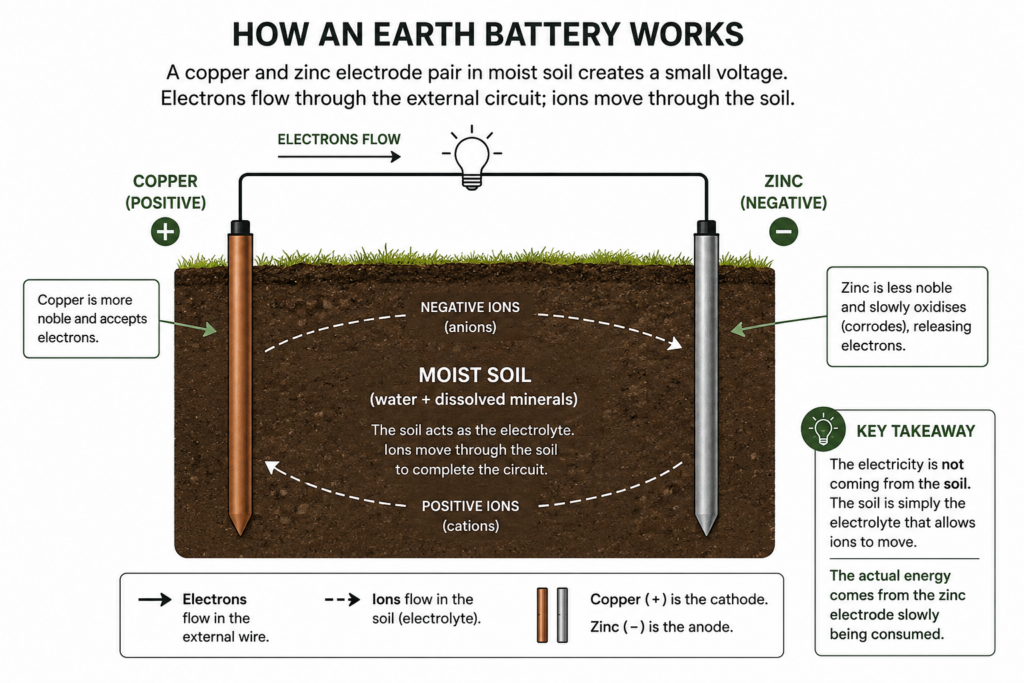
The Scottish inventor Alexander Bain demonstrated this properly in 1841, burying zinc and copper plates about a metre apart to run an electric clock, and the standard reference on the earth battery still credits him as the first working example. Victorian telegraph engineers used the same idea at remote relay stations. Both applications share a feature the modern videos skip past entirely: a clock escapement and a telegraph relay draw almost no current at all.
That word, current, is where the whole thing turns.
Every one of those videos talks about volts and only volts. Twelve cells in series, nine to twelve volts, the same as a car battery, therefore it will run twelve volt things. That reasoning is wrong in a way that is easy to miss if you have never measured a real cell.

Voltage is only half of power. Power is volts multiplied by amps. A copper and zinc pair in soil produces a respectable open circuit voltage of around 0.9 volts, which is exactly what the videos show you on a multimeter. But published laboratory work on earth batteries records that a single zinc and copper cell delivers only a few tens of microamperes of usable current. That is millionths of an amp. One of the more optimistic peer reviewed builds, using treated soil and a carbon and aluminium electrode pair rather than copper and zinc, managed 24 volts at 25 milliamps from twenty five cells, which is still under a watt from an entire buried array.

The reason is soil resistance. Your cell has enormous internal resistance, typically several thousand ohms, because ions have to shuffle through packed earth rather than through acid. The moment you connect anything that draws real current, the voltage collapses to nearly nothing. Your multimeter draws essentially zero current, which is precisely why it shows you a healthy nine volts and why that reading is meaningless as a measure of power.
Here is the arithmetic that kills the workshop lighting claim. A modest three watt LED strip at twelve volts wants a quarter of an amp. If your twelve cell string has a combined internal resistance of around 100 kilohms, you would need tens of thousands of volts behind it to push a quarter amp through. You do not have tens of thousands of volts. You have nine, on a good day, with nothing connected.
None of that means the project is worthless. It means you should build it for what it actually is. Here is the shopping list.
One metre of 15mm copper pipe, cut into twelve pieces of roughly eighty millimetres, runs about R90. Twelve 100mm galvanised nails or galvanised fence droppers give you your zinc, at around R30 for a box. Ten metres of thin single core copper wire is another R25. Total, R145, and you almost certainly have the wire and some of the copper lying in a drawer already.
Galvanised steel is a compromise worth naming. The zinc coating is only a few tens of microns thick, so it will deplete faster than a solid zinc rod would. Solid zinc anodes sold for boats and geysers last far longer but cost R80 or more each, which blows the budget twelve times over. Start with galvanised, measure the decline, and you will have generated a genuinely useful data point that nobody has published for South African soil.
Dig 300 to 400 millimetres down, which is deep enough to sit below the zone where soil dries out completely between rains. Pick a spot that stays damp: below a downpipe, near a greywater outlet, at the low end of a bed, or under thick mulch. Gauteng clay will outperform Cape sand considerably, and both will outperform Kalahari sand.
Space the copper and the zinc in each pair about 150 millimetres apart. Then space each complete pair at least half a metre from the next one, and this is the part almost no guide mentions. Because soil conducts, adjacent cells partially short each other through the ground itself, which quietly wrecks a series string. If you want clean results, bury each pair in its own bucket of soil with drainage holes, isolating the electrolyte while still letting rain keep it wet.
One safety note before you dig. A galvanic cell in soil will accelerate corrosion of any other buried metal nearby. Keep your electrodes well clear of steel water pipes, borehole casing, and your house earth electrode. Never connect any of this to household wiring.
This is the protocol that separates a real result from a YouTube result.
Measure open circuit voltage first, and write it down knowing it means very little on its own. Then measure short circuit current on the microamp range of your multimeter, briefly. Divide the first number by the second and you have your internal resistance, which is the single most important figure in the whole experiment.
Next, load the cell through a range of resistors: one kilohm, ten, forty seven, one hundred, two hundred and twenty, one megohm. Record the voltage across each. Calculate power as voltage squared divided by resistance for each one. The resistance where power peaks is roughly equal to your internal resistance, and that peak is the true maximum your cell can deliver.
Log all of it daily for a month. Note rainfall. Note temperature. That single spreadsheet is worth more than every earth battery video ever made.
Based on the published figures, expect a peak somewhere between ten and one hundred microwatts per cell. A twelve cell string does not multiply current, only voltage, so treat the whole array as delivering perhaps half a milliwatt to a few milliwatts. Over a full year that is somewhere in the region of five to twenty five watt hours. A single 18650 lithium cell holds about ten watt hours. Your entire buried grid produces roughly what one small battery already contains, per year.
At current Eskom rates, following the 8.76 percent increase that took effect for direct customers in April 2026, that annual output is worth somewhere around five cents. The payback period on your R150 is measured in millennia.
Now the interesting part, because a milliwatt is not nothing. It is simply a different class of problem.

The trick is to stop trying to power a load directly and start harvesting into storage. Purpose built energy harvesting chips exist precisely for this, and the Analog Devices LTC3108 will start up and boost from inputs as low as twenty millivolts, which your soil comfortably exceeds. Feed it into a one farad supercapacitor and you accumulate charge continuously, then spend it in short bursts.
At half a milliwatt average, a supercapacitor charges to a usable level in a few hours. A fifty millisecond LED flash costs a few millijoules. That gives you a path marker or gate indicator blinking every ten seconds, forever, with no panel to steal, no battery to replace and nothing visible above ground. In a country where solar panels and batteries walk off properties routinely, a light source that is entirely buried has a real security argument behind it.
Duty cycled sensing is the other honest application. A soil moisture probe that wakes, reads and transmits once an hour is well within a few milliwatts of average budget. This is not theoretical: researchers running a plant microbial fuel cell in an Indonesian paddy field powered continuous LoRa data transmission from soil alone, generating around nine to fifteen watt hours per square metre across a growing season.
Be clear eyed about the competition, though. A ten watt solar panel costs around R300 and will produce in a single sunny day roughly what your entire earth battery grid produces in a year. The earth battery only wins where sunlight is genuinely unavailable or where visible hardware is a liability.
The videos claim the soil does the work and never gets used up. That is the most fundamental error in the whole pitch.
The energy comes out of the zinc. Zinc oxidises, releasing two electrons per atom, and by Faraday’s laws one gram of zinc carries about 2 950 coulombs of charge. At one hundred microamps, that gram would last close to a year. A solid zinc rod would therefore theoretically run for centuries, which sounds like vindication until you realise the actual limits are elsewhere: parasitic corrosion that consumes zinc without producing any current, mineral films building up on the copper, and soil drying out. Your galvanised nails will likely fade within one to three years, and the honest answer is that nobody has published good long term South African field data. Which is an argument for building one and keeping records, not for believing a script.
If you find the idea of pulling power from the ground genuinely interesting, the serious version is microbial fuel cells, where bacteria in the soil do the electron transfer rather than a sacrificial metal.
The numbers there are more encouraging but still modest. Soil based microbial fuel cells characterised in laboratory conditions produced power densities in the range of sixteen to twenty nine milliwatts per square metre, and sediment based systems have been pushed higher with engineered anode placement. A broad assessment of microbial fuel cell configurations is blunt about the ceiling, noting that the highest reported densities come from nearly ideal conditions with concentrated fuel and highly conductive electrolytes rather than from real ground.
Milliwatts per square metre is a serious research field with real applications in remote sensing and wastewater treatment. It is not a route to running your house, and the people working on it have never claimed otherwise.
Build it. It is a cheap, fascinating weekend project that teaches internal resistance better than any textbook chapter, and it can genuinely run a buried marker light or a slow sensor indefinitely on materials you can buy in Centurion for the price of a takeaway.
Just do not build it because a video told you it would replace your electricity bill. The gap between a milliwatt and a kilowatt is a factor of a million, and no amount of digging closes it. The people selling you the manual know that. Now you do too, and you have a measurement protocol they never included.
Bury the electrodes. Take the readings. Post the numbers. Real self sufficiency is built on figures you verified yourself, not on stories about farmers in towns that do not exist.