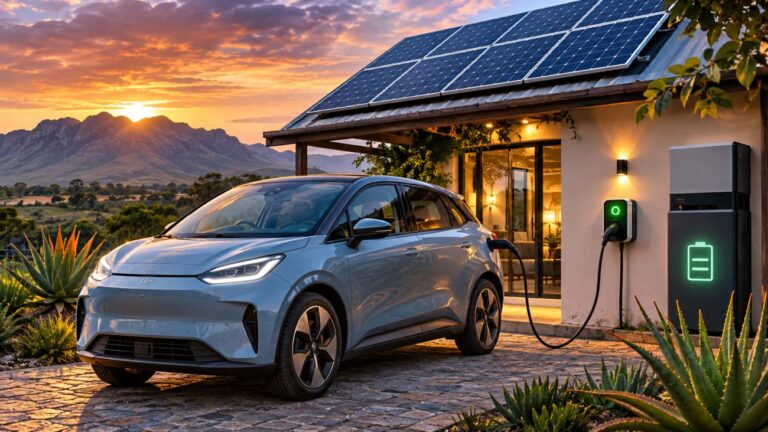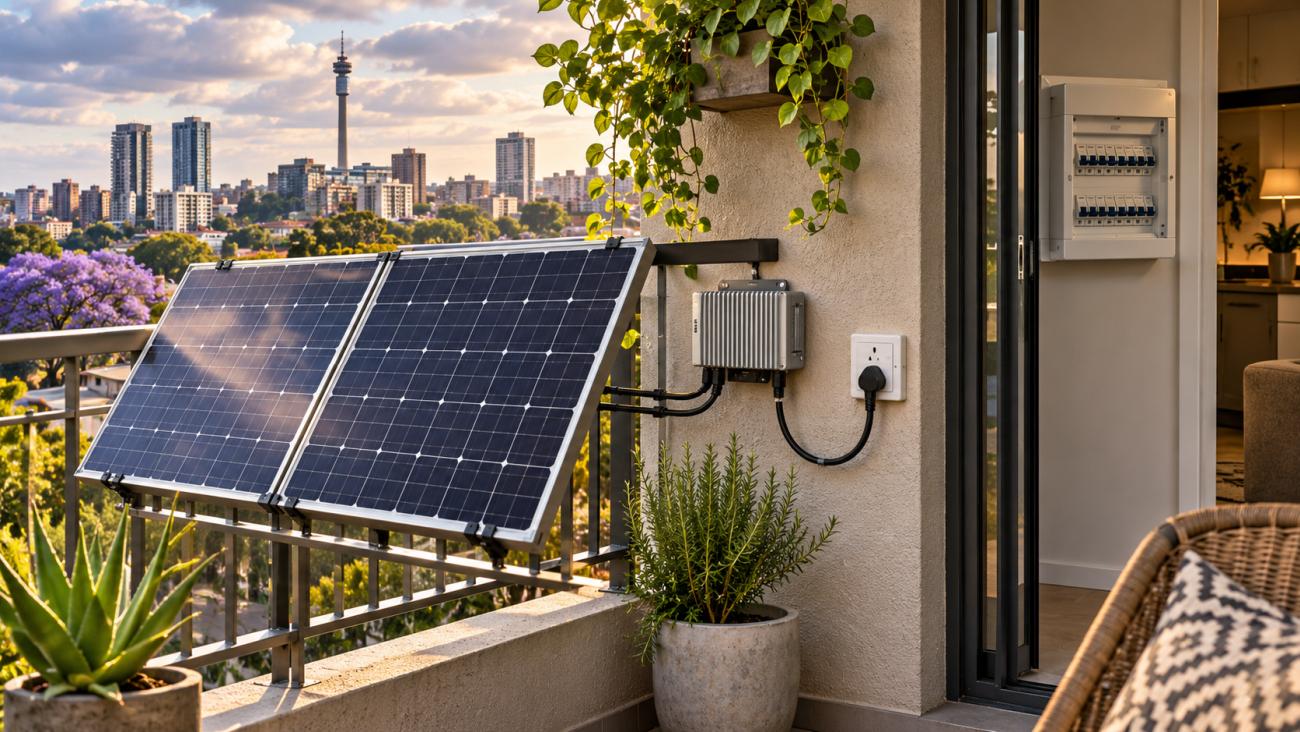

A new kind of solar kit has started appearing in South African online shops. One or two panels clip onto a balcony railing or a garden wall, connect to a small box called a microinverter, and plug straight into an ordinary wall socket. No roof, no installer, no distribution board work. Entry-level kits start at around R7,500, according to Briefly News, which puts them within reach of renters, flat dwellers and anyone who has priced a full rooftop system and walked away.
Overseas, these “balcony power plants” have become a genuine movement. So the obvious question for South African households is whether you can simply buy one, plug it in and start shaving your electricity bill. The short answer is no, not legally, at least not yet. The longer answer is more useful, because there are legal ways to get most of the same benefit.
What Plug-In Solar Actually Is
A plug-in system is a small grid-tied solar setup, usually between 300 and 800 watts. The microinverter converts the panels’ direct current into 230 volt alternating current and pushes it into your home’s wiring through the socket. Whatever the panels produce is used first by appliances that are already running, such as the fridge, the Wi-Fi router and anything on standby, so you draw slightly less from the grid while the sun is shining.
It is not a backup system. It has no battery, and a properly designed microinverter switches itself off the moment the grid goes down. That is a safety feature, not a flaw: it stops your panels from feeding power into a line that a technician believes is dead.
Where It Is Legal Overseas
Germany pioneered the idea, and well over a million households there now run balcony systems. Great Britain joined in this year: from 27 August 2026, households can legally plug in certified kits of up to 800 watts, and major retailers can sell them, as Solar Power Portal reported. The British rules still require independent safety testing, landlord or freeholder consent where relevant, and they exclude battery integration.
Other countries are moving more slowly. In Australia, plug-in solar is not yet approved because the national inverter standard requires a permanent connection on a dedicated circuit, and energy ministers agreed in September only to explore a pathway, according to SolarQuotes. In the United States, a handful of states have passed laws reclassifying small plug-in kits as appliances, backed by a new safety standard called UL 3700. The video below explains how that American framework works and why the safety questions matter.
The common thread is that every country that allows plug-in solar first changed its rules to allow it. None of them simply looked the other way.
The Short Answer for South Africa
South Africa has not made that change. Three separate layers of rules apply to any solar system that connects to your home’s wiring, and a plug-in kit does not fit neatly into any of them.
Registration. The National Energy Regulator of South Africa clarified in February that the trigger for registration is whether a system has a point of connection to the grid, not whether it exports power. In its statement, carried by SAnews, NERSA said only facilities with no grid connection are exempt, and that grid-connected systems up to 100 kW must register with their distributor, meaning Eskom or the municipality. A balcony kit plugged into a wall socket is, by design, connected to the grid through your house wiring. Eskom’s own guidance says all households with systems below 100 kVA must register even if they never export a single unit.
The wiring code. Every electrical installation in a home falls under SANS 10142-1, the national wiring standard, and must be backed by a Certificate of Compliance from an electrician registered with the Department of Employment and Labour. OUTA’s solar FAQ describes the CoC as the lawful proof that an installation is safe. Engineers quoted by Briefly News pointed out that the wiring regulations do not currently provide for generators that feed power back through a socket rather than a proper connection at the distribution board.
Inverter certification. To be registered, a grid-tied inverter needs a type-test certificate showing it meets NRS 097-2-1, the South African grid connection standard that covers anti-islanding protection. Many microinverters sold online carry European or American certifications instead, which do not automatically satisfy local requirements.
Put together, there is currently no route by which you can plug a kit into a socket, skip the electrician and remain compliant.
What Happens If You Plug One In Anyway
Enforcement depends on who supplies your electricity, and it is still contested. Eskom has said it will not fine or disconnect residential customers simply for failing to register, but municipalities keep their own powers, with reported penalties of about R6,000 to R30,000, according to a recent EnergyBee analysis. OUTA disputes whether Eskom and municipalities have clear legal standing to fine homeowners, and that question has not been settled in court.
Cape Town is the strictest example. The City’s SSEG frequently asked questions state that failing to obtain authorisation is an offence that can lead to an unauthorised SSEG fee and disconnection, and that off-grid and standby PV systems are no longer permitted on properties with City electrical connections. Johannesburg’s City Power, Tshwane, Ekurhuleni and eThekwini all have their own registration processes, and the safest assumption anywhere in the country is that an unregistered grid-tied generator is a problem waiting to be discovered.
There are practical risks too. An insurer assessing a fire claim will want to see a valid CoC for anything wired into the house, and a kit plugged into a socket will not have one. More importantly, a cheap or poorly made microinverter without proper anti-islanding protection could keep a line live during an outage. That is the scenario every one of these rules exists to prevent.
The Legal Way to Get the Same Benefit
The good news is that the expensive part of a solar system is no longer the paperwork. Since October 2025, Eskom has accepted a Certificate of Compliance from a registered electrician for residential systems instead of requiring sign-off by an engineer registered with ECSA, which removed one of the biggest cost barriers.
That opens a sensible middle path. You can buy a small panel and microinverter kit, then have a registered electrician connect it on its own circuit at the distribution board instead of through a socket. The electrician confirms the inverter has an NRS 097-2-1 certificate, issues a CoC, and helps you register the system with Eskom or your municipality. You end up with the same modest daytime saving as a balcony kit, plus the legal standing and insurance cover that the plug-in shortcut cannot give you.
Before you buy, ask the supplier for the inverter’s NRS 097-2-1 type-test certificate and check your municipality’s approved inverter list where one exists. If a seller cannot produce the certificate, look elsewhere. For a fuller picture of what registration involves and why so few households have done it, see our piece on why fewer than 200 Eskom households have registered their rooftop solar.
The Off-Grid Route: No Socket, No Registration
If you rent, live in a flat or simply want to avoid the process entirely, there is another option: keep your solar completely separate from the house wiring. A portable power station with a built-in battery, charged by one or two folding or fixed panels, does not connect to the grid at all. You plug appliances into the power station, not the other way round.
Because there is no point of connection to the grid, NERSA’s exemption for off-grid facilities applies, and Eskom confirms that fully off-grid customers do not need to register, although it asks them to declare their independence from its supply. The trade-off is that you have to move appliances onto the power station yourself, and you need a battery big enough for what you want to run. In return, you get something a balcony kit cannot offer: power during an outage.
Cape Town residents should check with the City first, given its stance on off-grid PV at properties with a City connection. Our guide to the more affordable way to go solar in South Africa covers how to size a starter system.
Renters and Sectional Title Owners
Even a legal system needs permission. If you rent, your lease almost certainly requires the landlord’s written consent before you fix anything to the building or change its electrical installation. In a sectional title scheme or estate, the body corporate or HOA will usually have rules about what can be mounted on balconies and facades. Get that consent in writing before you spend money, because a system you have to take down is no saving at all.
What to Watch For
South African rules are still catching up with small-scale solar. The industry has been pushing for a dedicated wiring standard for embedded generation, SANS 10142-1-2, which would clarify many of today’s grey areas. As Engineering News reported, the absence of that standard creates confusion and adds cost. If regulators eventually follow Britain’s lead with a certified plug-in category, balcony kits could become a legal, low-cost option for millions of households without a roof of their own. Until then, treat any shop listing that promises “no electrician needed” with caution.
The Bottom Line
Plug-in balcony solar is a clever idea, and it is already legal in places that changed their rules to allow it. South Africa is not one of them yet. Plugging a kit into a wall socket here leaves you without a Certificate of Compliance, without registration and potentially on the wrong side of your municipality. If you want a small, renter-friendly solar setup today, the two legal paths are a small system wired in properly by a registered electrician and registered with your supplier, or a fully off-grid power station that never touches the house wiring.
This article is for general information only and is not legal or electrical advice. Registration rules, fees and penalties differ between Eskom and individual municipalities and are changing quickly, so check the current requirements with your electricity supplier before buying or installing any solar equipment, and always use an electrician registered with the Department of Employment and Labour for work on your home’s wiring.