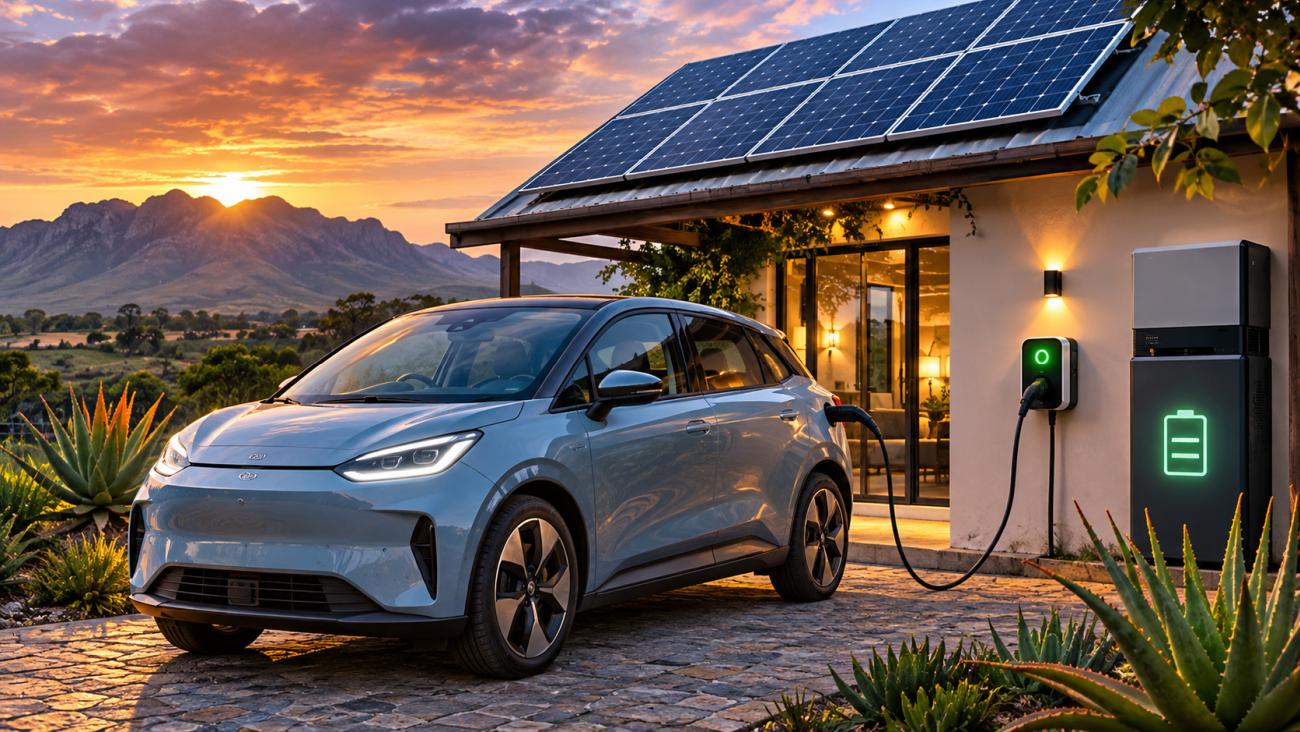

Most electric car reviews start with how fast the car gets to 100km/h and how big the screen is. For a household working towards energy independence, those are the wrong questions. The useful ones are simpler: can you fuel it from your own roof, can it keep the lights on when the grid fails, and does the money work out once you leave the brochure behind?
South Africa has reached the point where these questions can be answered with real numbers. Entry prices have dropped sharply, an off-grid charging network is appearing on the national roads, and petrol has been setting records. This guide works through what an electric vehicle (EV) means for a self-sufficient home, using one of the cheapest EVs on sale here as the running example.
Why the Question Is Worth Asking Now
Until recently, an EV in South Africa was a luxury purchase. Only a couple of years ago the cheapest one cost close to R800,000. According to CAR magazine’s November 2026 list of the most affordable EVs, the Dongfeng Box now starts at R329,000, and the Geely E2, BYD Dolphin Surf, Chery Q and Arcfox T1 all start below R360,000.
Fuel has pushed things along from the other side. CAR magazine’s confirmed November 2026 fuel prices put inland 95 at R30.24 a litre and coastal 95 at R29.37, after months of record highs. Earlier in 2026, inland 95 cost close to R20.
Buyers still haven’t moved much. CleanTechnica reports that only 1,018 passenger battery-electric cars were sold in South Africa in 2025, about 0.17% of the new-vehicle market. People who already run solar at home are in an unusual position, though: for them, the fuel for an EV can be close to free.
How Much Solar Does an EV Actually Need?
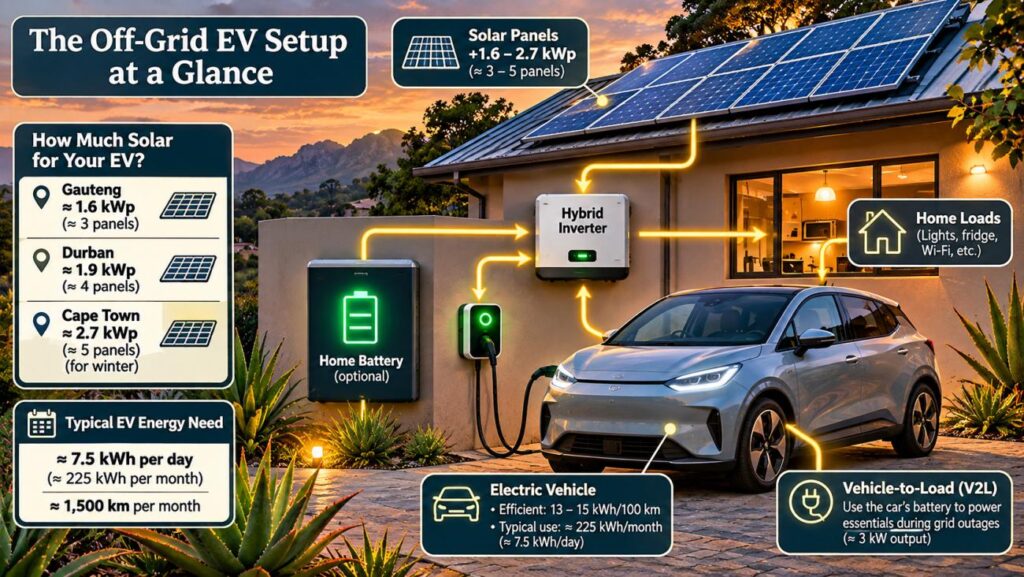
Start with distance. A typical South African car covers somewhere around 1,500km a month. A small, efficient EV uses roughly 13 to 15kWh per 100km once you allow for losses while charging. That works out to about 225kWh a month, or 7.5kWh a day.
How many panels that takes depends on where you live. EnergyBee’s month-by-month solar output figures estimate yearly output at about 1,749kWh per installed kilowatt-peak (kWp) in Johannesburg, 1,681kWh in Cape Town and 1,482kWh in Durban. As daily averages, that is roughly 4.8kWh, 4.6kWh and 4.1kWh per kWp.
Spread across a year, 7.5kWh a day needs about 1.6kWp of extra panels in Gauteng and closer to 1.9kWp in Durban. That is three or four modern 550W panels. Cape Town is the exception. Its winter output falls to about 2.8kWh per kWp a day in June, so carrying a full commute through a Western Cape winter takes nearer 2.7kWp, or about five panels.
The point is that powering a car is a modest add-on to a solar system, not a whole new installation. The harder part is getting the energy into the car at the right time.
The Daytime Charging Problem
Solar power is produced while most commuter cars sit in an office parking lot. If you plug in at 18:00, the car is charging from your home battery or the grid, not from the sun. Moving energy from panels to a home battery and then into a car loses some of it along the way, and it eats into the reserve your household needs to get through the night.
Off-grid households work around this in a few ways:
- Charge on the days the car stays home. Weekends, work-from-home days and short-errand days can cover most of a week’s driving for a lower-mileage household.
- Slow the charger down. Many EVs come with a 7kW wall charger, and the BYD Dolphin Surf accepts up to 6.6kW on AC, according to Business Day’s launch coverage. Most residential hybrid inverters can’t supply that on top of the house’s own load. Set the charger to 10A, about 2.3kW, so that it uses only your spare solar. At that rate it takes around ten hours of sun to take a 38.8kWh battery from 20% to 80%, which is a full sunny day.
- Use a solar-aware charger. Some wall boxes can read your inverter or energy meter and adjust their charge rate to whatever surplus the panels are producing. A setup like this costs more, but it removes the guesswork.
A home charger needs its own dedicated circuit, and the installation must be done by a registered electrician and signed off with a Certificate of Compliance. Don’t skip that step to save money.
Can the Cheapest EVs Charge Slowly From Solar?
All five of the cheapest EVs on sale in South Africa will charge happily at about 2kW, which suits the spare daytime output of a typical home solar system. Under the Type 2 charging standard, a car accepts any current the charger offers from 6A upwards, roughly 1.4kW on a 230V supply. The limit is the charger, not the car.
| Model (entry trim) | Price | Max AC charging | Battery | 20% to 80% at 2kW |
|---|---|---|---|---|
| Dongfeng Box E2 330 | R329,000 | 6.6kW | 32.6kWh | about 10 hours |
| Geely E2 Aspire | R339,900 | about 7kW | 39.4kWh | about 12 hours |
| BYD Dolphin Surf Comfort | R341,900 | 6.6kW | 30kWh | about 9 hours |
| Chery Q Comfort | R349,900 | about 6kW | 42.7kWh | about 13 hours |
| Arcfox T1 Pro | R359,900 | 6.6kW | 42.3kWh | about 12.5 hours |
Prices are from CAR magazine’s November 2026 list of the most affordable EVs. For everyday driving, the full-refill time matters less than it looks. Topping up 7.5kWh a day takes about four hours at 2kW in any of these cars, which fits comfortably into a sunny day.
The thing to check is the charger. A portable unit with a selectable current works well, since 10A is about 2.3kW. A wallbox should let you turn its charge rate down, or have it set automatically by a home energy-management system. Expect slightly higher losses at low power, because the car’s electronics stay switched on for longer while it charges.
How do you hold a car to 2kW or so? The charger sets the limit, not the car. A home charger constantly signals the maximum current the car may draw, and the car never takes more. On a 230V supply, 10A is about 2.3kW and 11A is about 2.5kW. This matters because a hybrid inverter has a hard output limit. Picture a house drawing 2kW while the car charges at 2.5kW. Switching on a 2.2kW kettle brings the total to 6.7kW, comfortably inside an 8kW inverter. If a 3kW geyser on the same supply also switches on, the total reaches about 9.7kW, which is enough to overload many inverters.
A fixed current setting on a portable charger or wallbox takes care of the kettle. For the geyser, you need dynamic load management. That can be a wallbox with a current clamp on your supply, or a smart charger controlled by a home energy system. Either one turns the car down to its 6A minimum, or pauses it, while the big appliance runs, then turns it back up. Some cars also let you cap the charging current from the dashboard or app, which is worth checking on a test drive.
Your Car as a Backup Battery
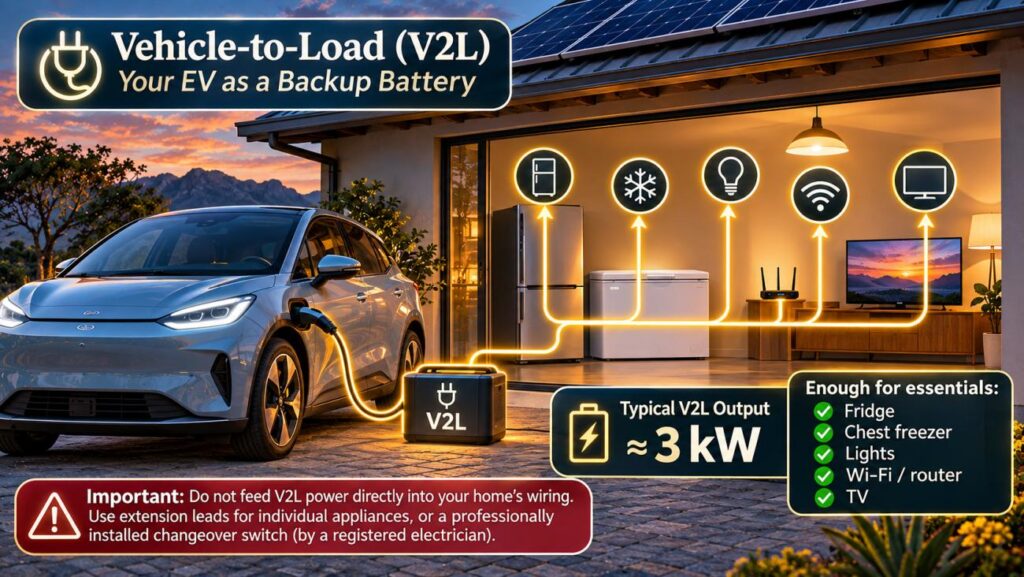
For a self-sufficient home, the most useful feature of many affordable EVs is vehicle-to-load (V2L). This lets the car’s battery power appliances directly, much like a large power bank on wheels. TopAuto lists V2L among the Dolphin Surf’s standard features, alongside its 30kWh and 38.8kWh battery options.
To put that in perspective, the larger Surf battery stores more energy than many home battery banks. On models that publish a figure, V2L output is typically around 3kW. That is enough for a fridge, a chest freezer, lights, Wi-Fi and a TV, but not a geyser, oven or borehole pump. Cars generally stop supplying power at a set minimum charge so you can still drive away, but a mostly full battery can keep the essentials running for several days.
Two cautions apply. First, V2L means running extension leads from the car to individual appliances. Never feed it into your home’s wiring through a homemade plug-to-plug lead. That can send power back down the supply line and endanger anyone working on the network. If you want the car to back up the distribution board, you need a proper changeover switch installed by an electrician. Second, full vehicle-to-home (V2H) setups, where the car works as part of the home’s energy system, need a bidirectional charger and a compatible car. In South Africa these are still limited to a few premium models.
Is backup still worth paying for? Load shedding has largely gone quiet. In April 2026, BusinessTech reported that Eskom had gone 341 consecutive days without it. The same report noted that load reduction still affects many areas, and the plan is for Gauteng and KwaZulu-Natal to be cleared only by early 2027. Add cable theft, storm damage and substation failures, and a battery on wheels is still useful insurance.
Running Costs: Electricity Versus Petrol
Here is the monthly comparison for 1,500km of driving.
A petrol hatchback using 7 litres per 100km burns about 105 litres a month. At November’s prices that costs about R3,175 inland and R3,080 at the coast.
An EV using 225kWh charged entirely from the grid costs anywhere from about R750 to R1,150. The range comes from EnergyBee’s comparison of metro tariffs. Johannesburg’s lowest block is R3.34 per kWh, eThekwini charges a flat R4.17, Ekurhuleni R4.23, and Tshwane’s highest block is R5.12. All of these include VAT. Watch the block structure: the car’s units come on top of what the household already uses, so in Cape Town, Johannesburg and Tshwane they often land in the most expensive block. Eskom-direct customers in towns and rural areas pay a different, usually lower, rate.
Even on grid power, that is a saving of roughly R2,000 to R2,400 a month. Charge mostly from your own panels and nearly all of the R3,000-plus monthly fuel bill goes away. Maintenance is lower too, because an EV has no oil changes, spark plugs, clutch or timing belt.
Here is the full monthly picture for a Dolphin Surf Comfort at R341,900 against South Africa’s best-selling petrol car, the Volkswagen Polo Vivo 1.4 Life at R294,500. Both are financed over 72 months with a 10% deposit at 11.75%. That rate is prime plus 1%, with prime at 10.75% since the Reserve Bank’s September 2026 hike. Running costs assume 1,500km a month at November 2026 fuel prices and July 2026 municipal tariffs.
| Car and how it is fuelled | Price | Repayment per month | Fuel or charging per month | Total per month | Total over 6 years |
|---|---|---|---|---|---|
| Polo Vivo, petrol inland (R30.24/L) | R294,500 | R5,147 | R3,175 | R8,322 | R628,680 |
| Polo Vivo, petrol at the coast (R29.37/L) | R294,500 | R5,147 | R3,084 | R8,231 | R622,100 |
| Surf on grid only, top block (R5.12/kWh) | R341,900 | R5,976 | R1,152 | R7,128 | R547,400 |
| Surf on grid only, lowest block (R3.34/kWh) | R341,900 | R5,976 | R752 | R6,728 | R518,560 |
| Surf on 80% solar, 20% grid (R4.17/kWh) | R341,900 | R5,976 | R188 | R6,164 | R477,960 |
| Surf on solar only | R341,900 | R5,976 | R0 | R5,976 | R464,450 |
The Surf’s repayment is about R830 a month higher, but it costs R1,900 to R3,175 less to fuel. That makes it the cheaper car to run every month in every scenario. Over the six-year loan, including the deposit, the mostly-solar Surf comes out about R150,000 ahead of the Vivo inland. Charged only from the grid, it is still R81,000 to R110,000 ahead.
These totals leave out insurance, servicing and resale value, and they hold fuel and electricity prices flat. The solar rows also need three or four extra panels. At EnergyBee’s 2026 panel prices of R1,650 to R2,500 for a 550W Tier 1 panel, that adds R6,600 to R10,000 before mounting and labour. Your own finance rate depends on your credit record, so treat the repayments as a guide.
What It Costs to Get In
The catch is the purchase price, and a large part of that comes from tax. Bizcommunity’s coverage of Zero Carbon Charge’s tax submission gives an example: an imported EV with a customs value of R500,000 attracts R125,000 in customs duty at the general 25% rate, plus R141,750 in ad valorem excise. That adds R266,750 before VAT. Petrol cars imported from the EU face an 18% duty. Industry groups have repeatedly lobbied Treasury to close that gap.
Despite that, the cheapest EVs now cost only about R50,000 more than South Africa’s best-selling petrol hatchback. The Dolphin Surf’s 8-year/200,000km battery warranty also answers the most common worry about battery replacement cost for most of an average ownership period.
Range, Charging and Life Outside the Cities
The budget EVs are built for town. The Surf is rated at 232km (Comfort) or 295km (Dynamic) on the WLTP test cycle, and its top speed is 130km/h. Highway driving and air-conditioning reduce real-world range further. If your homestead is 80km from the nearest town on gravel, you will manage, but a monthly trip to the coast takes planning.
Public charging is improving, and some of it runs on the same off-grid approach as a self-sufficient home. Zero Carbon Charge opened two fully off-grid charging stations on the Johannesburg to Durban N3 in May 2026, one at the Reitz Interchange in the Free State and one at the Colenso to Winterton Interchange in KwaZulu-Natal. According to CBN’s report on the N3 launch, both run on solar microgrids with battery storage. Each can charge up to eight vehicles at once and takes a typical EV from 20% to 80% in about half an hour. The N1 is next, with a goal of 120 stations nationally. Beyond the main routes, coverage is still thin.
Practical Checks Before You Buy
- Dealer distance: Find out where the nearest dealer that services the model is, and whether it can repair high-voltage systems.
- Insurance: Get quotes before you sign. Premiums for newer Chinese brands vary widely between insurers.
- Inverter headroom: Check whether your inverter and battery can handle a car charger without tripping, or plan to throttle the charger.
- V2L accessories: Confirm whether the V2L adaptor comes with the car or costs extra.
- Real mileage: Check your actual monthly distance from fuel slips or a tracking app rather than guessing.
So, Does an EV Belong on a Self-Sufficient Homestead?
It does for the right household. If you already have solar, mostly drive locally and can charge during daylight a few days a week, a small EV turns your roof into your fuel supply and gives you a large backup battery in the driveway. If you regularly drive long distances in remote areas, or your solar system has no spare capacity, a hybrid or an efficient petrol car is still the more practical choice for now.
What has changed is that the question is no longer only for the wealthy. At around R330,000, with fuel above R29 a litre, the arithmetic is worth doing for your own situation.