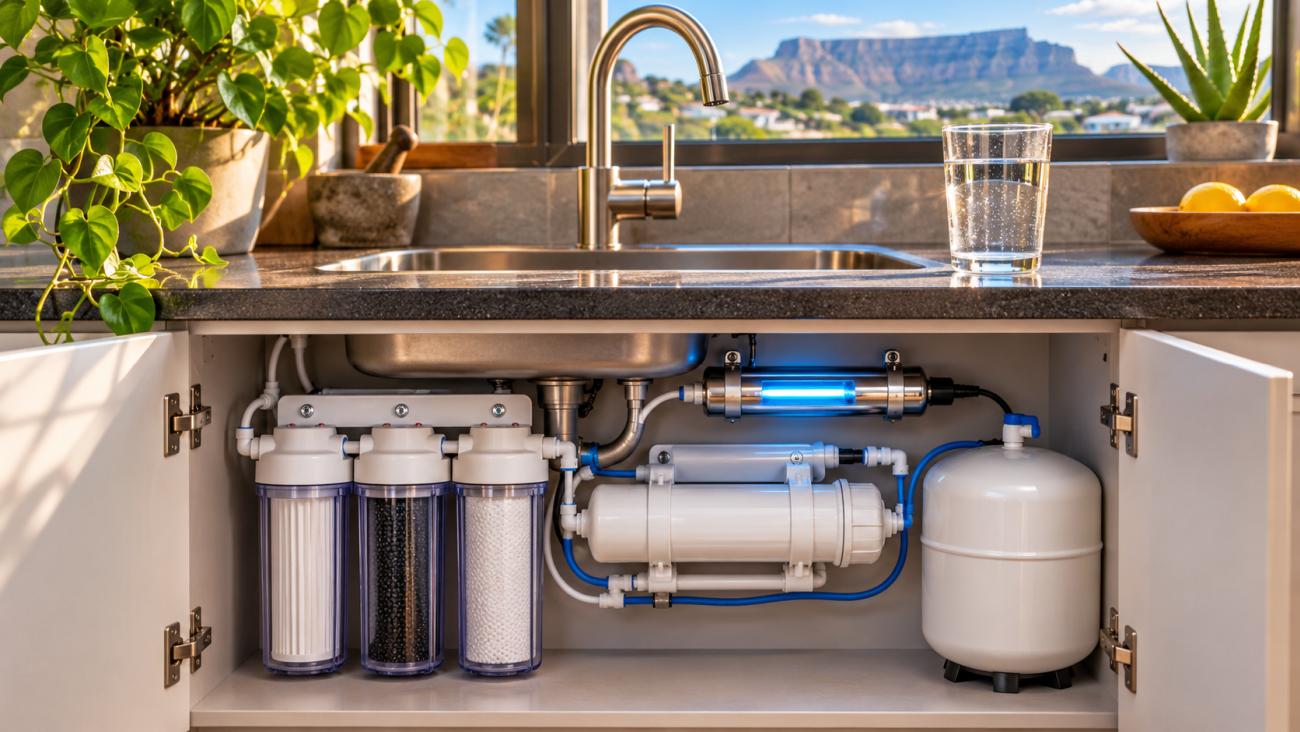

Walk into any hardware store or scroll through an online shop and you will find under-sink water filters promising everything from “pure” water to “99.99% of germs removed”. Some of those claims are true, some are true only under lab conditions, and a few are simply marketing. The four technologies behind almost every system sold in South Africa are carbon filtration, ultrafiltration, reverse osmosis and ultraviolet (UV) sterilisation. Each one solves a different problem, and the right setup for a flat in Cape Town on reliable municipal supply is not the same as the right setup for a smallholding on a borehole in Limpopo. This guide explains what each stage actually does, what it cannot do, what it costs to buy and run, and how to match a system to the water coming out of your tap.
Why South African households are filtering their tap water
The case for a filter is no longer just about taste. The Department of Water and Sanitation’s 2023 Blue Drop assessment found that close to half of the country’s 958 drinking water systems had poor or bad microbiological compliance at some point during the audit period, a sharp slide from just 5% in 2014. As Daily Maverick’s report on the Blue Drop findings noted, only 26 systems nationally earned full Blue Drop certification, 15 of them in the Western Cape and none in the Eastern Cape. Chemical quality slipped too: the Mail & Guardian’s coverage reported that almost a quarter of systems had unacceptable chemical compliance, against 15% a decade earlier.
The national picture hides big local differences. Water in the large metros is generally good, while many smaller towns struggle. But even good water can be compromised on its way to your house. Supply interruptions are now routine in several metros, and in November 2026 Tshwane reported some reservoirs as low as 5% according to EWN’s update on the city’s supply. When pipes run dry and then refill, the first water through the tap is often cloudy or discoloured, and a network that loses pressure is more vulnerable to contamination. The worst case is a matter of record: the 2023 cholera outbreak in Hammanskraal eventually claimed 32 lives, and the Water Research Commission found that both the local drinking water works and the upstream sewage works were failing, as set out in Daily Maverick’s account of the WRC investigation.
None of this means every household needs an elaborate system. It means you should know what each stage protects you from, so you buy the protection you actually need.
Sediment and carbon: the stages almost every system starts with
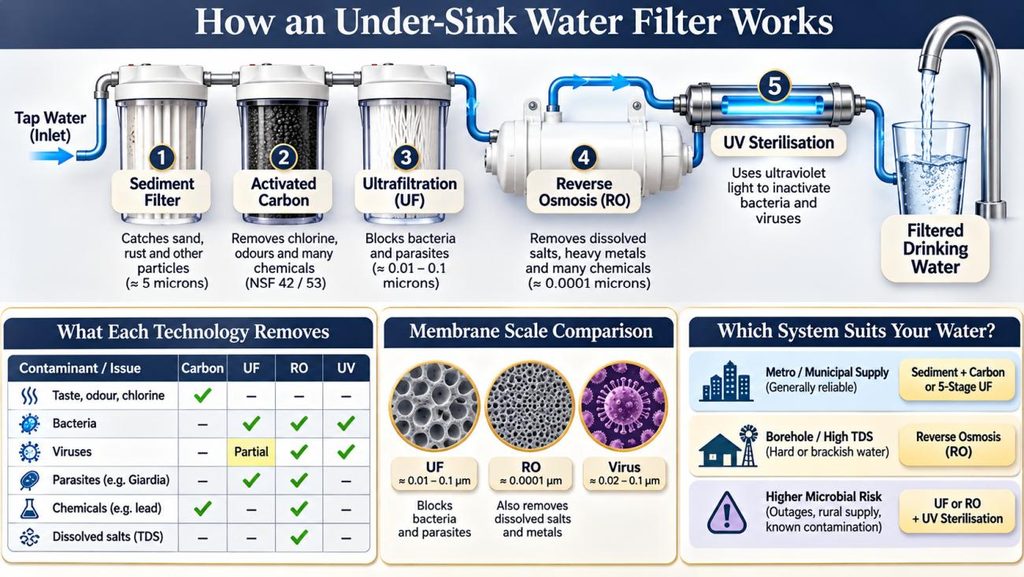
Nearly every under-sink unit begins with a sediment cartridge, usually rated at 5 microns, which catches sand, rust flakes and the grit that arrives after a pipe burst or outage. It is cheap, it protects everything downstream, and it is the cartridge that clogs first when your supply is dirty.
Next comes activated carbon, either as loose granules or as a compressed block. Carbon grabs chlorine and many organic chemicals, which is why it transforms the taste and smell of municipal water. Here certification matters. The NSF standards for water treatment systems separate filters certified under NSF/ANSI 42, which covers taste, odour and chlorine, from those certified under NSF/ANSI 53, which covers contaminants with health effects such as lead. A filter that only claims “NSF 42” will make water nicer to drink, but it has not been proven to make it safer.
What carbon does not do is reliably stop bacteria or viruses. A carbon filter is a taste and chemical stage, not a disinfection stage, so on its own it is only a sensible choice where your water is already microbiologically safe.
Ultrafiltration: the membrane that keeps your minerals
Ultrafiltration (UF) pushes water through hollow fibres with pores of roughly 0.01 to 0.1 microns, small enough to physically block bacteria and parasites such as Giardia and Cryptosporidium. According to the CDC’s overview of home water treatment systems, ultrafiltration removes parasites and bacteria, may let some viruses through, and does not remove chemicals.
UF has three practical advantages for South African homes. It runs on ordinary mains pressure without a pump, it needs no electricity, and it produces no wastewater, because nothing is flushed down a drain. It also leaves dissolved minerals such as calcium and magnesium in the water, so the taste stays close to what you are used to. Most UF units sold locally combine the membrane with sediment and carbon cartridges, which makes a five-stage UF system a solid all-rounder for metro households whose main worries are taste, sediment and the occasional microbiological slip.
Reverse osmosis: the most thorough option, with a cost in water
Reverse osmosis (RO) forces water through a membrane with pores around 0.0001 microns, fine enough to hold back dissolved salts and metals. The CDC lists RO as effective against parasites, bacteria and viruses and against chemicals such as lead, copper, chromium, sodium and chloride, though it may only partly reduce arsenic, fluoride and nitrate. That makes RO the system to consider when your problem is chemical: hard or brackish borehole water, high total dissolved solids, or a known metals issue.
RO has trade-offs that the box rarely mentions. The first is wastewater. To keep the membrane clean, an RO system sends a stream of concentrated water to the drain, and University of Nevada extension guidance on reverse osmosis puts the figure at two to four units of water for every unit of treated water in most systems, with output dropping further in cold water. Newer high-efficiency units do better, but in a water-scarce country it is worth checking the ratio before you buy, and worth routing the reject line to a garden bucket or a rainwater harvesting tank rather than straight into the drain.
The second trade-off is pressure. Most RO membranes need decent incoming pressure to work well, so homes on low-pressure supply or a gravity-fed tank often need a booster pump, which adds cost and an electrical connection. The third is that RO strips minerals along with contaminants, which some people find gives a flat taste; many systems add a remineralisation cartridge at the end for this reason. Finally, the Extension Foundation’s reverse osmosis fact sheet cautions that RO on its own is not recommended for treating bacteria and other micro-organisms, and it advises replacing pre and post filters at least once a year.
UV sterilisers: the last line of defence against germs
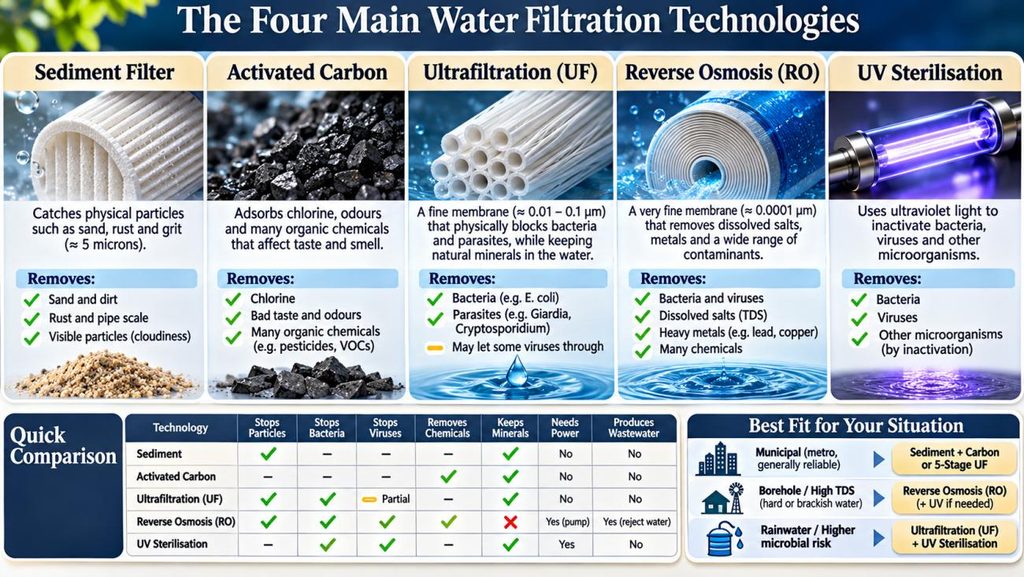
A UV steriliser is a stainless-steel chamber with a UV-C lamp inside a quartz sleeve. Water flows past the lamp and the light damages the genetic material of bacteria, viruses and parasites so they cannot reproduce. Nothing is added to the water and nothing is removed from it, which is both the strength and the limitation of UV: it disinfects, but it does nothing for taste, chlorine, metals or dissolved solids.
UV only works on clear water, because sediment and cloudiness shield microbes from the light. That is why it is always installed as the final stage, after sediment and carbon or after an RO or UF membrane. For buyers, the key standard is NSF/ANSI 55, which separates Class A units designed to disinfect untreated water from Class B units meant only as a supplementary treatment for water that is already disinfected.
Three practical points matter more than the wattage on the label. First, flow rate: a UV chamber is rated for a maximum flow, and small 6W under-sink units are often rated at around a litre a minute or less, which suits a dedicated drinking tap but not a full-flow kitchen mixer. Second, power: the lamp must be on whenever water flows, so during a power cut untreated water passes straight through unless you have backup power or a solenoid valve that stops the flow. Third, lamp life: most lamps are rated for 8,000 to 9,000 hours, which is roughly a year of continuous running, and the lamp keeps glowing long after its germicidal output has faded, so replace it on schedule rather than waiting for it to fail. Units with a lamp-failure alarm are worth the small premium.
Matching the system to your water
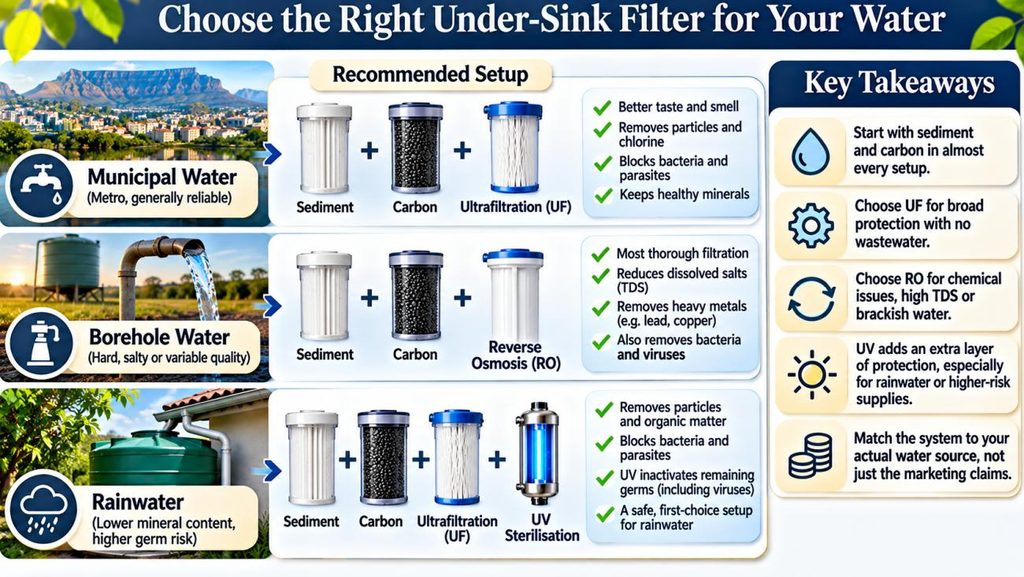
The simplest way to choose is to start with your source and your specific worry.
- Metro municipal water with taste or chlorine complaints: a sediment plus carbon block system certified to NSF/ANSI 42 is usually enough.
- Metro water where outages, dirty water after restoration or microbiological reports worry you: a UF system, or carbon followed by a UV stage.
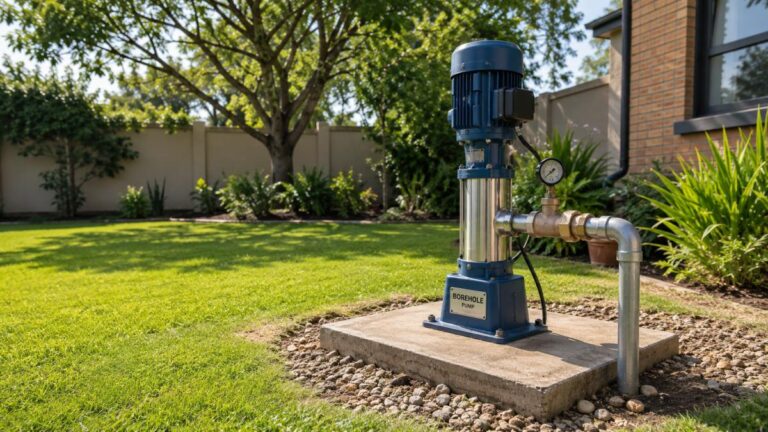
- Borehole or wellpoint water: test it first. Hard, salty or high-TDS water points to RO; microbial contamination points to UF or UV after good pre-filtration. Our borehole cost guide covers testing as part of the permit process.
- Rainwater: UF or UV after sediment and carbon is the usual combination, since rainwater is low in minerals but can pick up bacteria from roofs and gutters.
Whatever your source, a lab test against the SANS 241 drinking water standard tells you far more than any sales brochure. Test once before you buy and again after installation to confirm the system is doing its job.
What under-sink systems cost in South Africa
Prices on major South African online stores in November 2026 fall into clear bands. A basic three-stage slimline sediment and carbon unit costs around R800. Five-stage UF systems range from roughly R730 for entry-level units to about R2,800 for stainless-steel models with branded membranes. A 75-gallon-per-day RO system with a storage tank starts around R1,800, while tankless high-output RO units of 400 to 800 gallons per day sell for roughly R4,000 to R4,700. A small 6W inline UV steriliser to add as a final stage costs about R600 to R850.
The purchase price is only part of the cost. Budget for replacement sediment and carbon cartridges every six to twelve months depending on how dirty your water is, a UF membrane or RO membrane every two to five years, and a UV lamp every year. Sediment cartridges clog fastest in areas with frequent outages, because every restoration sends a slug of debris through the pipes.
Installation and the maintenance people forget
Most under-sink units are designed for DIY installation. They tee off the cold-water supply under the sink and feed a separate drinking tap through 1/4 inch push-fit tubing. RO units also need a drain connection for the reject water, and both RO boosters and UV lamps need a plug point inside or near the cabinet, which is the step that catches many people out.
Maintenance is where systems succeed or fail. Write the installation date on each cartridge, flush new carbon cartridges for a few minutes before drinking from them, and wipe the UV quartz sleeve when you change the lamp, because scale on the glass blocks the light. After a long outage, run the filtered tap for a minute when supply returns before you fill a glass.
How to tell a good system from a box of parts
Look for a specific certification claim rather than vague wording such as “tested to NSF standards”. A genuine claim names the standard and the contaminant, and it can be checked. Choose a system that uses standard 10-inch cartridges and standard fittings so you are not locked into one supplier for replacements. Check that replacement parts are actually in stock locally before you buy. And be wary of any listing whose specifications contradict each other, such as a lamp wattage in the title that differs from the one listed in the box contents.
The bottom line
No single filter does everything. Carbon fixes taste and many chemicals, ultrafiltration blocks bacteria and parasites while keeping minerals, reverse osmosis handles dissolved salts and metals at the cost of some water, and UV disinfects clear water as long as the lamp is powered and fresh. For most metro homes, a well-certified UF or carbon-plus-UV setup covers the realistic risks. For borehole households, a water test should decide between UF and RO. If you are building towards full water independence, an under-sink system is the cheapest place to start, and our guides to purifying any source of water and running a purification system off solar take it further.
Disclaimer: This article is for general information only and is not professional water treatment, plumbing, electrical or medical advice. No home filter makes every water source safe to drink, and performance depends on the specific product, its certification, correct installation and regular maintenance. Have your water tested by an accredited laboratory if you rely on a borehole, rainwater or any source you are unsure of, and follow municipal boil-water notices whatever filter you use. Systems that connect to mains plumbing or need a power point should be installed according to the manufacturer’s instructions, and by a qualified plumber or electrician where required. Product prices were correct at the time of writing and may change, so check with suppliers before you buy.