


South Africa now has an enormous amount of solar power on its rooftops. Eskom’s own weekly reporting put behind-the-meter rooftop solar at roughly 9,430 MWp by September 2026. That is only marginally less than Medupi and Kusile, the utility’s two biggest coal stations, can produce together at full output.
Very few of the homes behind that capacity have formally told Eskom about their systems. Eskom’s distribution division recently presented figures at an EE Business Intelligence webinar. They show that only about 184 Eskom Direct households have moved onto the Homeflex tariff, and Homeflex is compulsory for any residential customer who registers a solar system with Eskom. After more than two years of campaigns, deadlines and warnings, the number of homes that have actually completed the process is tiny.
If you have panels on your roof, or are planning to install them, it is fair to ask what this means for you. This guide sets out where the rules stand today, what registration involves, and how to decide.
Why the Homeflex number tells the real story
Eskom does not let residential solar owners register and stay on their old tariff. Its residential tariff page says that households with rooftop PV must be on Homeflex. Homeflex is a time-of-use tariff, so the price of each unit changes with the hour and with the season. Electricity costs most during the morning and evening peaks, especially in winter, and least overnight and over parts of the weekend.
Eskom moved its first customer onto Homeflex in June 2024. Since then, roughly 184 households have made the switch. For comparison, around 59,000 Eskom homes are on Homepower 4, the most common single-phase residential tariff. Eskom had previously reported 1,485 registered small-scale embedded generation (SSEG) systems by November 2025, but that total included businesses.
Energy analyst Chris Yelland reads the Homeflex figure as a good proxy for how many Eskom households have actually registered. It is an inference rather than an official registration count, but the gap is hard to ignore. Industry estimates suggest there are somewhere between 40,000 and 80,000 unregistered residential solar systems on Eskom and municipal networks combined.
How Eskom softened its stance during 2026
At the start of 2026, Eskom was talking tough about penalties and disconnection for unregistered systems. That position has eased in several steps:
- The original registration deadline of 31 March 2026 was pushed out to 30 September 2026.
- Eskom no longer insists on sign-off by an engineer registered with the Engineering Council of South Africa (ECSA). A certificate of compliance (CoC) from an electrician registered with the Department of Employment and Labour is now enough.
- Eskom withdrew its earlier threats to fine or disconnect households purely for not registering. Daily Maverick set out the concessions Eskom made after pressure from OUTA.
- On 30 September, Eskom extended its fee waiver until further notice for eligible systems up to 50 kVA, without setting a new deadline.
Eskom’s own SSEG registration page now states plainly that it has not fined customers for failing to register. Eskom still maintains that registration is a legal requirement for any grid-connected system under 100 kVA, whether or not it exports power. It also reserves the right to act against installations it considers unsafe.
What registering with Eskom actually involves
If you are an Eskom Direct customer, registration happens online through Eskom’s customer application portal. You need three documents:
- a valid CoC covering the installation
- a type test certificate for your inverter, showing compliance with NRS 097-2-1 (your supplier or installer should have it)
- an Embedded Generation Installation (EGI) test report, which a registered installation electrician or master installation electrician may now sign
Once Eskom approves the application, it installs a bidirectional smart meter. Without the waiver, Eskom puts the quotation, connection and smart meter costs at roughly R10,800 before VAT. For systems up to 50 kVA, those charges are currently waived.
After that, you move to Homeflex, and a few details are worth knowing:
- Export credits: Exported energy earns credits on your bill, not cash payments. The credits only offset the energy portion of your account, not fixed charges.
- Prepaid meters: Export on prepaid metering is not yet fully supported, so some households may have to move to a postpaid arrangement.
- Deposits: Eskom says it reassesses deposits case by case when a customer changes to a time-of-use tariff.
The case for holding back
The Organisation Undoing Tax Abuse (OUTA) has been the most prominent voice against compulsory registration. In a detailed Q&A on homeowners’ rights, Yelland and OUTA set out their reasoning:
- The CoC is the safety proof. A CoC issued under the Occupational Health and Safety Act, and backed by the mandatory SANS 10142-1 wiring standard, is the lawful evidence that a behind-the-meter installation is safe.
- Non-exporting systems may skip registration. In their view, a homeowner with a valid CoC whose system blocks export to the grid may choose not to register.
- Cost concerns. They worry that registration is being used to move households off cheap prepaid arrangements onto postpaid, time-of-use billing with higher fixed costs.
- Eskom already has the data. Eskom says it needs registrations to know how much solar is out there. OUTA points out that the system status reports, now published by the National Transmission Company of South Africa, already estimate rooftop capacity every week.
There is another side. Eskom and the energy regulator say registration depends on whether a system is connected to the grid, not on whether it exports. Eskom says solar and non-solar customers pay the same fixed charges. The South African Photovoltaic Industry Association has supported registration on grounds of worker safety and grid stability. None of this has been tested in court, so treat both positions as arguments rather than settled law.
The case for registering
In some situations registering is clearly the right call.
You export power. If your system feeds electricity into the grid, or you want credits for surplus power, register. Even OUTA accepts that exporting customers need approval, a connection agreement and the right meter.
The meter is free for now. While the waiver lasts, Eskom Direct customers avoid a bill of around R10,000. Nobody can say how long that will continue.
Your household can shift its usage. Homes with a battery and the ability to run heavy loads outside peak hours can come out ahead on a time-of-use tariff, because off-peak units are cheaper. If you use a lot of grid power in the early evening, the numbers may work against you. Run the figures for your own usage before switching.
Your paperwork needs to be complete. After a fire or electrical fault, your insurer will want to see that the installation was compliant. When you sell your home, you will need a valid electrical CoC for the transfer. Getting your documentation in order is worth doing whether or not you register.
Municipal customers play by different rules
Eskom’s waiver and its Homeflex requirement apply only to customers supplied directly by Eskom. Many South African households buy electricity from their municipality instead, and each metro sets its own by-laws, fees and tariffs.
The City of Cape Town has one of the most developed systems. Its online SSEG authorisation process is free, but unauthorised systems attract a service fee. The City cross-checks registrations against aerial photographs. Owners caught with an unregistered system can be told to disconnect it within five working days and to start the authorisation process within a month.
In Cape Town, a system that blocks reverse power flow can stay on the existing tariff. Exporters need an advanced meter at their own cost and move to the SSEG tariff. The City no longer accepts applications for new standby or off-grid systems. It also still requires sign-off by an ECSA-registered professional, unlike Eskom.
Johannesburg’s City Power runs its own application process. In 2026 it drew criticism from OUTA over pre-approval requirements and complaints that earlier applications had gone unprocessed. Tshwane, Ekurhuleni, eThekwini, Nelson Mandela Bay, Mangaung and smaller municipalities all have their own approaches. Before you do anything, check your municipality’s current electricity by-laws and tariff schedule.
A practical checklist for solar owners
- Find out who supplies you. An Eskom bill means Eskom’s rules apply. A municipal rates and services account means your municipality’s rules apply.
- Check your CoC. Confirm it specifically covers the solar and battery installation, not just the original house wiring. If it does not, have a registered electrician issue a new one.
- Ask for the inverter certificate. Get the NRS 097-2-1 type test certificate from your installer and keep it with your CoC.
- Decide whether you will export. If yes, registration is unavoidable. If not, make sure export blocking is properly configured.
- If you are an Eskom Direct customer, model Homeflex first. Compare it with your current tariff using a few months of your own consumption, and ask whether your deposit will change.
- Tell your insurer. Do this whatever you decide about registration.
- Keep everything in one place. That includes certificates, invoices, test reports and any correspondence with your utility.
The bottom line
About 184 registered households, set against tens of thousands of rooftop systems, show that the current registration model is not working for most homeowners. Eskom has responded by dropping its threats, simplifying sign-off and suspending fees indefinitely, but it has not changed its view that registration is required.
For now, Eskom Direct customers face no fines and no fixed deadline. The sensible course is to make sure your installation is safe and properly certified, register if you export or want credits, and weigh the tariff consequences carefully if you do not. Policy in this area has changed several times in a single year, so check your supplier’s rules again before making any major change.
Disclaimer
This article is for general information only and is not legal, financial, electrical or insurance advice. Registration rules, fee waivers and tariffs for rooftop solar change often, and they differ between Eskom and individual municipalities. The information here reflects the position at the time of writing and may be out of date by the time you read it.
Before you register, change your tariff, alter your installation or decide not to register, confirm the current requirements directly with your electricity supplier. For advice on your specific situation, consult a registered electrician, your insurer or a qualified legal professional. Any electrical work on your system must be done by a person registered with the Department of Employment and Labour. SelfSustain accepts no liability for decisions made on the basis of this article.

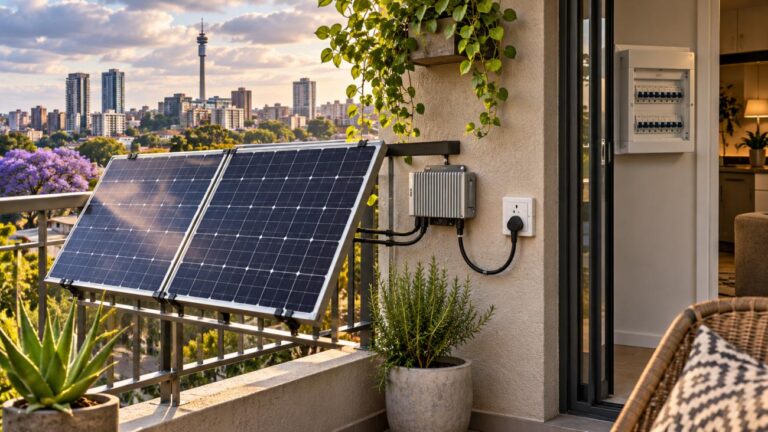






[…] Before you buy, ask the supplier for the inverter’s NRS 097-2-1 type-test certificate and check your municipality’s approved inverter list where one exists. If a seller cannot produce the certificate, look elsewhere. For a fuller picture of what registration involves and why so few households have done it, see our piece on why fewer than 200 Eskom households have registered their rooftop solar. […]