
This summer is shaping up to be a hot one. The South African Weather Service warned in September that a strong El Niño was developing and that above-normal temperatures were very likely through to January, with heatwaves expected to become more frequent, as SAnews reported in its summary of the SAWS outlook. By mid-November that forecast had already arrived, with EWN reporting a heatwave across Gauteng, the Free State and the Northern Cape and Upington forecast to top 40°C.
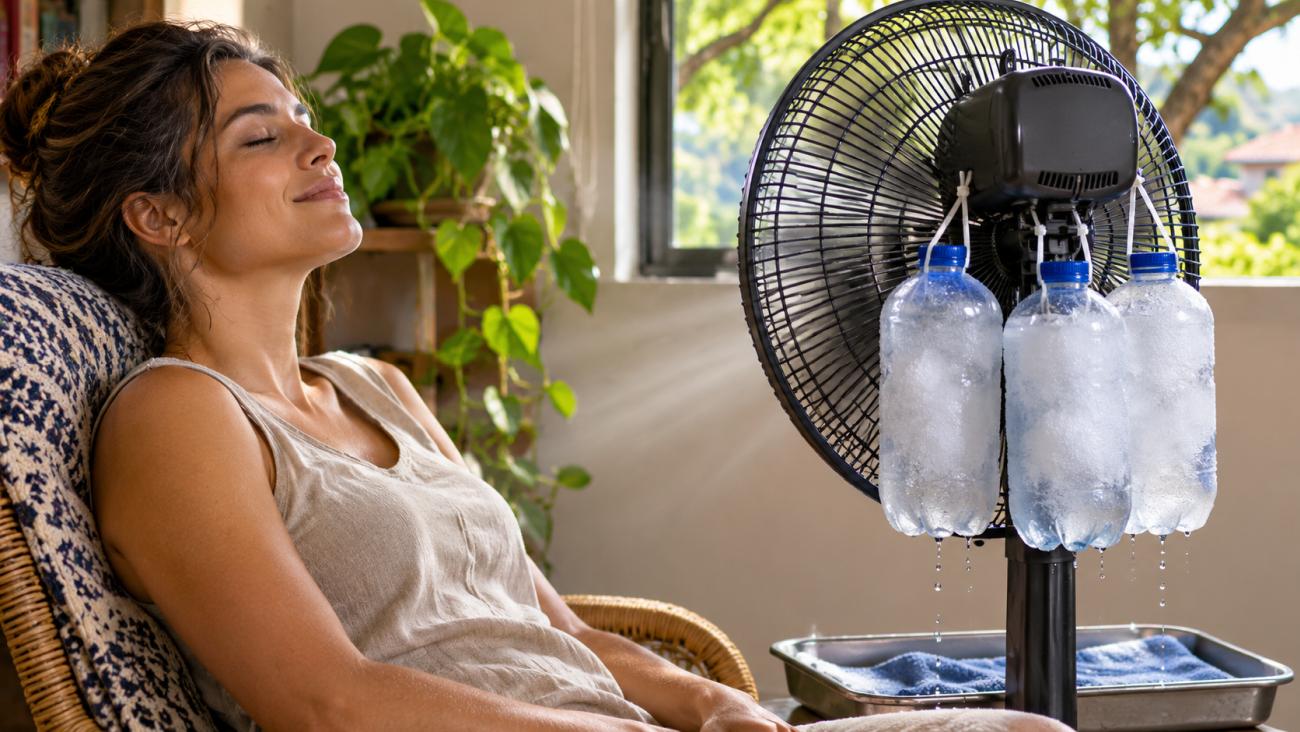
Aircon is the obvious answer, but it is expensive to buy, expensive to run, and close to useless during a power cut unless you have a large inverter and battery bank. One of the oldest low-tech alternatives is also one of the simplest: put frozen water bottles in front of, or behind, an ordinary fan. It costs almost nothing, it runs on a fraction of the power, and it genuinely helps. It also gets oversold online. This guide explains how it works, how to set it up safely, what it can realistically do, and how to make it fit a South African home running on solar.
How a frozen bottle fan actually cools you
Ice is a store of cold. When a kilogram of ice melts, it soaks up a large amount of heat without changing temperature, which physicists call the latent heat of fusion. For water that figure is 334 kJ per kilogram, as set out in this open physics textbook’s chapter on latent heat. A fan pushing warm room air across a frozen bottle forces that air to give up some of its heat to the ice, so the air coming out the other side is cooler.
It helps to put numbers on it. A two-litre bottle frozen solid in a household freezer holds roughly 900 kJ of cooling by the time it has melted and warmed to room temperature. That is about a quarter of a kilowatt-hour. Four such bottles over an eight-hour night average out to somewhere around 125 watts of cooling. For comparison, a resting adult gives off roughly 100 watts of body heat, and even a small split aircon removes well over 2,000 watts of heat from a room.
That comparison tells you exactly what the frozen bottle fan is good for. It will not cool a room the way an air conditioner does. What it does well is cool the person sitting or sleeping in the airflow, by blowing a stream of noticeably cooler air across them. Think of it as personal cooling, not room cooling, and it will not disappoint you.
What you need
The setup is simple and uses things most households already have:
- A fan. A desk fan suits one person at close range; a pedestal or box fan covers a bed or a couch. Oscillating fans spread the cooler air further.
- Plastic bottles with screw caps, from 500 ml up to two litres. Reused cooldrink or water bottles are fine, as are commercial freezer ice packs.
- Something to hang them with: zip ties, cable ties, bread-bag ties, picture hooks, S-hooks, opened-out paper clips or a length of cotton cord.
- A tray or folded towel to go under the fan, because the bottles will drip.
- A space in your freezer for a second set of bottles, so you can swap them as they melt.
Setting it up
Fill your bottles to about 90% to leave room for expansion, cap them tightly and freeze them overnight. Squeeze one before you use it: it should be hard all the way through.
Attach a hanger to the neck of each bottle rather than tying the bottle to the fan. A short zip tie around the neck with a picture hook or bent paper clip through it lets you hook the bottle onto the fan’s grille and lift it off again in a second. That matters, because the whole system depends on rotating melted bottles back into the freezer and bringing frozen ones out.
Hang the bottles on the back grille, where the fan draws air in, so all the air passes over the ice before it reaches you. On a box fan you can drape pairs of bottles joined at the handles over the top so one hangs behind and one in front, which gives the air two passes over ice. Whatever fan you use, keep two rules in mind. Do not cover more than about a third of the grille, because a starved fan moves less air and its motor can overheat. And keep bottles and drips well away from the motor housing.
Point the fan at where you will be, not at the middle of the room, and keep it close. The cool stream fades within a couple of metres.
For a demonstration, this video from the Zen Garden Oasis channel shows the idea in a home workshop, including several ways to hang the bottles so they are quick to swap.
The salt question: colder, not longer
A popular tip, repeated in that video, is to add salt to the water before freezing it, on the basis that salty ice melts more slowly. The chemistry actually points the other way, and it is worth understanding before you start dosing your bottles.
Salt lowers the temperature at which water freezes. The more salt, the lower the freezing point, down to about minus 21°C for a solution of 23.3% salt, as Chemguide’s explanation of the salt and water phase diagram shows. The tip of three to four tablespoons of salt to a cup and a half of water works out to roughly 13 to 16% salt by weight, which according to the freezing point table for salt solutions on Wikipedia starts to freeze at around minus 8 to minus 12°C.
That has three consequences. First, brine ice sits colder than plain ice while it melts, so the air coming off it is a little cooler. Second, it does not store more cooling. The salt takes up space that would otherwise be water, and only the water part freezes and melts. Third, salty water freezes over a range of temperatures rather than all at once, and the last of it only sets near minus 21°C. Most household freezers run at about minus 18°C, so a strong brine bottle often comes out with a slushy core, which is why the video recommends turning your freezer colder and squeezing the bottle to check it.
The practical advice: plain water is fine and gives you the most stored cooling per bottle. A small amount of salt, a tablespoon or so per litre, gives slightly colder air at little cost. Heavily salted bottles are not worth the extra freezer effort. If you do use salt, mark those bottles clearly so nobody drinks from them, and wipe the hangers, because salty drips corrode metal.
Humid coast or dry interior
Where you live changes how well this works. The bottles sweat because warm, moist air condenses on the cold plastic. In humid places such as Durban, the KwaZulu-Natal north coast or the Lowveld in mid-summer, a good share of the ice’s capacity goes into condensing that moisture rather than cooling the air, so you get less temperature drop and a lot more drip. You also get slightly drier air, which still feels better.
In the dry heat of the Highveld, the Karoo, the Northern Cape or the Western Cape interior, there is less moisture to condense, so more of the cooling goes into the air and the effect is stronger. Evaporative methods such as a wet cloth over a fan or a zeer pot also work best in dry air. On the humid coast, frozen bottles are the better choice, because evaporative coolers struggle when the air is already damp.
Running it on solar
The catch with ice is that somebody has to freeze it. Your freezer pumps the heat out of the water and dumps it, plus the energy it used, into your kitchen. Done at night on grid power, you are mostly shifting electricity use rather than saving it.
The picture changes on a solar system. Most rooftop systems produce more power around midday than the house can use, and once the batteries are full that surplus is wasted. Loading the freezer with water bottles in the morning turns that surplus into stored cold. At night, the fan is all that runs. A typical pedestal fan draws roughly 40 to 60 watts, so an eight-hour night uses well under half a kilowatt-hour of battery, while a small aircon would draw that much in well under an hour. If you are still planning a system, our guide to the more affordable way to go solar covers the basics, and our piece on finding the appliances that inflate your bill shows how to measure what your fan and freezer actually use.
The same habit helps in a power cut. A freezer full of frozen bottles holds its temperature longer than a half-empty one, and the FoodSafety.gov guidance on power outages puts a full freezer at about 48 hours against 24 hours half full. Plain-water bottles also melt into drinking water, which is useful during the water outages that often come with load reduction and pump station failures. Keep the freezer door shut as much as you can, and make each bottle swap quick.
Safety first
Water and mains electricity need respect. In South Africa, socket outlet circuits must be protected by an earth leakage unit under the wiring code, and that device exists to protect people when current leaks through water or damaged insulation, as Lite-Glo’s explainer on earth leakage and circuit breakers sets out. Press the test button on your earth leakage unit to check it trips. If you run the fan from an inverter or a portable power station, confirm that circuit is also protected; if you are unsure, ask a registered electrician.
Beyond that:
- Always hang bottles below or behind the motor, never above it, and keep drips off the cord and plug.
- Put a tray or towel under the fan and check it before bed.
- Make sure hooks and ties cannot swing into the blades. Run the fan for a minute and watch.
- Stabilise pedestal and box fans, especially with children or dogs in the house. A heavy base or a board screwed underneath helps.
- Never cover the whole grille, and switch off if the motor feels hot.
Getting the most from it
A few small habits make a real difference. Freeze two full sets of bottles so one is always ready. Use larger bottles for overnight cooling, since they last longer than small ones. Combine the fan with the basics: close curtains on sunny windows during the day and open windows once the outside air is cooler than inside. Our guide to keeping your home cool without aircon covers insulation, shading and ventilation, which do far more to keep a room cool than any fan.
The frozen bottle fan is not air conditioning, and anyone promising a 10 or 20 degree drop across a whole room is overselling it. What it does offer is a cheap, quiet, low-power way to sleep through a hot night, especially if your freezer runs on midday sun. For most South African households heading into a hot El Niño summer, that is well worth the price of a few empty bottles.
Disclaimer: This article is for general information only and is not professional electrical, engineering or medical advice. Using water near mains-powered appliances carries a risk of electric shock, so run fans only on earth leakage protected circuits, keep water away from motors, cords and plugs, and stop using any fan that is damaged, overheating or wet inside. If you are unsure about your wiring, inverter or backup power setup, consult a registered electrician. Cooling, power use and energy figures are indicative estimates and will vary with your fan, freezer, room and climate. Salted bottles are not safe to drink, so label them clearly and keep them away from children and pets. A frozen bottle fan is not a substitute for proper cooling for babies, older people or anyone vulnerable to heat, and if anyone in your home shows signs of heat stroke, such as confusion, a very high body temperature or fainting, seek medical help immediately.