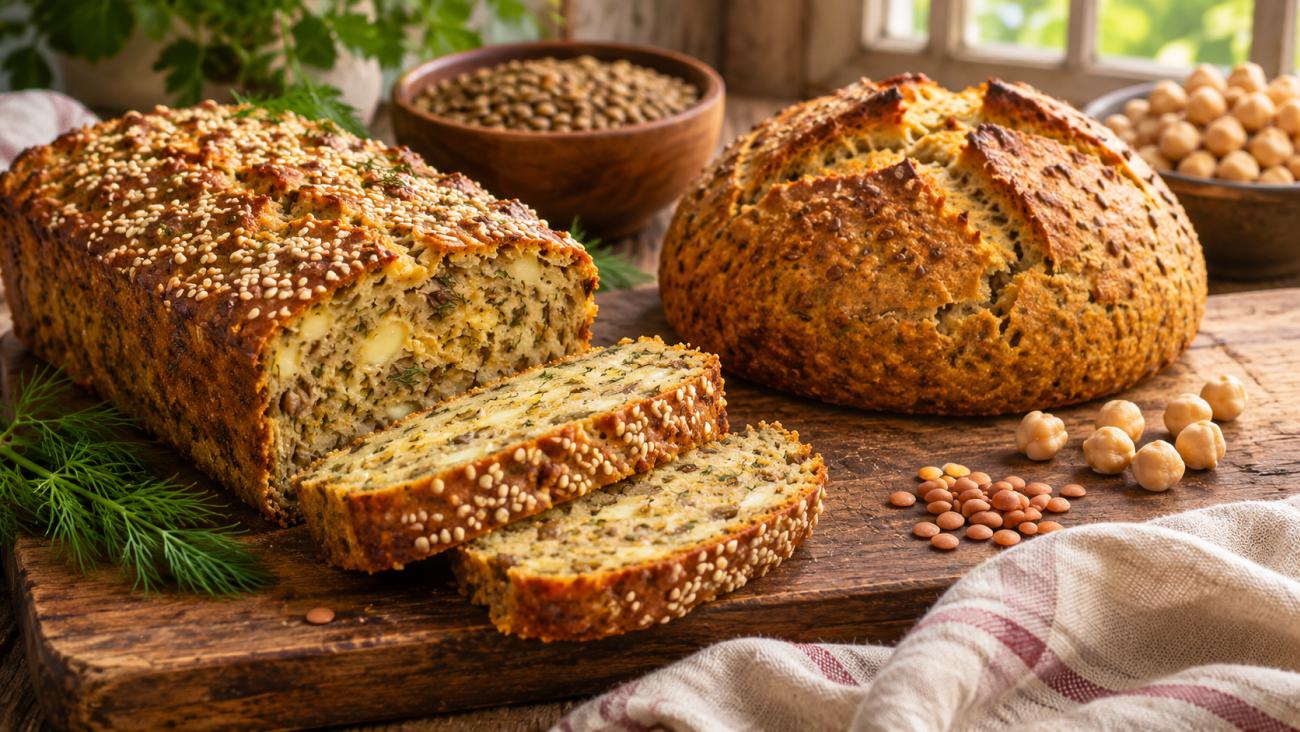

Bread without flour sounds like it shouldn’t work. But whole dried pulses can become a dense loaf you can slice, using just an overnight soak, a blender and a hot oven. There’s no yeast to wake up, no kneading and no waiting for dough to rise. That matters if you’re trying to depend less on the shops. A bag of dried lentils or chickpeas keeps for months in the cupboard, and you can turn it into bread on whatever day you need it.
This guide gives you two versions. The first is a savoury flourless lentil bread made richer with eggs, two cheeses, sesame and fresh dill, served with a quick avocado and basil spread. The second is fully plant-based: a chickpea loaf held together with flaxseed and psyllium and lifted by a bicarbonate and vinegar reaction. Neither uses wheat or yeast, and both start the same way, with a bowl of water the night before.
Why Bake With Whole Pulses Instead of Flour
Lentils and chickpeas are some of the most useful foods a self-sufficient kitchen can keep. The Harvard T.H. Chan School of Public Health’s guide to legumes and pulses calls them a cheap source of protein, fibre and complex carbohydrates, and links regular eating of them to better heart health. They also keep for a long time when dry, which makes them good emergency stock.
Baking with whole pulses also means you don’t need a mill. Gluten-free flours are expensive and can be hard to find outside the big centres. Here, soaking and blending do the miller’s job, and you start with a pantry staple sold in nearly every supermarket in the country.
If you’re baking for someone with coeliac disease, check the labels on your psyllium and baking powder. Some brands are packed in facilities that also handle wheat.
What the Overnight Soak Actually Does
Soaking does three jobs. First, it rehydrates the pulses. Chickpeas roughly double in weight overnight, so 200 g of dry chickpeas ends up at around 400 g. Second, it softens them enough for a blender to turn them into a smooth batter, not a grainy paste. Third, it starts breaking down lectins and similar compounds that raw legumes contain in fairly high amounts.
Harvard’s overview of lectins explains that soaking followed by thorough high-heat cooking largely switches these compounds off. In these breads, the soaked pulses go into the oven uncooked, and the long bake in a moist batter does the cooking. That’s why the baking times are close to an hour and why you should never pull a loaf out early. For the same reason, don’t taste the raw batter, and don’t swap in red kidney beans, which need a hard boil before they’re safe to eat.
Always throw away the soaking water and give the pulses a good rinse before blending.
The Ingredients Doing the Heavy Lifting
Without gluten, something else has to hold the crumb together. In both recipes that job falls mainly to psyllium husk, a fibre from the seed coat of the Plantago ovata plant. When it’s wet it forms a thick gel. BAKERpedia’s ingredient profile on psyllium notes that it can mimic the structure gluten gives wheat bread, while also helping the bread hold moisture and go stale more slowly. Pharmacies and health shops usually stock it as whole husk or as a finer powder. The chickpea loaf calls for the powder. If you only have whole husk, run it through a spice grinder first.
Flaxseed adds a second binder to the vegan loaf. Grind it just before you use it. The Mayo Clinic’s answer on ground versus whole flaxseed explains that whole seeds often pass through the gut undigested. Grinding also releases the sticky gel that helps hold the dough together.
Leaveners give these loaves their lift. King Arthur Baking’s explainer on baking soda and baking powder sets out the key difference. Bicarbonate of soda is a base and needs an acid to release carbon dioxide, while baking powder already contains its own acid. The chickpea loaf uses both, plus vinegar. Once the acid goes in, the bubbles start forming, so shape the loaf and get it into the oven quickly.
In the lentil loaf, eggs and cheese provide much of the structure that psyllium and flax supply in the vegan version.
Recipe One: Herbed Flourless Lentil Bread With Cheese
You will need:
- 200 g whole dried lentils (brown or green), soaked overnight
- 2 eggs
- 125 ml water
- A pinch of fine salt (Himalayan or ordinary)
- 1 tsp garlic powder
- 1 tbsp olive oil
- 2 tbsp psyllium husk
- 50 g grated mozzarella
- 50 g grated cheddar
- 30 g sesame seeds, with a little kept back for the top
- 1 tsp baking powder
- 2 tbsp chopped fresh dill
- A little oil for greasing the tin
Method:
Soak the lentils in plenty of cold water for at least six hours, ideally overnight. They’ll swell noticeably. Drain them, rinse well and let them drip dry for a few minutes.
Heat the oven to 180°C and grease a standard loaf tin with oil.
Put the lentils, eggs and water in a tall jug or deep bowl and blend with a stick blender until the mixture is mostly smooth. A little texture is fine. Add the salt, garlic powder, olive oil, psyllium, both cheeses, most of the sesame seeds, the baking powder and the dill, then blend or stir until evenly mixed. Leave it for two or three minutes so the psyllium can start to thicken the batter.
Scrape the batter into the tin and smooth the top. Cut a shallow slit along its length with a sharp knife, then scatter the rest of the sesame seeds over the top. Bake for 45 to 50 minutes, until the crust is a deep golden brown and a skewer pushed into the centre comes out clean.
Let the loaf rest in the tin for ten minutes, then turn it out onto a rack and let it cool completely before slicing.
Want to see the lentil loaf being made? Watch the original lentil bread video on YouTube.
A Quick Avocado and Basil Spread
While the loaf cools, make a spread to go with it. Put the flesh of one ripe avocado in a jug with 2 tbsp Greek yoghurt, 3 tbsp chopped fresh basil, 2 peeled garlic cloves, 1 tbsp lemon juice and 1 tbsp olive oil. Season with salt and black pepper, then blend until creamy.
The lemon juice adds brightness and also slows browning. If you have leftovers, press cling film directly onto the surface and refrigerate. It’s best eaten within a day.
Recipe Two: Vegan Chickpea Loaf With Flax and Psyllium
You will need:
- 200 g dried chickpeas, soaked for about nine hours or overnight
- 180 ml fresh water
- 25 g whole flaxseed, freshly ground
- 40 g (about 4 tbsp) psyllium husk powder
- ½ to ¾ tsp salt
- 1¼ tsp baking powder
- ¾ tsp bicarbonate of soda
- 1½ tbsp vinegar (lemon or lime juice also works)
Method:
Soak the chickpeas in a large bowl with plenty of water, because they’ll roughly double in size. The next day, drain and rinse them. You should have about 400 g of soaked chickpeas.
Heat the oven to 180°C and line a baking tray with baking paper.
This batter is too thick for a stick blender, so use a food processor. Blend the chickpeas with the 180 ml of water, stopping now and then to scrape down the sides, until you have a smooth, thick purée. Add the ground flaxseed, psyllium powder, salt, baking powder and bicarbonate of soda, then pour in the vinegar. Blend again until everything is fully combined. The dough firms up quickly as the psyllium absorbs the liquid. You want it stiff but still easy to handle.
Tip the dough onto the lined tray and shape it into a round loaf. Wet your hands slightly and smooth the top and sides. Score a line or cross on top with a sharp knife so the loaf can expand evenly, and sprinkle a few whole flaxseeds over it if you like.
Bake for 50 to 60 minutes. The loaf is ready when the crust feels firm and the base sounds hollow when you tap it.
How to Tell When Your Pulse Bread Is Done
Both loaves need patience at the end. The psyllium gel keeps setting as the bread cools, so a loaf cut while warm will feel gummy even if it’s fully baked. Wait until it reaches room temperature, which usually takes about two hours.
If the centre is still damp once it has cooled, the loaf was underbaked. Put it back in a 180°C oven for another 10 to 15 minutes. A loaf that comes out flat usually means old baking powder, or too long a wait between adding the vinegar and getting the tray into the oven. A crumbly loaf usually means the batter was too dry, or the psyllium was measured short.
Keeping the Loaf and Stocking the Pantry
Pulse bread is moister than wheat bread, so keep it in the fridge in a sealed container and eat it within about four days. For longer storage, slice it, freeze the slices with baking paper between them and toast them straight from frozen.
The bigger win is stocking up on dried pulses. The University of Maine Cooperative Extension’s guide to storing and cooking dried beans recommends a cool, dry spot and a tightly closed container, and using them within about a year for best quality. Move bulk purchases out of their thin supermarket packets into glass jars or food-grade buckets, and write the purchase date on each one. Many home cooks freeze a new bag for a few days before putting it in the pantry to kill any weevil eggs.
Growing Your Own Chickpeas in South Africa
Lentils are seldom grown here, so for most of us they’ll stay a shop-bought staple. Chickpeas are a different story. At a University of Venda farmers’ field day, researchers advised planting them in winter, because heavy summer rain holds them back, and noted that the crop needs relatively little water. They suggested irrigating about once a week.
“Relatively little” doesn’t mean none. A study on chickpea biomass under different irrigation levels, published in Water SA, found that growth fell sharply when the soil was allowed to get too dry, and that sandy loam did better than loamy sand. Wherever you garden, the aim is the same: let the plants grow through the cool months with steady moisture, then let them dry down for harvest before the heat and summer storms arrive.
A few square metres won’t supply a year of bread. But it will give you enough chickpeas for several loaves, and as a legume the crop adds nitrogen to the soil, which helps whatever you plant in that bed next.
Making Pulse Bread a Regular Habit
The easiest way to make this a habit is to tie it to your week. Put the pulses in to soak on Saturday night, bake on Sunday morning, and you’ll have bread for the first half of the week. Once you know how the batter should feel, try your own versions. Rosemary or chives can replace the dill, sunflower or pumpkin seeds can go on top, and chopped sun-dried tomatoes fold well into the lentil batter. The chickpea loaf is neutral enough for sweet toppings like nut butter and sliced banana, as well as savoury ones like hummus or that avocado spread.