Physical Address
304 North Cardinal St.
Dorchester Center, MA 02124
Physical Address
304 North Cardinal St.
Dorchester Center, MA 02124

The power cuts we braced ourselves through for years at least followed a schedule. You knew Stage 4 meant six hours without electricity, and you planned around it. The water crisis unfolding across South African municipalities in 2026 is different. There is no schedule. There is no app. The tap runs, and then one morning it does not, and nobody can tell you when it will again.
Johannesburg alone logged at least 22 major water outages in the first weeks of 2026. Some residents in parts of the city have been without reliable supply for years, not weeks. The situation in Joburg is well-documented by Daily Maverick, with burst pipes recurring in the same streets within days of each other, e-coli found in the distribution system, and infrastructure that in some areas has not been meaningfully replaced since it was installed eight decades ago.
This is the context in which South African households are starting to ask the same question about water that many already asked about electricity: what would it actually take to stop depending on the municipality entirely?
The honest answer is that full water independence is expensive and complicated. But partial independence, the kind that gets you through a week-long outage without resorting to buying bottled water or queueing at a tanker, is within reach for most middle-income households. Here is what the different layers of water independence cost, what each one actually achieves, and how to think about sequencing your investment.
Before looking at solutions, it helps to understand the scale of the problem you are working around. The national maintenance backlog for water and sanitation infrastructure has been estimated at R400 billion according to government’s own figures, compared with just over R12 billion allocated to the relevant grant programmes in the 2025/26 financial year. That gap does not close in a political cycle or two.
The Department of Water and Sanitation’s own Blue Drop, Green Drop, and No Drop assessments paint a consistent picture. AfriForum’s analysis of the latest reports found that nearly half of all treated municipal water is lost before it reaches a paying customer, physical leakage has worsened, and water use nationally now exceeds available supply by 13%. Three years of reports have identified the same problems, and conditions have either stayed flat or deteriorated further.
Professor Anja du Plessis, writing for Conviction at the start of 2026, frames this clearly: South Africa’s water crisis is primarily a governance failure, not a rainfall failure. In Gauteng, severe supply disruptions happened even when dams were relatively full. The water is there. The infrastructure to get it reliably to your tap, and the institutional capacity to maintain that infrastructure, is where the system is breaking down.
For households, this means that waiting for a systemic fix is not a strategy. Building your own buffer is.
The most accessible first step is simply storing water on your property so that short-term outages do not immediately become crises. This is what the JoJo tank setup achieves, and it is where most households should begin.
A practical backup configuration for a typical family home involves two 5,000-litre tanks connected in series, a pump, and basic filtration for the water entering the system. This gives you 10,000 litres of stored water, which covers a family of four for roughly 10 to 14 days of moderate use. Drinking and cooking consume far less water than most people assume. The bulk of household water use goes to flushing toilets, bathing, laundry, and garden irrigation. A 10,000-litre reserve is genuinely useful.
The cost for a two-tank setup with a pump and filtration sits between R25,000 and R45,000 depending on the pump quality and whether you use a pressure booster to maintain reasonable flow through the system. This range does not include plumbing labour, which adds R5,000 to R10,000 for a professional installation that integrates the tanks into your household supply.
An important detail: JoJo tanks filled from municipal supply do not make you independent of the municipality. They make you resilient against short interruptions. For a week-long outage you are covered. For a month-long collapse you are not. That is why storage alone is layer one, not the whole solution.
Rainwater harvesting adds a refill mechanism that does not depend on the municipality at all. Rainfall in Gauteng averages around 700 millimetres per year, and most of that falls between October and March. A roof catchment system captures this water and channels it into your storage tanks.
The calculation is straightforward. A 150 square metre roof area in Gauteng, with 700mm of annual rainfall and a typical collection efficiency of around 80%, can yield roughly 84,000 litres of water per year. That is more than enough to keep two 5,000-litre tanks topped up through the wet season, with significant carry into the dry months.
The hardware required includes guttering in good condition, first-flush diverters to discard the initial dirty runoff from each rain event, a collection header pipe, and a connection into your storage tanks. First-flush diverters are critical: the first millimetre or two of rainfall from any given storm washes dust, bird droppings, and debris off the roof. Diverting that water away before collection dramatically improves the quality of what enters your tanks.
If you intend to use harvested rainwater for drinking and cooking, you need additional filtration and ideally a UV sterilisation unit. A properly specified potable rainwater system adds R8,000 to R15,000 to the cost of a basic storage setup. For non-potable uses such as toilet flushing, garden irrigation, and laundry, collected rainwater can go straight from tank to pump with minimal treatment.
A complete rainwater harvesting setup that supplements your municipal supply and covers non-potable needs costs between R15,000 and R30,000 installed, depending on your roof area, tank positioning, and whether you add potable treatment.
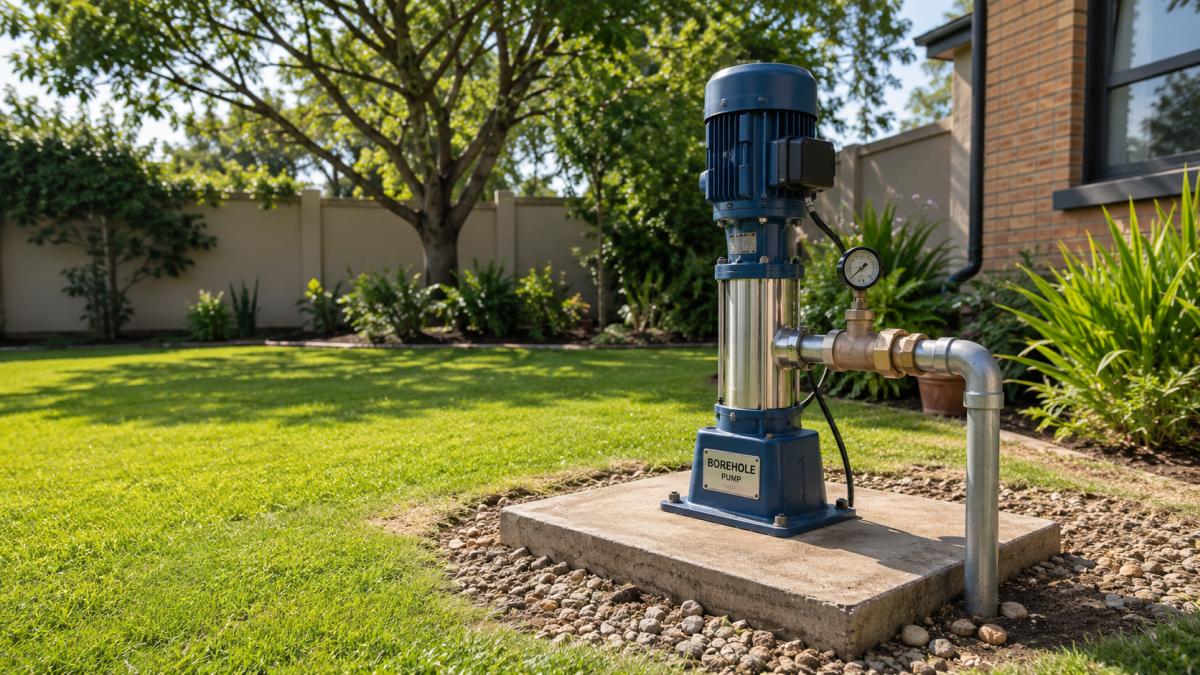
For households that want to eliminate dependence on municipal water for the long term, a borehole is the most significant step available. It is also the most expensive and the least predictable.
Drilling a borehole in Gauteng costs between R60,000 and R120,000 for drilling, casing, a submersible pump, a pressure tank, and basic filtration. The wide range reflects the fact that you do not know how deep you need to drill until you start. Shallow aquifers in parts of Gauteng can be reached at 30 to 40 metres. In other areas you might need 80 metres or more to find a reliable yield.
The additional cost that catches many households off guard is water quality treatment. Groundwater in South Africa frequently contains elevated levels of iron, manganese, fluoride, or nitrates depending on the local geology. Before using borehole water for drinking or cooking, you need a water quality test from a registered laboratory, which costs R800 to R2,000, and then treatment equipment matched to whatever the analysis finds. A full treatment train including iron removal, softening, and UV disinfection can add R15,000 to R40,000 on top of the drilling costs.
The realistic total for a functional borehole supplying a household including drilling, pump, pressure tank, filtration, and treatment sits between R80,000 and R160,000. There is also no guarantee of success: some sites yield insufficient water, and some aquifers in urban areas show contamination from decades of industrial activity or poor sanitation infrastructure. Hiring a qualified hydrogeologist to assess your site before committing to drilling costs R3,000 to R6,000 and can save you from a very expensive mistake.
The same logic that applies to solar investment applies here. Just as you can reduce your solar costs significantly by self-sourcing components and phasing your system, you can phase your water independence without having to fund the entire journey upfront.
Phase one is storage. Two tanks, a pump, and first-flush rainwater diversion. Budget R30,000 to R55,000 installed. This protects you against everything short of an extended multi-week outage.
Phase two is a proper rainwater harvesting system with potable treatment if your water use and rainfall patterns justify it. Budget an additional R20,000 to R40,000. At this stage you have a system that significantly reduces your dependence on municipal supply during the rainy season.
Phase three is a borehole, if your site geology supports it and your budget allows. This is the move that fundamentally changes your relationship with the municipality. Budget R80,000 to R160,000 for a full installation including treatment.
The combined cost of all three phases, done properly, sits between R130,000 and R255,000 depending on site conditions and equipment choices. That is a significant investment. But placed against the alternative of an unreliable supply, rising municipal tariffs, and a national infrastructure backlog that independent analysis confirms is not being adequately addressed, the calculation looks different each year.
The financial case for water independence is real but secondary. What you are actually purchasing is predictability. You are buying the certainty that your household functions when the municipality does not. You are removing one of the most fundamental uncertainties from your daily life.
South Africans spent years building that certainty around electricity. Inverters, batteries, and solar panels became normal fixtures in middle-income homes because the grid could not be trusted. The water conversation is following the same arc, just a few years behind.
The households starting that conversation now, rather than waiting until the crisis is at their own taps, are the ones who will have their systems bedded in and paid off when their neighbours are still filling buckets.
Costs quoted in this article reflect 2026 market pricing in Gauteng. Rural areas and coastal regions may vary. Always obtain at least two independent quotations before committing to any installation.