Physical Address
304 North Cardinal St.
Dorchester Center, MA 02124
Physical Address
304 North Cardinal St.
Dorchester Center, MA 02124


On 1 April 2026, petrol 95 in Gauteng jumped from R20.19 to over R23 per litre. Diesel climbed by as much as R7. This is not a routine monthly adjustment. It is one of the most aggressive fuel price increases in South African history, driven by the war between the United States, Israel, and Iran that has pushed global oil prices above $100 per barrel and weakened the rand to over R17 to the dollar.
For a commuter driving 1,000 km per month and using roughly 80 litres of fuel, the increase adds approximately R225 per month in fuel costs alone. That is before the knock-on effects hit food prices, taxi fares, and the cost of every product that moves by road, which in South Africa means over 80% of all freight.
The government’s response so far has been to suggest that people work from home. For millions of South Africans who cannot do their jobs remotely, that advice is useless. But there are practical strategies that real people are using right now to reduce their fuel dependence, some immediately and some over the coming months. None of them require waiting for government to act. All of them put control back in your hands.
Here are seven ways South Africans are cutting their fuel bills, starting with what you can do today.
It is the most obvious strategy and the most divisive. Not everyone can work from home. But for those who can, the savings are immediate and substantial.
The International Energy Agency released a report in March 2026 recommending remote work as one of the fastest ways to reduce fuel demand during the current oil crisis. The IEA estimated that if workers did an additional three days from home per week, national oil consumption from cars could drop by 2% to 6%, with individual drivers seeing fuel savings of around 20%.
In South Africa, economist John Loos has noted that the COVID-19 lockdowns proved a significant portion of office workers can operate effectively from home. With petrol now above R23, the financial argument for hybrid work has never been stronger. A Johannesburg commuter doing a 30 km round trip five days a week uses roughly 60 to 75 litres of petrol per month on commuting alone. At R23 per litre, that is R1,380 to R1,725 per month purely on getting to and from work. Cutting that to two or three office days saves R550 to R1,035 every month.
If your employer has not offered hybrid work, now is the time to make the case. Frame it around productivity and cost savings for both parties, not just your personal convenience. Some employers who resisted remote work during calmer times are reconsidering as fuel costs reshape the economics of daily commuting.
This is the lowest-tech, lowest-cost fuel saving strategy available, and it works for everyone regardless of job type. If four people share a car instead of driving separately, each person’s fuel cost drops by 75%. Even sharing with one other person halves the bill.
South Africa has a long tradition of lift clubs, particularly in Gauteng where commuting distances are long and public transport coverage is patchy. The mechanics are simple: find colleagues, neighbours, or parents at your children’s school who travel a similar route at similar times, agree on a schedule, and take turns driving or split fuel costs weekly.
Apps like CarpoolWorld and local WhatsApp groups make it easier than ever to find compatible lift partners. Many large employers and office parks have internal lift club boards or Slack channels. If yours does not, start one. At R23 per litre, the financial incentive to share a ride has never been more compelling.
The IEA’s March 2026 report specifically listed car sharing alongside reduced speed limits and public transport as immediate actions that can lower fuel consumption without any infrastructure investment.
You cannot control the price of petrol, but you can control how much of it your car burns per kilometre. Fuel-efficient driving techniques, sometimes called eco-driving, can reduce your consumption by 15% to 25% without any modification to your vehicle.
Slow down. The single biggest factor in fuel consumption at highway speeds is air resistance, which increases exponentially with speed. Driving at 100 km/h instead of 120 km/h on the N1 can cut fuel use by 15% to 20%. The IEA recommended that governments reduce highway speed limits by at least 10 km/h during the crisis. You can do this yourself right now.
Accelerate gently. Hard acceleration from traffic lights and stop signs burns significantly more fuel than smooth, gradual acceleration. Anticipate traffic flow and avoid unnecessary braking and speeding up.
Maintain tyre pressure. Under-inflated tyres increase rolling resistance and can raise fuel consumption by 3% to 5%. Check your tyres monthly and keep them at the manufacturer’s recommended pressure.
Remove excess weight. Every extra kilogram your car carries increases fuel consumption. Clear out your boot. Remove roof racks and carriers when not in use. A roof rack alone can increase fuel consumption by 5% to 10% at highway speeds due to aerodynamic drag.
Service your vehicle. A well-maintained engine with clean air filters, fresh oil, and properly functioning spark plugs runs more efficiently. A single clogged air filter can increase fuel consumption by up to 10%.
These changes cost nothing and can save you R270 to R450 per month based on a typical Gauteng commuting distance.
This is the option that is gaining traction fastest among South Africans who live within 15 km of their workplace. An electric bicycle or electric scooter costs between R8,000 and R25,000 for a decent commuter model, charges from a standard wall socket for a few rands per charge, and eliminates your fuel bill entirely for daily commuting.
The South African e-bike market is growing at 5.65% annually, with city and urban usage already accounting for 53% of the market. Pedal-assisted e-bikes can cover 40 to 80 km on a single charge depending on the battery size and how much you pedal. For a Centurion-to-Midrand commute or a Sandton-to-Rosebank run, that is more than sufficient.
The running cost comparison is stark. Charging an e-bike battery costs approximately R2 to R5 per charge. A car doing the same 15 km commute burns roughly 1.5 litres of petrol, which at R23 per litre costs R34.50 per trip, or R69 per day for the return journey. Over a month of commuting, the e-bike costs R50 to R100 in electricity. The car costs approximately R1,500 in petrol. The e-bike pays for itself in 5 to 17 months depending on the model.
Security is a valid concern. Lock your e-bike securely, insure it if possible, and choose routes with good visibility. Many South African e-bike commuters report that the benefits, both financial and in terms of avoiding traffic, far outweigh the risks.
If a full e-bike is out of budget, a standard bicycle is even cheaper and burns no fuel at all. Johannesburg’s relatively flat topography in many areas makes cycling more viable than people assume.
Here is something most people miss when they think about fuel prices: you are not just paying R23 per litre at the pump. You are paying it on every item in your trolley. South Africa moves over 80% of its freight by road. When diesel jumps by R10 per litre, the cost of transporting tomatoes from Limpopo, maize from the Free State, and chicken from KZN to your local supermarket jumps with it. Economists are already warning that food inflation will climb toward 5% or higher in the months following this fuel shock.
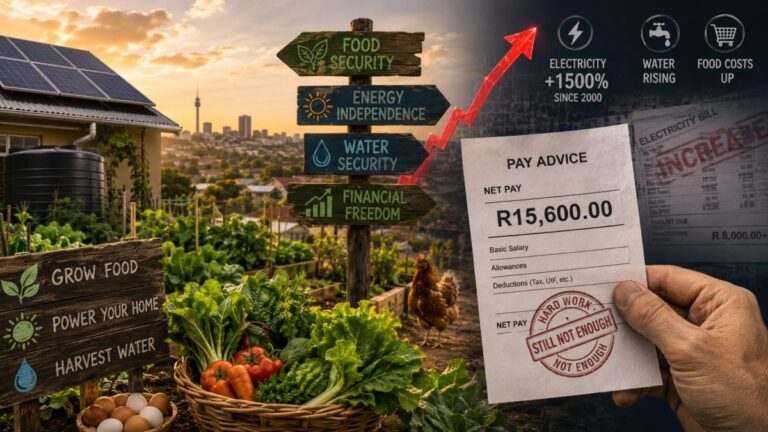
Every vegetable you grow at home is a vegetable that did not travel hundreds of kilometres by diesel truck to reach your plate. A balcony herb garden or a few containers of tomatoes and greens replaces R300 to R500 worth of fresh produce per month, produce that would otherwise carry a rising fuel surcharge baked into its retail price. As fuel costs push food prices up over the coming months, home-grown food becomes an increasingly valuable hedge.
This is not a theoretical saving. It is a direct response to the fuel crisis that most people overlook because they think of fuel purely as what goes in their car. In reality, fuel is embedded in the price of everything you eat. Reducing your dependence on the supermarket supply chain, even partially, is one of the most effective ways to insulate your household budget from petrol and diesel volatility.
For households that have already installed solar power, you can charge an e-bike from your own panels, water your food garden with a solar-powered pump, and cut your grocery bill simultaneously. That is the kind of stacking that makes real self-sufficiency possible.
This sounds basic, but most South African households burn significant fuel on inefficient errand patterns. Multiple short trips to the shops, separate runs to school, the gym, the office, and the supermarket, and impulse drives that could be combined or eliminated.
Plan your week’s errands in advance. Combine multiple stops into a single trip using the most efficient route. Shop for groceries once a week rather than making two or three trips. If you pass a shopping centre on your commute, stop on the way home rather than making a separate trip later.
Fuel-conscious shopping also means buying in bulk when possible to reduce the frequency of shopping trips. This connects directly to the pantry building strategy: a well-stocked household needs fewer emergency runs to the shop, which means fewer litres burned on unplanned trips.
Some families are taking this further by coordinating with neighbours. One household does the school run on Monday and Wednesday, the other on Tuesday and Thursday. One family shops at Makro this week, the other next week, and they share bulk purchases. These small cooperations add up to meaningful fuel savings across a community.
If your current vehicle is a fuel-hungry SUV or an older car with poor fuel economy, the maths on replacing it changes dramatically at R23 per litre. A vehicle that consumes 12 litres per 100 km costs you twice as much per month as one that does 6 litres per 100 km. Over a year of average driving (15,000 km), the difference at R23 per litre is R20,700.
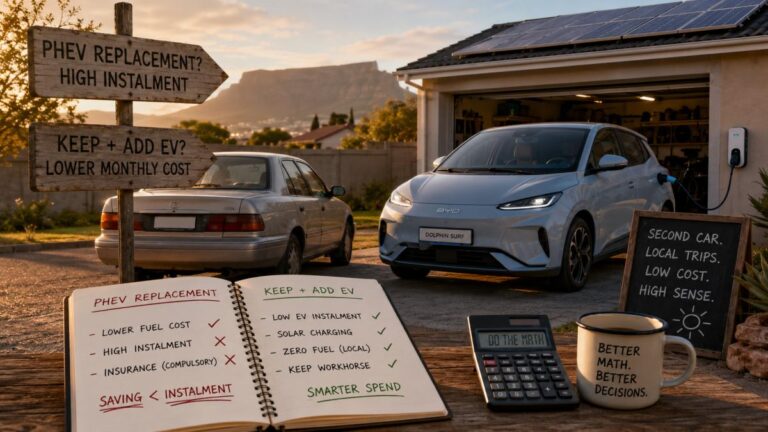
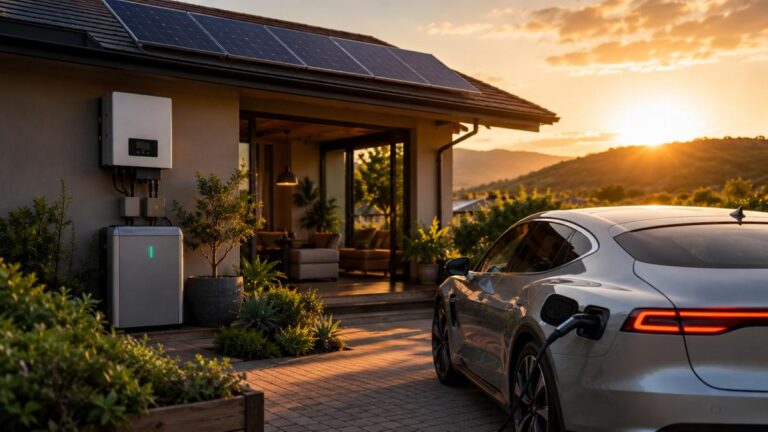
South Africa’s electric vehicle market has reached a tipping point in 2026. The BYD Dolphin Surf now starts at R339,900, making it the country’s most affordable EV. For households with solar panels at home, the running cost of an EV is near zero for daily commuting. Even without solar, charging an EV from the grid costs a fraction of what petrol does per kilometre.
If a new EV is out of reach, consider downsizing to a more fuel-efficient petrol or diesel vehicle. A small hatchback doing 5 to 6 litres per 100 km versus a medium SUV doing 10 to 12 litres per 100 km saves you R690 to R1,035 per month at current prices. Over three years, that fuel saving alone could exceed R25,000.
The long-term trajectory is clear: petrol prices are not coming back down to R15. The combination of geopolitical instability, a structurally weak rand, rising fuel levies, and global decarbonisation pressure means that every year, petrol will take a bigger bite out of your budget unless you actively reduce your dependence on it.
The April 2026 fuel price shock is not an anomaly. It is a preview of what life looks like when your household is fully dependent on a single, globally priced, government-taxed energy source for both transport and daily life. Every strategy on this list, from working from home to driving more efficiently to growing your own food to investing in an e-bike, is a step toward reducing that dependency.
You do not need to implement all seven strategies at once. Start with the ones that cost nothing: driving slower, forming a lift club, consolidating trips. Then build toward the investments that deliver the biggest long-term returns: an e-bike for commuting, a food garden to buffer against fuel-driven grocery inflation, and eventually, solar panels that make your transport and your household energy effectively free.
The petrol price is R23 today. It was R15 two years ago. It could be R30 within a year if the Middle East conflict escalates further. The question is not whether fuel will keep getting more expensive. The question is what you are going to do about it, starting now.