Physical Address
304 North Cardinal St.
Dorchester Center, MA 02124
Physical Address
304 North Cardinal St.
Dorchester Center, MA 02124

When the queues started forming at filling stations during the unrest of July 2021, the loadshedding-driven generator fuel runs of 2023, and again during the Middle East jitters of 2024 and 2025, a lot of South Africans made the same decision: keep some fuel at home. Smart move in principle. The trouble is that most people doing it are breaking by-laws they have never read, voiding their home insurance without realising it, and stashing fuel that will already be going stale by the time they need it.
This guide unpacks two questions every prepared South African household should be able to answer. How much petrol or diesel can you legally store at home? And how long will it actually still work when you pour it into your car or generator months later?
Petrol that flirted with R25 a litre, diesel jumping by R7 in a single price adjustment, refinery shutdowns at Sapref and Engen Durban, and ongoing geopolitical tension around the Strait of Hormuz have all pushed ordinary households toward keeping a buffer at home. Most are buying jerry cans on impulse and filling them at the local Engen or Sasol without much thought.
That impulse is reasonable. The execution is usually wrong. If you want the broader picture of how locals are coping with pump prices, we have covered the wider strategy in this article on cutting your fuel bill in half. What follows is the storage side of the equation, which is the part that can actually start a fire or land you with an uninsurable house.
There is no single national law that says “you may store X litres of petrol at home.” South African personal fuel storage is governed by a combination of the Petroleum Products Act of 1977, SANS 10089 (storage and distribution of petroleum products), SANS 10231 (transport of dangerous goods), and the flammable substances by-laws of your specific municipality. That last bit matters, because Tshwane, Cape Town, and eThekwini all word their by-laws slightly differently.
The practical answer for most metros is this: you may keep around 20 to 25 litres of petrol at home in an approved container without needing a permit or registration. According to TopAuto, SANS 10231 references a 60 litre threshold for transport, and private motorists can legally transport up to 500 litres of petrol or 1 000 litres of diesel before the formal dangerous goods provisions kick in. But transport is not storage. Storing more than the by-law limit at your house, even if you can drive it home legally, is a separate offence and almost always requires a flammable substances certificate.
Diesel is treated more leniently than petrol almost everywhere. It has a much higher flashpoint (around 52 to 96 degrees Celsius depending on grade) versus petrol’s terrifying minus 43 degrees, so the same explosive vapour risk simply does not exist. Many municipalities do not regulate small quantities of diesel at all, though you should still check your local by-law before you build a stash.
This is where most South Africans go wrong. A 25 litre paint drum from your garage is not a fuel container. A repurposed water bottle is not a fuel container. A generic plastic jerry can off Takealot may or may not be a fuel container, depending on what it is actually certified to.
An approved container in South Africa is one marked with the relevant SANS standard for portable fuel containers, or marked UN/DOT for steel jerry cans. The classic green metal Wavian or NATO-pattern jerry can is the gold standard. Plastic HDPE jerry cans are acceptable if they are explicitly rated for fuel and labelled accordingly. Filling stations are within their rights to refuse to dispense into anything that is not properly approved, and a growing number do exactly that.
Container size matters too. Most by-laws cap individual portable container size at 25 litres. A single 200 litre drum of petrol in your garage is a different legal animal entirely and almost always requires a permit, a bunded storage area, and a fire safety certificate signed off by your local fire department.
This is the part that usually shocks people. As SA Building Review reports, storing fuel outside legal limits or in non-compliant containers can void your home insurance. If your house burns down and the assessor finds three unmarked plastic drums of petrol in the garage, your claim is unlikely to pay out, regardless of whether the fuel actually caused the fire.
Some insurers go further and require you to declare any fuel stored beyond a small allowance. Read your policy. Phone your broker. Get the answer in writing. The cost of a five minute phone call is a great deal smaller than the cost of an unrecoverable house.
Now to the part that catches everybody out. You have bought your two legal jerry cans, you have stashed them properly, and you feel prepared. Six months later, the lights go out for two days, you pour the petrol into your generator, and it will not start.
Petrol degrades fast. In a sealed container at a steady 20 degrees Celsius, you have about six months before the fuel starts losing its lighter volatile fractions and oxidising into gum and varnish. At 30 degrees, which is closer to summer reality in Pretoria, Polokwane, or Phalaborwa, that drops to roughly three months. In an unsealed or vented container, you might get a single month before you have noticeable starting and running issues.
The reasons are chemical. Petrol is a deliberately volatile blend, and the same light hydrocarbons that make it ignite cleanly in your engine also evaporate out of any imperfect seal. What is left behind oxidises and forms the sticky deposits that gum up carburettors, injectors, and small engine fuel systems.
South African petrol specifications under SANS 1598 allow up to 7.5 percent ethanol at the coast and 9.5 percent inland. In practice, most refineries have historically blended at the lower E2 level, but the move toward biofuels means newer fuel is increasingly oxygenated.
Ethanol is hygroscopic. It pulls water out of the air. As Ravenol South Africa explains, ethanol-blended petrol can suffer phase separation in storage, where the water-laden ethanol settles to the bottom of the container as a corrosive layer that will wreck a carburettor or injector pump in short order. The higher the ethanol percentage and the longer the storage period, the worse the problem becomes.
This is the core reason petrol stored for “emergencies” so often fails when actually needed. It is not bad luck. It is chemistry doing exactly what chemistry does, on schedule, every time.
Diesel is the prepared homeowner’s friend. Pure petroleum diesel, kept cool, sealed, and dry, will store reliably for 12 months without any treatment, and 18 to 24 months in good conditions according to Bell Performance, one of the more authoritative voices on long-term fuel storage.
There are caveats. South African on-road diesel is now blended with up to 5 percent biodiesel (B5), and biodiesel attracts water aggressively. Modern ultra-low-sulphur diesel, mandated for newer engines, has had many of the natural sulphur compounds that used to act as preservatives stripped out during refining. So the 24 month shelf life applies to clean, dry, sealed diesel kept under ideal conditions. In practice, plan for 12 months before you start seeing degradation, and you will rarely be disappointed.
Diesel also suffers from a problem petrol does not: microbial contamination, sometimes called “diesel bug.” Bacteria and fungi grow at the water-to-fuel interface and produce sludge that clogs filters and corrodes tanks from the inside. This is why long-term diesel storage typically uses both a stabiliser and a biocide, not just one or the other.
A small spend on additives radically changes the equation. A capful of fuel stabiliser added to a fresh jerry can at the moment you fill it can extend petrol shelf life from six months to roughly twelve, and diesel from one year to two or three. Locally available options include the Lucas brand, STA-BIL, and the Wynn’s range, all of which are stocked at most automotive retailers including Midas, Auto Zone, and the larger Builders Warehouse outlets.
Two rules are non-negotiable.
First, add the stabiliser to fresh fuel. Stabiliser does not reverse degradation, it only slows it from the moment it is added. Pouring stabiliser into six-month-old petrol does almost nothing useful.
Second, fill containers as full as practical. Air space inside a partially filled jerry can is exactly where oxidation and water condensation happen. A 20 litre container with 18 litres of fuel and 2 litres of air will degrade noticeably faster than the same container filled to 19.5 litres.
SAOIL’s overview of blended fuels is worth reading if you want a deeper local picture of how additives, oxygenates, and ethanol blends interact during storage.
Pulling all of this together, here is what a sensible setup looks like for a typical Centurion, Cape Town, or Pietermaritzburg property.
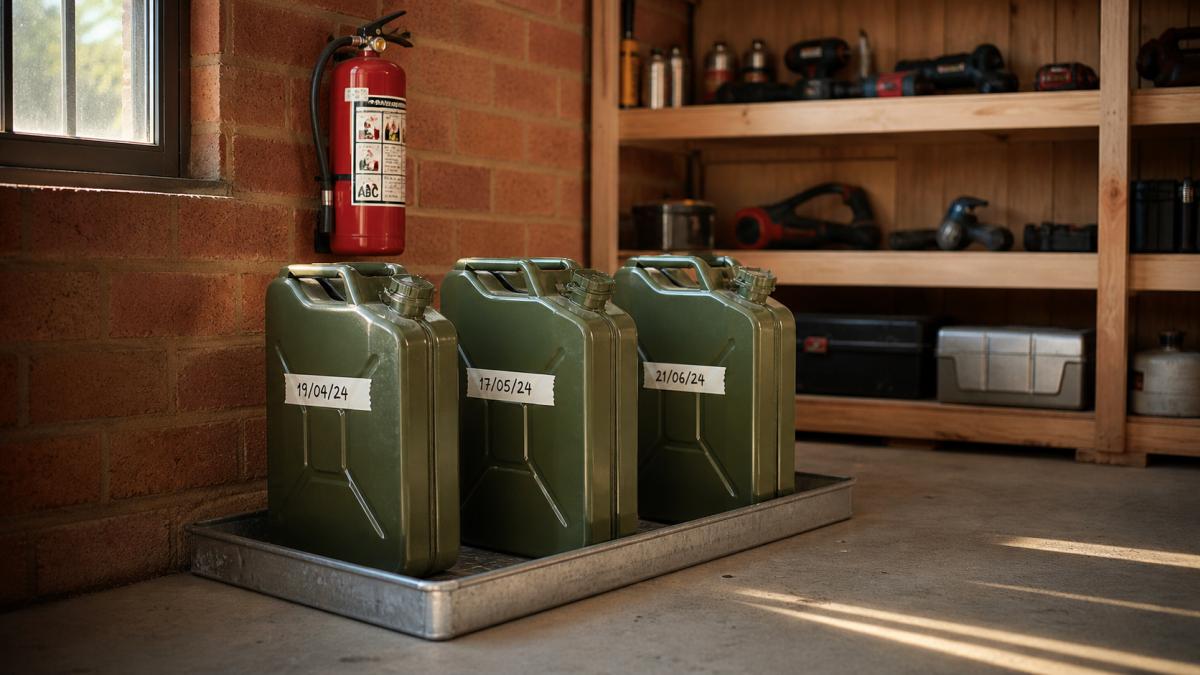
Two 20 litre approved jerry cans of diesel, treated with stabiliser, kept in a ventilated outbuilding or detached shed, sitting on a metal drip tray in case of leaks, well away from the main house, the geyser, and the gas cylinder. One smaller 5 or 10 litre approved container of petrol for the lawnmower, brush cutter, or small generator, also treated, also stored separately. Both containers labelled clearly with the date of fill in permanent marker.
Avoid the garage attached to the house. Avoid the kitchen and the pantry. Avoid the same room as your inverter battery bank, where a lithium thermal event would turn a fuel store into a catastrophe.
Keep a small ABC dry powder or foam fire extinguisher within arm’s reach of the storage point. Make sure everyone in the household knows where the fuel is stored and understands that they should never use a cellphone, light a cigarette, or start a generator within three metres of an open container.
The single most important habit is rotation. Every time you fill the car, top up your generator, or run the lawnmower, draw from your stored fuel and refill the jerry cans with fresh fuel from the pump. This keeps your stored fuel under three months old at all times, which sidesteps almost every shelf life issue discussed above.
Label every container with the date of fill. A piece of masking tape with a date written in permanent marker is enough. When you rotate, update the label. If you find a container with no date on it, treat the fuel as suspect and use it in low-stakes equipment like a lawnmower rather than risking it in your only car.
Stored fuel is genuinely useful. It buys you the freedom to skip a queue, ride out a regional shortage, and keep a generator humming through a 12 hour outage. But it is only useful if it is legal, insurable, and still combustible when you actually need it. The discipline costs a few extra rands and ten minutes every quarter. The alternative costs your house or your engine.
Disclaimer: This article is provided for general information only and does not constitute legal, safety, or insurance advice. Fuel storage regulations in South Africa vary between municipalities and are subject to change. Readers are responsible for confirming the specific by-laws applicable to their property with their local fire department or municipal office, and for verifying their home insurance policy terms with their broker before storing any quantity of fuel at home. Petrol and diesel are hazardous flammable substances and improper storage can result in serious injury, property damage, legal penalties, or loss of insurance cover. Selfsustain.co.za and its authors accept no liability for any loss, damage, or injury arising from the use or misuse of the information provided.