The Four-Cent Superfood Nobody Is Selling You

The Four-Cent Superfood Nobody Is Selling You

There is a complete, daily food system sitting in the bulk section of almost every grocery store. It costs less than a taxi ride, needs no electricity, no soil, and no equipment beyond a jar and water. It produces fresh, living food every single day with less than five minutes of effort. It has been used for centuries, validated by food science, and largely ignored by the modern supplement industry for one simple reason. There is nothing to sell. This is not a trend. It is a biological process you can run in your kitchen starting tomorrow morning.

A Practical Guide to Home Sprouting That Actually Works

There is a complete, daily food system sitting in the bulk section of almost every grocery store. It costs less than a taxi ride, needs no electricity, no soil, and no equipment beyond a jar and water. It produces fresh, living food every single day with less than five minutes of effort.

It has been used for centuries, validated by food science, and largely ignored by the modern supplement industry for one simple reason. There is nothing to sell.

This is not a trend. It is a biological process you can run in your kitchen starting tomorrow morning.


Why Sprouting Changes the Game

A dry seed is not designed to nourish you. It is designed to survive.

To do that, it locks away its nutrients.

  • Minerals are bound by phytic acid
  • Proteins are difficult to digest
  • Vitamin C is almost nonexistent

When you eat dry seeds or unsprouted legumes, a meaningful portion of that nutrition passes through your body unused.

Sprouting changes this completely.

The moment a seed absorbs water, it begins to germinate. This triggers a cascade of enzymatic activity:

  • Phytase breaks down phytic acid and releases minerals
  • Protease breaks proteins into absorbable amino acids
  • Vitamin C is synthesised from scratch
  • Overall digestibility improves

Within 48 to 72 hours, the seed transforms from a dormant storage unit into a living, nutrient-active food.

You are not adding anything. You are unlocking what was already there.


Why This Beats Supplements

At full rotation, a simple home sprouting setup produces:

  • Daily fresh protein
  • Vitamin C and K
  • Key minerals like magnesium, zinc, and iron
  • Healthy fats and vitamin E

Monthly cost in South Africa:

  • Roughly R55 to R90 from bulk seeds

To replicate this with commercial products would require multiple supplements and cost many times more.

There is no processing, no packaging, and no marketing built into sprouts.

Just water and time.


From Theory to Practice

So the question is not whether sprouting works.

The question is how to run it daily without thinking about it.

The answer is a simple rotating system.


The 3-Jar System

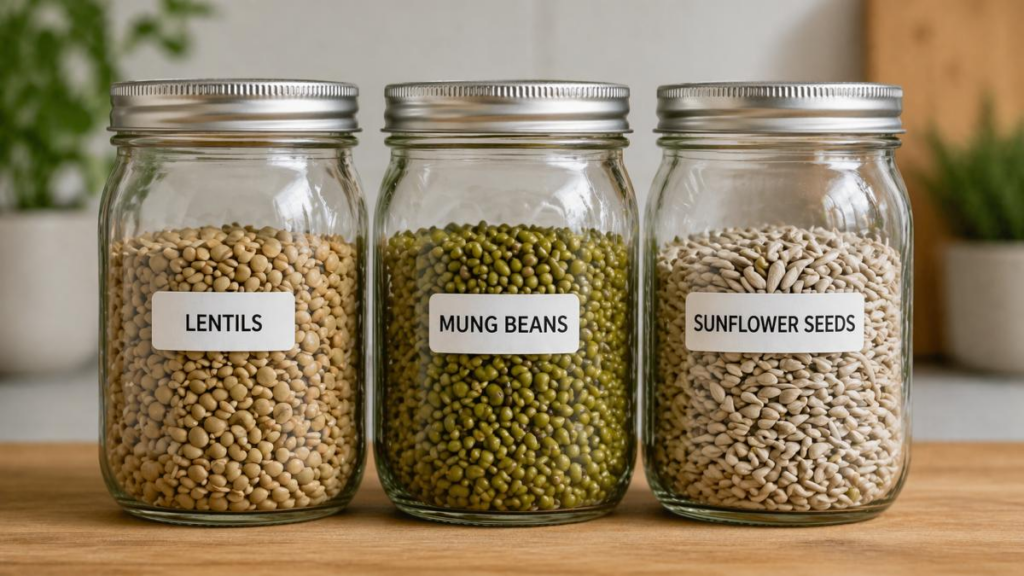
You run three jars at the same time:

  • Jar 1: Lentils
  • Jar 2: Mung beans
  • Jar 3: Sunflower seeds

Each jar is at a different stage.

At any given time:

  • One jar is soaking
  • One jar is growing
  • One jar is ready to eat

The Daily Loop

Every day you:

  • Rinse all jars
  • Harvest one jar
  • Restart one jar

Once this loop is running, you stop planning. You just maintain.


The 5-Day Sprouting Cycle

This is where most people get stuck. Here is exactly what happens, day by day.

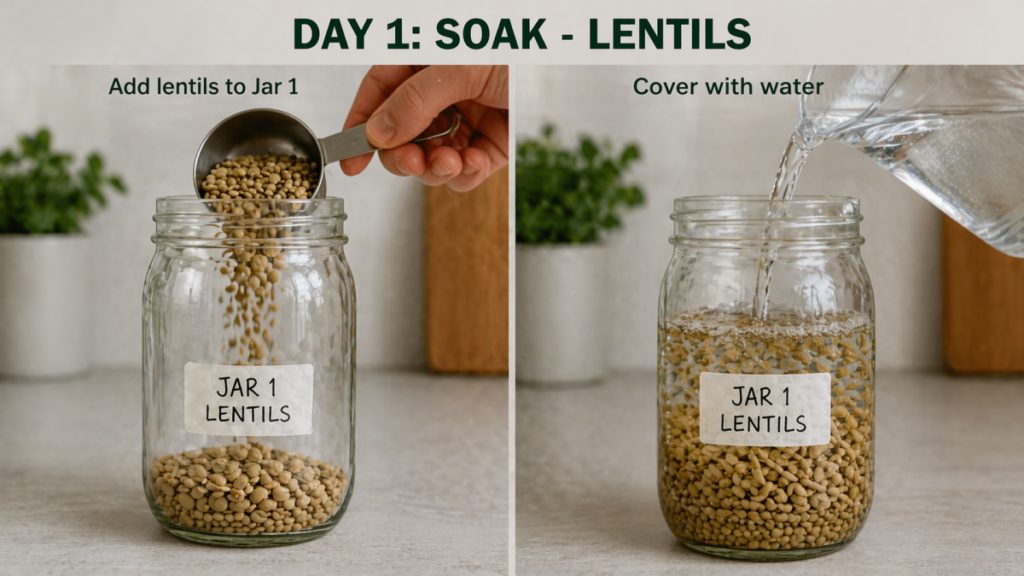
Day 1: Soak

What to do:

  • Add lentils to Jar 1
  • Cover with water
  • Leave overnight

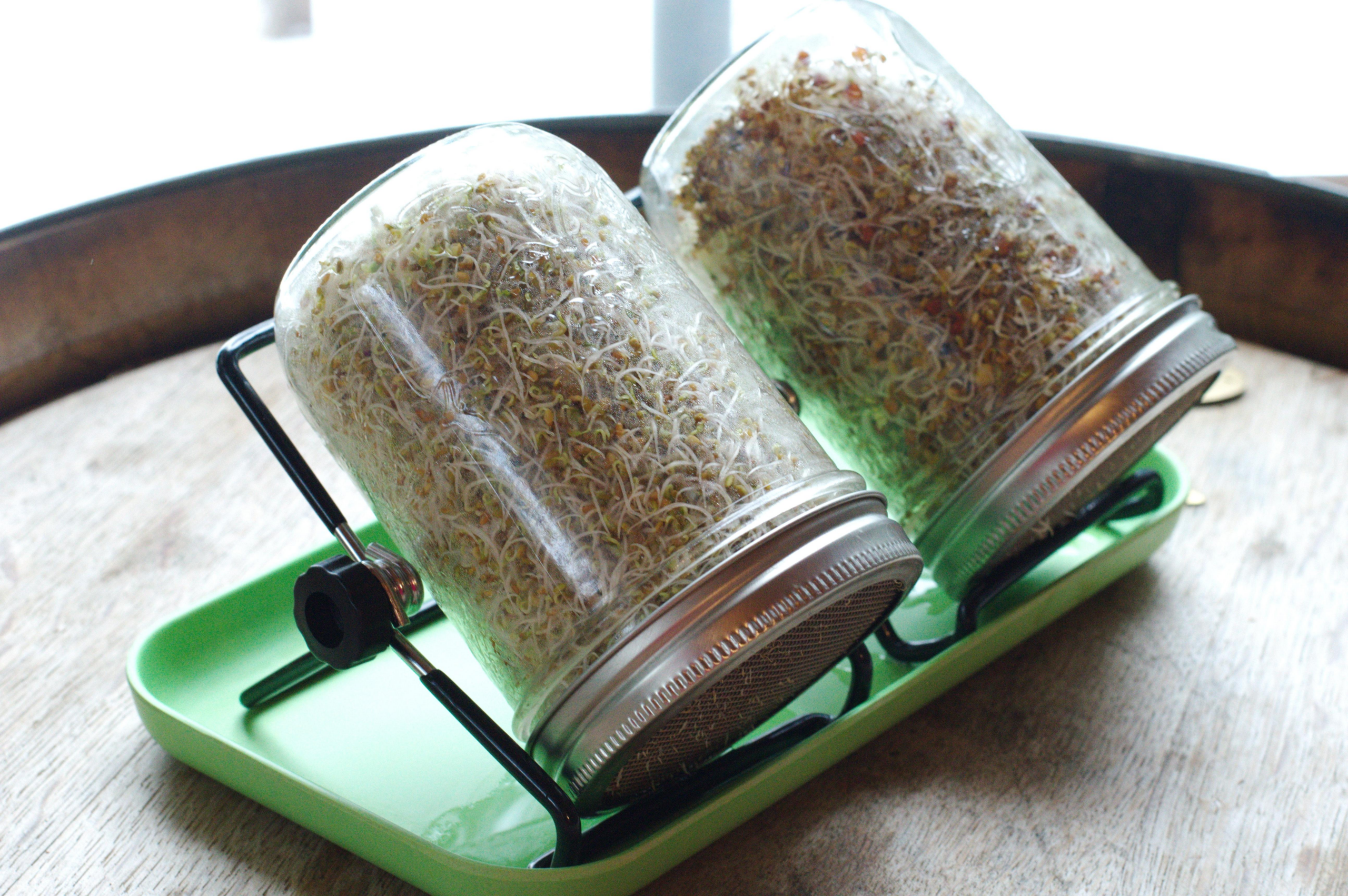
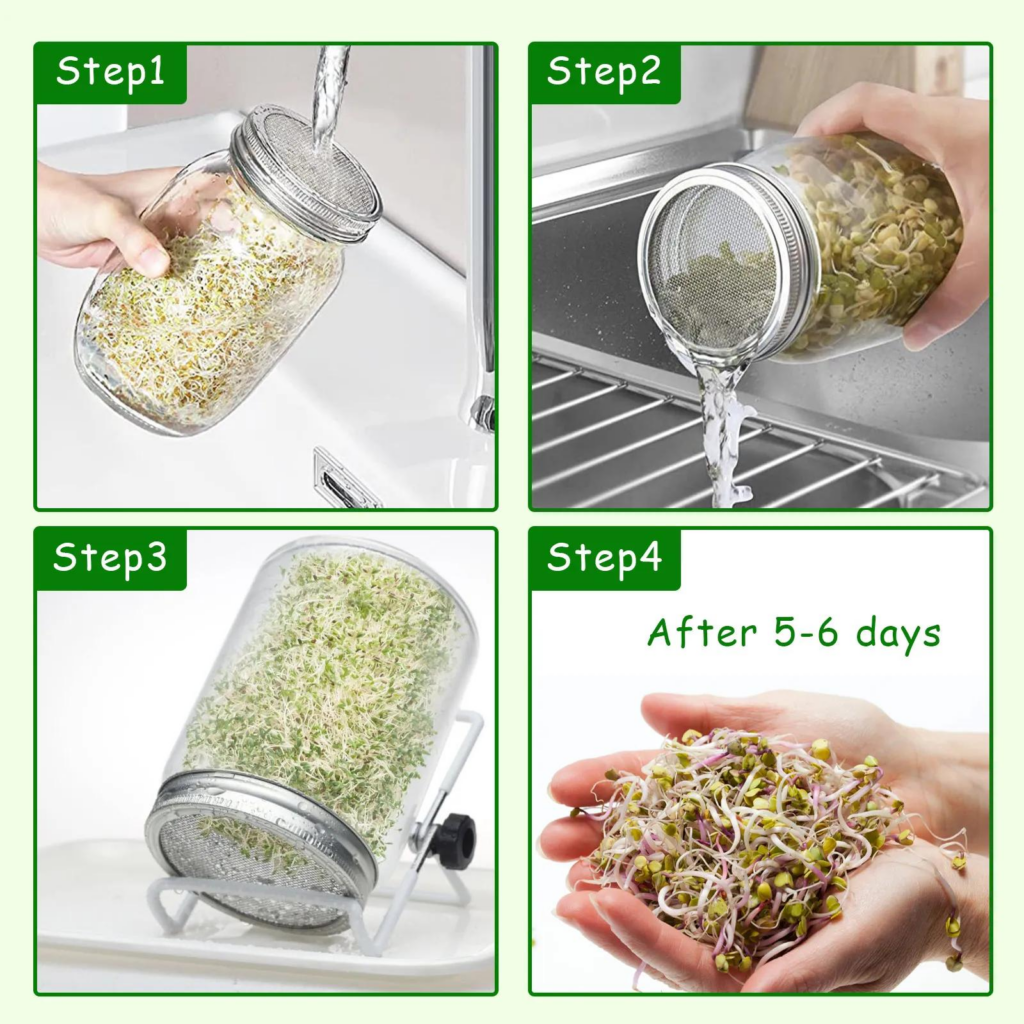
(A note on the jar lid – either use a cheese cloth tightened with a rubber band or get a grid/gauze top for your mason jar.)

What you will see:

  • Seeds swelling slightly

What matters:

  • Germination has started
  • Enzymes are activating

Day 2: Activate

What to do:

  • Drain lentils
  • Rinse twice
  • Tilt jar for drainage

Start Jar 2:

  • Add mung beans to soak

What you will see:

  • Tiny white root tips beginning

What matters:

  • The seed is now biologically active

Day 3: First Harvest and Reset

What to do:

  • Rinse lentils
  • Harvest and eat lentils
  • Immediately start a new lentil soak (Jar 1 resets)

Continue:

  • Drain and rinse mung beans
  • Start Jar 3 by soaking sunflower seeds

What you will see:

  • Lentils with short, white root tails
  • Mung beans just beginning to open

What matters:

  • This is the breakthrough moment
  • You now have your first harvest
  • The system begins to loop from here

Day 4: System Stabilises

What to do:

  • Rinse all jars

Jar status:

  • Jar 1: Lentils soaking (new cycle)
  • Jar 2: Mung beans growing
  • Jar 3: Sunflower seeds activating

What you will see:

  • Tiny white roots on lentils
  • Mung beans expanding and whitening
  • Sunflower seeds just starting to root

What matters:

  • All three jars are now active
  • The system is staggered and self-sustaining

What to do:

  • Rinse all jars

What you will see:

  • Mung beans expanding rapidly
  • Sunflower seeds just starting to root

What matters:

  • The system is now staggered and stable

Day 5: Continuous Harvest Begins

What to do:

  • Rinse all jars
  • Harvest lentils (Batch 2)
  • Harvest mung beans
  • Harvest sunflower seeds early if ready

What you will see:

  • Thick, crisp mung sprouts
  • Sunflower seeds with small root tips

What matters:

  • From this point on, you can harvest something every day
  • The system now runs continuously with minimal effort

Your Daily 5-Minute Routine

Morning

  • Rinse all jars
  • Drain completely
  • Harvest the ready jar

Evening

  • Rinse again
  • Drain and tilt

No measuring. No precision. Just repetition.


Setup That Prevents Failure

Success comes down to two simple variables.

Drainage

  • Always drain fully after rinsing
  • Keep jars tilted

Standing water leads to spoilage.

Airflow

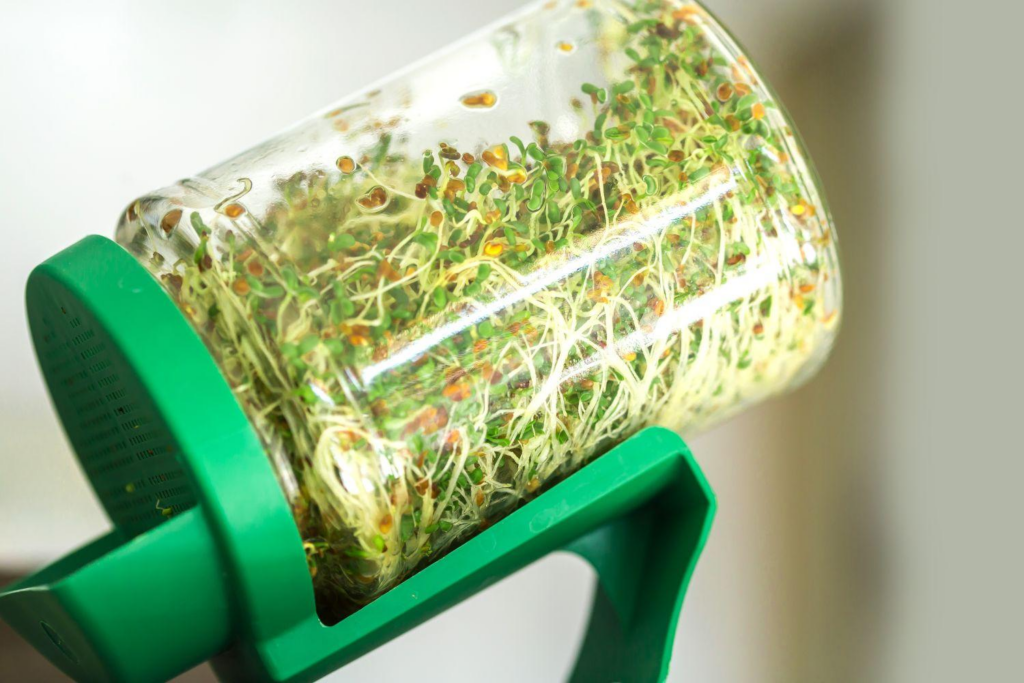
  • Use cloth, mesh, or a sprouting lid
  • Do not seal jars

Sprouts need oxygen once active.


Temperature Guide

  • Ideal: 18 to 24°C
  • Below 15°C: slower growth
  • Above 28°C: higher spoilage risk

A shaded kitchen counter works well.


Common Mistakes and Fixes

Bad smell
Cause: poor airflow
Fix: improve ventilation and drainage

Slimy texture
Cause: excess moisture
Fix: drain more thoroughly

No sprouting
Cause: cold environment or old seeds
Fix: move to a warmer area

Mold
Cause: trapped water
Fix: increase tilt and airflow


The Three Seeds Explained

Lentils: The Base

  • Fast and reliable
  • Ready in 2 to 3 days
  • Provide protein and structure

Mung Beans: The Fresh Layer

  • Slower growth
  • Crisp texture
  • Rich in newly formed vitamins

Sunflower Seeds: The Density Layer

  • Short sprouting window
  • Rich and filling
  • Provide vitamin E and healthy fats

Important note:

Most modern diets already contain sufficient omega-6. Sunflower seeds are included here to:

  • Add energy density
  • Provide fat-soluble nutrients
  • Improve satiety and texture

Harvest early. After day two they tend to become bitter.


Optional Variations

You can rotate the fat layer if needed:

  • Pumpkin seeds for additional minerals
  • Flax or chia for omega-3 balance

The system remains the same.


What You Actually Eat

A simple daily bowl:

  • Handful lentil sprouts
  • Handful mung bean sprouts
  • Spoon sunflower seeds
  • Olive oil and salt

Optional additions:

  • Eggs
  • Bread or wraps
  • Fresh vegetables

Simple, repeatable, and flexible.


Why This System Sticks

Most nutrition advice fails because it requires effort, planning, or discipline.

This works because:

  • It is cheap
  • It is simple
  • It produces food daily
  • It runs on a loop

Once started, it becomes automatic.


Final Thought

Sprouting is not a hack or a trend. It is a small biological system that runs on water, time, and consistency.

Set up three jars. Follow the cycle. Keep the loop going.

You stop thinking about nutrition.

You just harvest.

Izak Van Heerden
Izak Van Heerden
Articles: 22

Leave a Reply

Your email address will not be published. Required fields are marked *