Physical Address
304 North Cardinal St.
Dorchester Center, MA 02124
Physical Address
304 North Cardinal St.
Dorchester Center, MA 02124

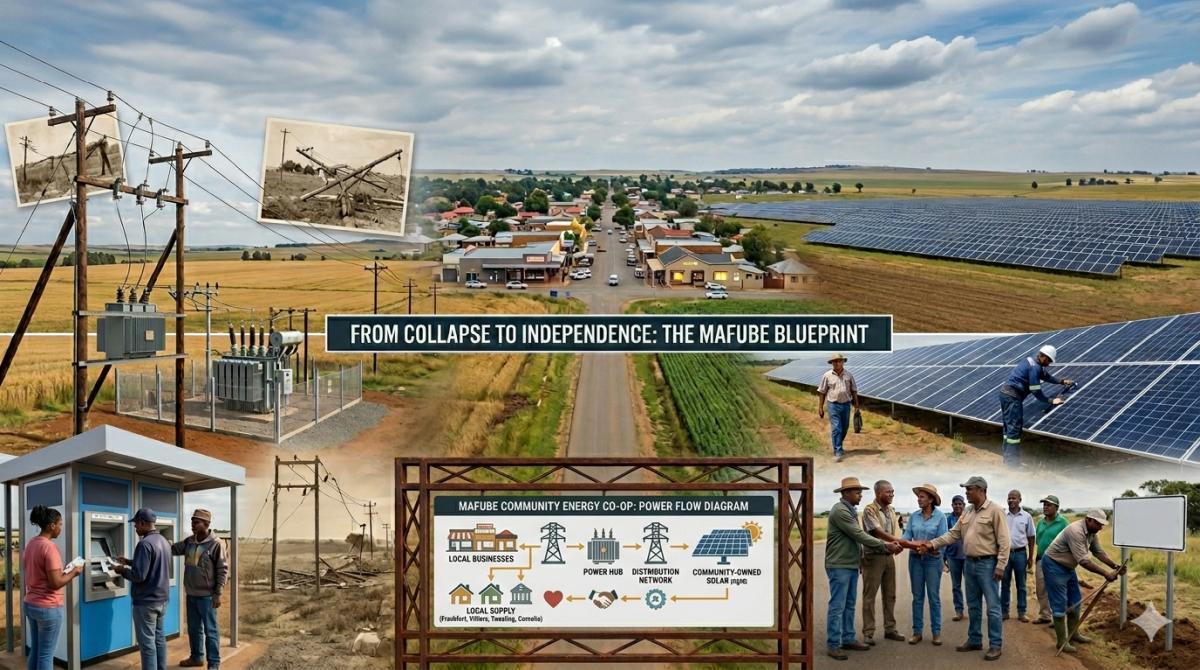
There is a small municipality in the Free State that did something almost no other community in South Africa has managed to do: it stopped waiting. While towns across the country sink under collapsing infrastructure, dry taps, sewage in the streets and municipal debt that runs into the billions, the towns of the Mafube Local Municipality — Frankfort, Villiers, Tweeling and Cornelia — quietly went the other way. The grid got rebuilt. The lights stayed on more often. Bills got paid. And eventually, the community started generating its own electricity.
It is the closest thing South Africa has to a working blueprint for local self-sufficiency at scale, and the lessons in it are not just for politicians. They are for anyone who has looked at their own street, their own water supply or their own electricity bill and thought: surely we can do better than this.
The story starts where so many South African municipal stories start — at the bottom. Mafube was paying Eskom roughly R5 million a month while collecting only around R1.7 million in electricity revenue. Maintenance had effectively stopped, billing was broken, and electricity theft was rampant. By the time things were at their worst, network losses had reached a staggering 50%.
In 2012, the municipality signed a long-term agreement with a private company, Rural Maintenance, to take over electricity distribution. The deal was structured as a 25-year concession: the company would rebuild the grid, bill customers, collect the money, keep an agreed margin for maintenance and profit, and pay the rest back to Eskom. Crucially, the company put up its own capital to do it.
The numbers since then tell the story. Between February 2012 and January 2025, Rural Maintenance spent R130.9 million on infrastructure upgrades alone, upgrading networks, cutting faults and making load-shedding manageable. Network capacity rose from 12.3 MVA to 21.1 MVA. Vending points grew from four to more than twenty, including online platforms. Over the same period, more than R1.13 billion was paid to Eskom and over R30 million in royalties flowed back to the municipality.
Here is the part worth pinning to the wall. As of 2023, only about 65 customers out of roughly 12,000 electricity users had been disconnected for non-payment over a twelve-year period. The default rate now sits at around 2%.
For years the dominant story in South Africa has been that people in struggling towns simply won’t pay. Mafube quietly demolishes that idea. When people receive a reliable service and are treated with basic respect, they pay for it. The non-payment problem turns out to be, in large part, a service problem wearing a disguise.
That single insight reframes the whole self-sufficiency conversation. Reliability is not a luxury you earn after you’ve fixed the finances — reliability is what fixes the finances. It is the same principle that plays out on a single property: a solar system that actually keeps the lights on during load-shedding earns its keep and changes behaviour, while a half-working setup just breeds frustration. Get the service right and the economics follow.
Once the grid was stable, Mafube did the thing that turns a turnaround into genuine independence — it moved into generating its own power. Rural Maintenance developed an 8.9 MW solar facility and began buying electricity from local solar farms owned by farmers, businesses and residents, distributing it across the network at a lower daytime tariff than Eskom charges.
The effect on the ground was immediate: solar generation reduced load-shedding in the area by roughly 17% compared to Eskom’s requirements during sunlight hours. For a town that had been at the mercy of the national grid, that is the difference between a business staying open and a business closing early.
This is the part that mirrors what a self-sufficient household does, just scaled up. You start by stabilising and metering what you have. Then you add generation. Then you store and distribute. The town of Frankfort essentially became a community-scale version of the hybrid solar setup so many South African homeowners are now building one panel at a time — and it ran into the same regulatory friction, ending up in a drawn-out legal fight with Eskom over how much self-generated power it was allowed to lean on.
The electricity project did not happen in a vacuum. It worked because the community organised around it. Rural Maintenance built relationships with the people who actually hold a town together — church leaders, taxi operators, business owners, community organisers — rather than routing everything through politics.
The clearest example of that buy-in is the farmers’ levy. Local farmers voluntarily agreed to contribute around R18 per hectare to fund local services, raising roughly R7 million a year with about 90% participation. That is a community taxing itself, on purpose, because it trusted that the money would do something visible. Alongside it, groups like the Mafube Business Forum and Mafube First used court action, funding drives and public-private cooperation to tackle sewage, roads and municipal finances. The wider economic payoff followed: reduced outages, a major agricultural cooperative that created more than 100 jobs, rising property prices and businesses willing to invest again.
It hasn’t been frictionless. National Treasury has pushed to have the contract reviewed, and the arrangement remains politically contested. A working model is not the same as an uncontested one — and that, too, is a lesson for anyone trying to build something that bypasses a failing system.
You may not be in a position to rebuild a municipal grid. But the underlying logic of Mafube scales all the way down to a single household or a single street:
Mafube’s real message isn’t “privatise everything” or “the government will never fix it.” It is simpler and more useful than that. A community that decides it will not let its town fall apart, and then organises around a service that actually works, can build something resilient — from the bottom up, one system at a time. That is self-sufficiency in its truest sense, and it is a great deal more achievable than the daily news would have you believe.