Physical Address
304 North Cardinal St.
Dorchester Center, MA 02124
Physical Address
304 North Cardinal St.
Dorchester Center, MA 02124

Eskom tariffs keep climbing, municipal markups stack on top, and most of us only really notice the damage once the prepaid meter starts demanding another voucher far sooner than expected. If you have ever wondered which appliance in your home is the actual villain behind those rising costs, the good news is that you can stop guessing. There are three practical tools available to South African households for measuring electricity use, and each one tells a different story about where your money is going.
This article walks through what each option does, what it costs to set up, and what you can realistically expect to save once you know the numbers.
Most households have only one figure to work with, namely the total amount on the prepaid voucher or the monthly bill. That single number tells you nothing about which appliance is responsible. You might assume the geyser is the biggest culprit, and in many South African homes it absolutely is, but assumption is not measurement. Without real data, any attempt to cut consumption is essentially a shot in the dark.
Energy tracking tools change that. They convert vague worry into specific information you can act on. Once you know that a certain appliance is pulling far more than you thought, the decision to replace it, schedule it differently, or unplug it entirely becomes obvious.
For households on a strict budget, this kind of clarity can mean the difference between staying ahead of the bill and watching it spiral. According to the International Energy Agency, targeted efficiency measures remain one of the cheapest ways to lower household energy costs and the fastest route to lower emissions at the same time.
The simplest and cheapest option is a plug-in meter, often sold under the Kill A Watt name internationally and available locally under various brands. You plug it into a wall socket, plug your appliance into the meter, and it displays real-time wattage along with cumulative kilowatt hours.
Some models let you enter your tariff so the screen shows actual rand and cent values. Others give you only the raw electrical data, which you multiply by your local rate to work out the cost yourself. Either way, the device is small, requires no installation, and usually retails for under R400.
The catch is that it only measures one appliance at a time, and only appliances that use a standard wall plug. Your geyser, your stove, your air conditioner, and your borehole pump are all out of reach. For tracking a fridge, a TV, or a desktop computer, however, it works perfectly well.
A smart plug does everything the plug-in meter does, plus a few extras. It connects to your home Wi-Fi, sends data to an app on your phone, and lets you switch the appliance on or off remotely. You can also schedule it to run during cheap periods and stay off during peak ones, which is useful for households on time-of-use tariffs.
A reliable smart plug with energy monitoring usually costs between R250 and R500 depending on the brand. Local options from Takealot and Makro are widely available, and many of them work with the Tuya Smart ecosystem, which means you can control multiple plugs from one app and feed the data into a single dashboard.
The same limitation applies as with the plug-in meter, namely that only appliances on a standard plug can be tracked. Smart plugs do, however, let you automate behaviour, which the basic meter cannot. Switching off a pool pump during expensive hours, for instance, becomes a one-time setup rather than a daily chore.
This is where serious tracking begins. A whole-home energy monitor, such as the Emporia Vue or the Shelly Pro family of devices, installs inside your distribution board. Current sensors clip around individual circuits, and the device reports live wattage for each one through a phone app.
Installation is not a do-it-yourself job for most people. You will want a qualified electrician, both for safety reasons and because tampering inside the DB board can void your home insurance. Budget for around R3,500 to R6,000 for the device and installation combined, depending on which brand and how many circuits you choose to monitor.
The advantage is that you finally get to see the appliances that the plug-in tools cannot reach. The geyser, the oven, the borehole, the underfloor heating, the swimming pool circuit, all become visible. You can watch the wattage climb when the geyser element kicks in, and you can correlate that spike with the time of day to see exactly when your hot water is costing the most.
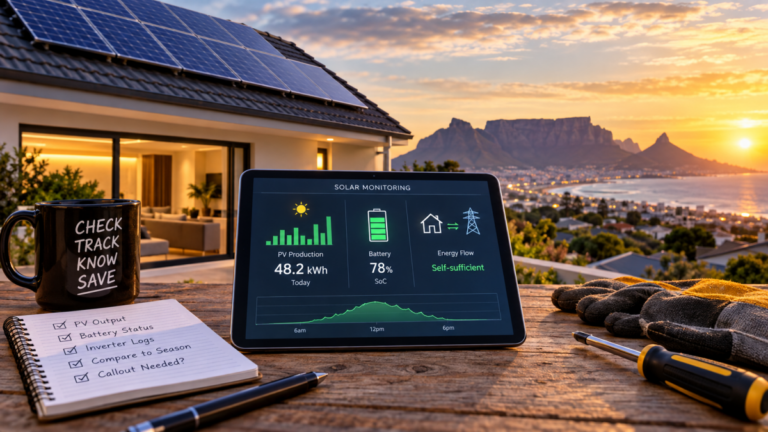
For homes with solar, these monitors can also track generation against consumption, which is invaluable when you are trying to size a battery or work out whether to expand your panel array. The South African Photovoltaic Industry Association publishes useful background reading on how that monitoring fits into a broader self-generation strategy.
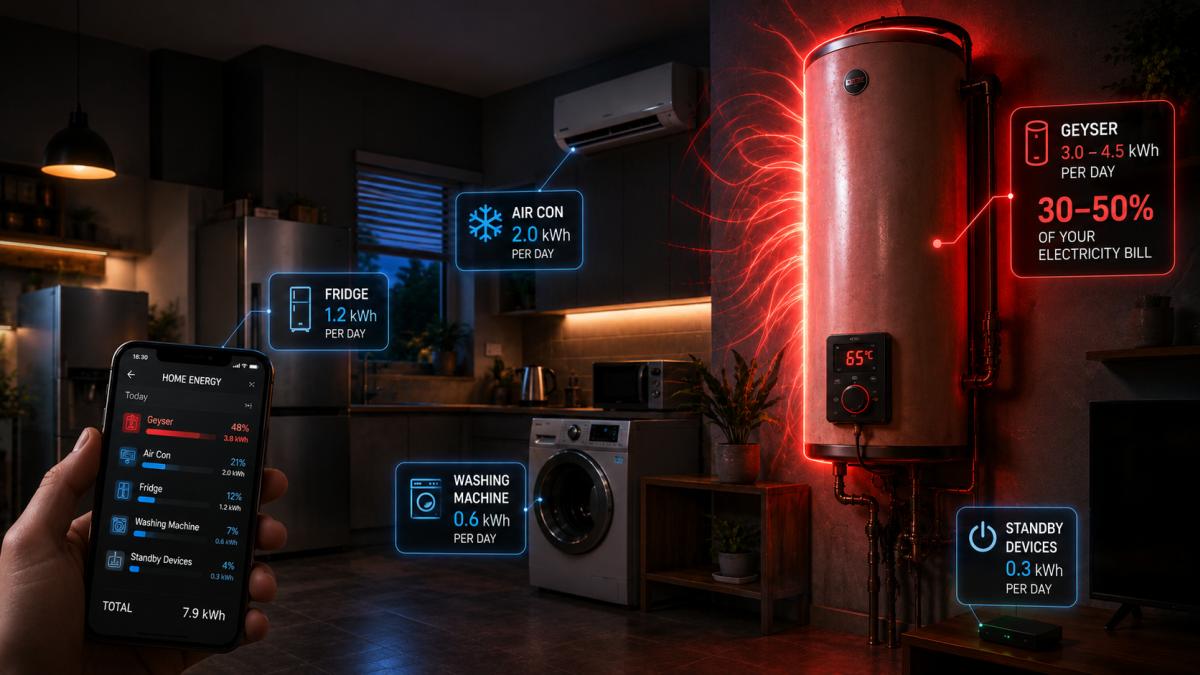
Once households start measuring, the same suspects keep appearing at the top of the list. The geyser is almost always the biggest single consumer in a South African home, often accounting for between 30 and 50 percent of the entire bill depending on family size and habits. Air conditioners and heaters come next, followed by ovens, tumble dryers, and pool pumps.
Refrigerators, despite running constantly, usually consume less than people expect. A modern fridge typically pulls between 1 and 2 kWh per day, which works out to roughly R100 to R250 per month at current Eskom tariffs. That is not nothing, but it is rarely the place where real savings are hiding.
The genuinely surprising findings tend to involve standby power. Older televisions, set-top boxes, gaming consoles, microwaves with digital displays, and Wi-Fi routers all draw small amounts of power around the clock. Individually they look harmless, but a household with a dozen of these can lose 100 to 150 kWh per month to standby loads alone. The United States Department of Energy has published practical guidance on reducing these loads that translates well to local conditions.
Measurement is only valuable if it leads to action. Once you have identified your top three or four power-hungry appliances, the response is usually some combination of the following.
Replace inefficient elements with better ones. Swapping a worn-out geyser element for a more efficient model can shave a meaningful chunk off your monthly bill. We covered this in detail in How a Simple Geyser Element Swap Can Cut Your Electricity Bill by Up to 25%, and it remains one of the highest-return upgrades available to South African homeowners.
Add a geyser timer or smart geyser controller so the cylinder is not heating water at three in the morning when nobody needs it. Wrap the geyser and the first metre of pipe in proper insulation to slow heat loss. Run the dishwasher and washing machine on cold or warm settings rather than hot, and only when full.
For air conditioners, set the thermostat one or two degrees higher in summer and lower in winter. Install thermal curtains or external shading on west-facing windows. Reduce tumble dryer use by hanging laundry outside, which the South African climate actively rewards for most of the year.
For pool owners, fitting a variable speed pump and running it during off-peak hours can cut pool-related electricity by half or more. The European Commission energy efficiency guidance covers the underlying principles in depth.
There comes a point where every reasonable efficiency tweak has been made and the bill is still uncomfortable. At that stage, the conversation shifts from cutting consumption to generating your own electricity. A small solar setup, even just a few panels feeding a single circuit such as the geyser or a handful of essential plug points, can knock a noticeable amount off the monthly purchase from Eskom.
Battery storage adds another layer of independence, useful both for load shedding resilience and for storing daytime solar production for evening use. The economics shift constantly, but the trend over the last few years has been clear. Panels keep getting cheaper, batteries keep getting better, and grid electricity keeps getting more expensive.
For households serious about long-term energy autonomy, the data from a whole-home energy monitor becomes extremely useful when sizing a system. You stop guessing how big a battery you need and start sizing it against actual measured consumption.
A plug-in meter at under R400 is enough to satisfy curiosity about a few key appliances. A smart plug at under R500 adds remote control and scheduling. A whole-home energy monitor at several thousand rand answers questions the smaller tools cannot, although it is arguably overkill for many households unless solar generation is on the cards.
Whatever route you choose, the principle is the same. You cannot manage what you do not measure. A few weeks of decent data is usually enough to expose the worst offenders, and from there the savings compound month after month.